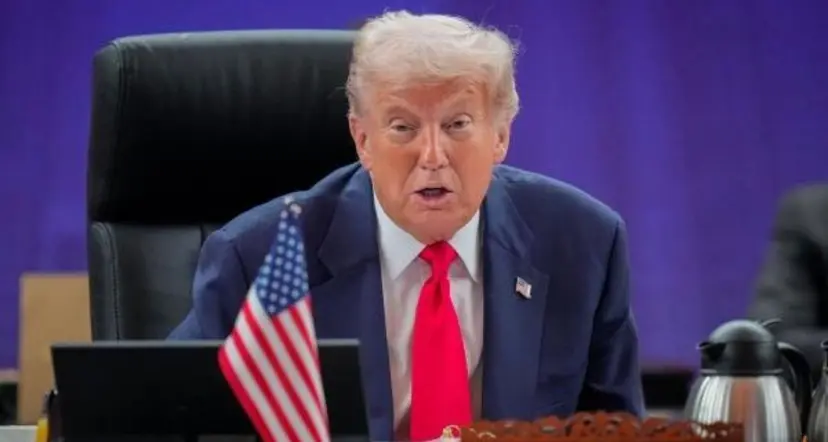
U.S. President Donald Trump has declared that the Monroe Doctrine has “returned,” signaling American determination to limit the influence of rival powers in the Western Hemisphere.
The Monroe Doctrine was first articulated on December 2, 1823, by U.S. President James Monroe during his annual message to Congress.
At the time, the doctrine warned European powers against further colonization or political interference in the Americas, asserting that the Western Hemisphere was no longer open to external domination.
In exchange, the United States pledged non-interference in European internal affairs.
The doctrine, originally framed as a defensive policy to protect newly independent Latin American states, gradually evolved into a cornerstone of U.S. foreign policy.
By the late 19th and early 20th centuries, it was expanded through interpretations such as the Roosevelt Corollary (1904), which asserted the U.S. right to intervene in Latin American countries to maintain order and protect American interests.
This era saw repeated U.S. interventions across Central America and the Caribbean.
President Trump’s remarks in early January 2026 suggest a modern revival of the doctrine, adapted to contemporary geopolitical rivalries rather than European colonial ambitions.
Unlike the 19th-century focus on Europe, today’s application centers on countering the growing presence of China, Russia, and Iran in Latin America and the wider Western Hemisphere.
In recent decades, China has expanded its economic footprint in the region through infrastructure investments and trade agreements, while Russia and Iran have deepened military, energy, and diplomatic ties with select Latin American governments.
U.S. officials increasingly view these developments as strategic challenges close to America’s borders.
The renewed attention to this doctrine follows developments earlier this month, when U.S. forces launched a large-scale military operation in Venezuela on January 3, 2026.
The mission, dubbed Operation Absolute Resolve, culminated in the capture of Venezuelan President Nicolás Maduro and his wife in Caracas, and their subsequent transfer to the United States to face longstanding criminal charges.
According to Trump, the move was part of a broader effort to protect U.S. interests in the hemisphere and counter destabilizing influences.
He indicated that United States would temporarily administer Venezuela during a transition period
Although President Trump has not issued a formal diplomatic ultimatum demanding the immediate withdrawal of these countries from the region, his declaration shows a broader U.S. policy posture aimed at reasserting American dominance in the hemisphere and limiting external influence.
After more than two centuries since its introduction, the Monroe Doctrine—once thought to be a relic of 19th-century diplomacy has once again emerged as a central reference point in U.S. foreign policy debates.