By Obinna Ejianya (9News Nigeria – Melbourne, Australia)
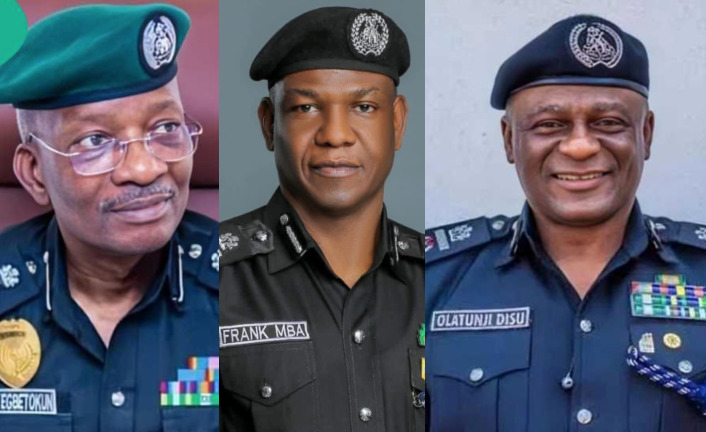
President Tinubu’s appointment of Tunji Disu as Acting Inspector-General of Police, following the resignation of Kayode Egbetokun, is being presented as routine executive succession. Yet, to many observers, it reflects something far more troubling: a recurring trajectory in which institutional processes are adjusted to produce predetermined outcomes, and where those most fitted by seniority, record, and progression are once again edged aside. What has unfolded is not merely administrative transition; it bears the imprint of deliberate design. An apparent pattern of elevation and exclusion that raises uncomfortable questions about equity, federal balance and meritocracy – “who the cap fits and who gets to wear it.”
This is not merely about an appointment. It is about a pattern.
When Mr Egbetokun was appointed in June 2023 as the 22nd Inspector-General of Police, officers senior to him were retired to legitimise his elevation. Public backlash followed. The National Assembly amended the Police Act to allow an appointed IGP to complete a four-year tenure irrespective of age or years in service. The presidency defended the move as legal. Legality, however, does not neutralise perception. The perception was clear: institutional mechanisms were adjusted to secure a preferred outcome.
Now, the sequence repeats itself. Mr Disu, born April 13, 1966, was less than two months from statutory retirement under existing police regulations when he was elevated. By virtue of becoming IGP, he is now positioned to serve a four-year tenure, unless removed or resigned. Once again, officers senior to him must exit the Force to accommodate the hierarchy required by his appointment.
Among those compelled into retirement is Frank Mba.
Frank Mba’s career trajectory is not one shaped by sudden accelerations or political patronage. He entered the Nigeria Police Force as an Inspector and climbed every rung of the institutional ladder through structured promotion: Assistant Superintendent of Police in 1999; Deputy Superintendent in 2003; Superintendent in 2008; Chief Superintendent in 2012; Assistant Commissioner in 2014; Deputy Commissioner in 2018; Commissioner of Police in 2020; Assistant Inspector-General in 2023; and subsequently Deputy Inspector-General. His rise reflects procedural continuity, not executive indulgence.
He is a three-time National Police Spokesman — an unusual distinction that speaks to institutional trust in his competence, articulation, and strategic communication capacity. He served in the United Nations Mission in Liberia between 2006 and 2007 and earned the UN Medal for service. In a Force that has wrestled with public perception crises, his ability to represent the institution domestically and internationally was not incidental; it was strategic capital.
Yet when the apex position opened, seniority, institutional experience, reform exposure, and global policing perspective did not converge into opportunity.
It would be intellectually dishonest to argue that Mr Disu lacks credentials. His record is substantial. He has commanded critical units, including the Lagos Rapid Response Squad. He led operational deployments in Rivers and the Federal Capital Territory. He has served in tactical and intelligence capacities. His experience spans three decades.
The issue is not competence comparison in isolation. The issue is recurrence.
Two consecutive Inspectors-General emerging from the same regional bloc. Two successive moments in which senior officers were retired to accommodate chosen successors. Two instances where statutory constraints that ordinarily would have ended careers were functionally neutralised by elevation. And once again, an Igbo senior officer — widely regarded as capable — exits at the threshold.
Nigeria is not a unitary state. It is a federation built on delicate equilibrium. The office of Inspector-General of Police is not merely administrative; it is symbolically and operationally central to national power architecture. Representation in such offices carries psychological, political, and integrative weight.
For decades, voices from the South-East have articulated concerns about structural marginalisation within federal power distribution. Those concerns are often dismissed as rhetorical grievance. But governance is not measured solely by constitutional text; it is measured by patterns of access to consequential authority.
When senior Igbo officers repeatedly approach the summit of national security leadership only to be bypassed at the decisive moment, perception hardens into belief. When elevation mechanisms are flexible enough to extend tenure or override retirement thresholds, yet never align to produce inclusivity at the apex, the optics become difficult to ignore.
The retirement of Frank Mba following the appointment of his junior is not a bureaucratic footnote; it is an event laden with symbolic consequence. In institutional ecosystems, symbols shape morale. In federations, symbols shape belonging. The message such outcomes transmit — intentionally or otherwise — is that ceilings remain intact even when qualifications are not in dispute.
This is not a plea for ethnic entitlement. It is an argument for structural fairness within a federal construct that promises equity. If seniority and demonstrable merit can be subordinated to executive preference, then the federal character principle risks becoming ornamental rather than operational.
The Nigeria Police Force stands at a moment requiring credibility, reform-minded leadership, and national trust-building. An officer whose career blended operational command, institutional communication, international peacekeeping exposure, and steady progression represented more than personal ambition; he represented a bridge between reform narrative and command authority. His exclusion therefore carries weight beyond personnel reshuffling.
The presidency may invoke discretion. The law may validate procedure. But in plural societies, legitimacy rests not only on legality but on perceived fairness and inclusive symbolism.
Frank Mba did not depart under scandal. He did not fall under indictment. He did not exit because of professional failure. He retired because the structural arithmetic of succession required space for another.
That is the discomforting truth.
Nigeria must now confront a defining question: can national cohesion endure when patterns of exclusion — real or perceived — persist at the commanding heights of security governance?
The Inspector-General of Police is more than a rank; it is a national signal. It signals whose leadership is trusted with the coercive power of the state. It signals whose progression is allowed to culminate at the summit. It signals whether federal balance is a living principle or a rhetorical ornament.
Frank Mba leaves the Force with honour. His record stands. But the broader narrative does not dissolve with his retirement.
After Egbetokun, now Disu, but not Mba.
For many Nigerians, especially from the South East, that no longer feels like fate.
It feels like design.