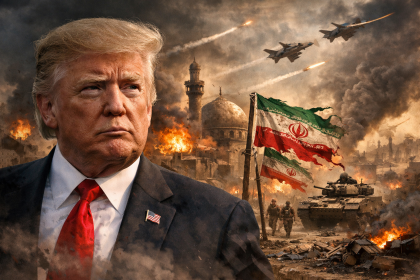
Global oil supply and trade face unprecedented risks as Iran’s threats in the Strait of Hormuz disrupt shipping, spike fuel prices, and deepen geopolitical tensions across the Middle East and beyond.
By Obinna Ejianya (9News Nigeria)
The global economy faces growing uncertainty after Iran’s new Supreme Leader, Mojtaba Khamenei, vowed to keep the strategic Strait of Hormuz closed, while military activity in the narrow shipping corridor raises fears of a prolonged disruption to global energy supply.
Khamenei assumed leadership following the death of his father, Ali Khamenei, and in his first major declaration signaled that the waterway could remain shut as part of Iran’s strategic confrontation with the United States and Israel.
The Strait of Hormuz is widely considered the world’s most critical oil transit chokepoint. Nearly one-fifth of the world’s daily oil consumption passes through the narrow channel connecting the Persian Gulf to global markets. Any disruption to this route immediately reverberates through energy prices, shipping costs, and global trade flows.
But beyond the closure threat itself, defense analysts warn that Iran has reportedly begun deploying naval mines in the strait, a move that significantly escalates the risks to international shipping.
Naval mines pose one of the most serious threats to maritime navigation because they are difficult to detect and even harder to remove. Military experts say the number of mines already deployed in the Strait of Hormuz remains unknown, creating a dangerous situation for oil tankers and commercial cargo vessels attempting to transit the area.
Unlike the relatively crude mines used during conflicts such as World War II, modern naval mines are highly sophisticated weapons. Experts say many of the systems believed to be in Iran’s arsenal are capable of sensor-based activation, meaning they can detect and target specific vessels using acoustic, magnetic, or pressure signatures.
This allows certain mines to be programmed to trigger only when large oil tankers or military vessels pass overhead, while ignoring smaller ships. Such capabilities make them significantly more difficult to neutralize and increase the risk for shipping companies attempting to navigate the waterway.
Security analysts warn that even if hostilities end soon, mine-clearing operations could take months, possibly longer, before the strait can be declared safe for normal maritime traffic again. Minesweeping in narrow and heavily trafficked waterways requires painstaking detection, controlled detonations, and extensive naval coordination.
For the global economy, the consequences are already unfolding.
Oil supply disruptions linked to the crisis have sent crude prices surging while creating widespread concern about energy shortages. The Strait of Hormuz handles approximately 20 percent of global oil shipments and a significant portion of liquefied natural gas exports, making it indispensable to both Western and Asian economies.
Economists warn that a prolonged disruption could trigger a major global economic shock, as rising energy prices increase transportation costs, manufacturing expenses, and inflation worldwide.
The aviation industry is already feeling the pressure. Jet fuel prices have climbed sharply, forcing airlines to review routes and operations across the Gulf region. Major Middle Eastern carriers including Emirates, Etihad Airways and Qatar Airways have reportedly scaled back operations and rerouted flights due to security threats and regional airspace tensions.
These airlines together form one of the most important aviation hubs in the world, connecting Europe, Asia, Africa and the Americas. Any prolonged disruption in Gulf airspace could affect millions of passengers and thousands of international routes.
The geopolitical fallout is also spreading beyond the Persian Gulf.
Regional tensions have intensified as Iran has warned neighboring countries hosting American military bases that they could face retaliatory strikes. Meanwhile, Recep Tayyip Erdoğan has reportedly issued warnings after Iranian missile activity near regional territories heightened security concerns.
Markets across the world have reacted sharply to the unfolding crisis. Stock markets have experienced volatility while investors shift toward commodities and defense sectors amid fears that the conflict could expand.
Economic analysts estimate that the broader conflict—driven by energy shocks, military spending, and disruptions to trade routes—could cost the global economy trillions of dollars if the situation continues to escalate.
For global policymakers, the central challenge now lies in securing the Strait of Hormuz and ensuring freedom of navigation. However, the potential presence of sophisticated Iranian naval mines has created a new layer of complexity that could keep the world’s most important energy corridor under threat long after the current conflict ends.