By Obinna Ejianya (9News Nigeria)
The Nigerian government and the Presidency have remained conspicuously silent following the dramatic capture of Venezuelan President Nicolás Maduro and his wife, Cilia Flores, by United States forces—a development that has drawn sharp and divergent reactions from major global powers.
The operation, carried out under the administration of U.S. President Donald Trump, has triggered a wave of condemnation, praise, and diplomatic caution across Europe, Asia, the Middle East, and Latin America. Nigeria, however, has yet to issue any official statement—neither condemning nor endorsing the unprecedented military action.
Growing Questions Over Nigeria’s Silence
The absence of a Nigerian response has raised questions among analysts and the public, particularly given Nigeria’s increasing entanglement in U.S. security and counterterrorism operations.
Observers are asking why Abuja has not articulated a position on a matter that touches directly on international law, sovereignty, and foreign military intervention—especially as Nigeria itself remains designated by Washington as a “country of concern” and was the site of a recent U.S. military strike against Islamic State-linked militants in Sokoto State.
Some commentators suggest the federal government may be exercising strategic caution, wary of antagonizing either Washington or non-Western power blocs at a time of heightened global polarization. Others argue that Nigeria’s silence reflects diplomatic unease following its own cooperation with U.S. forces in recent counterterrorism operations.
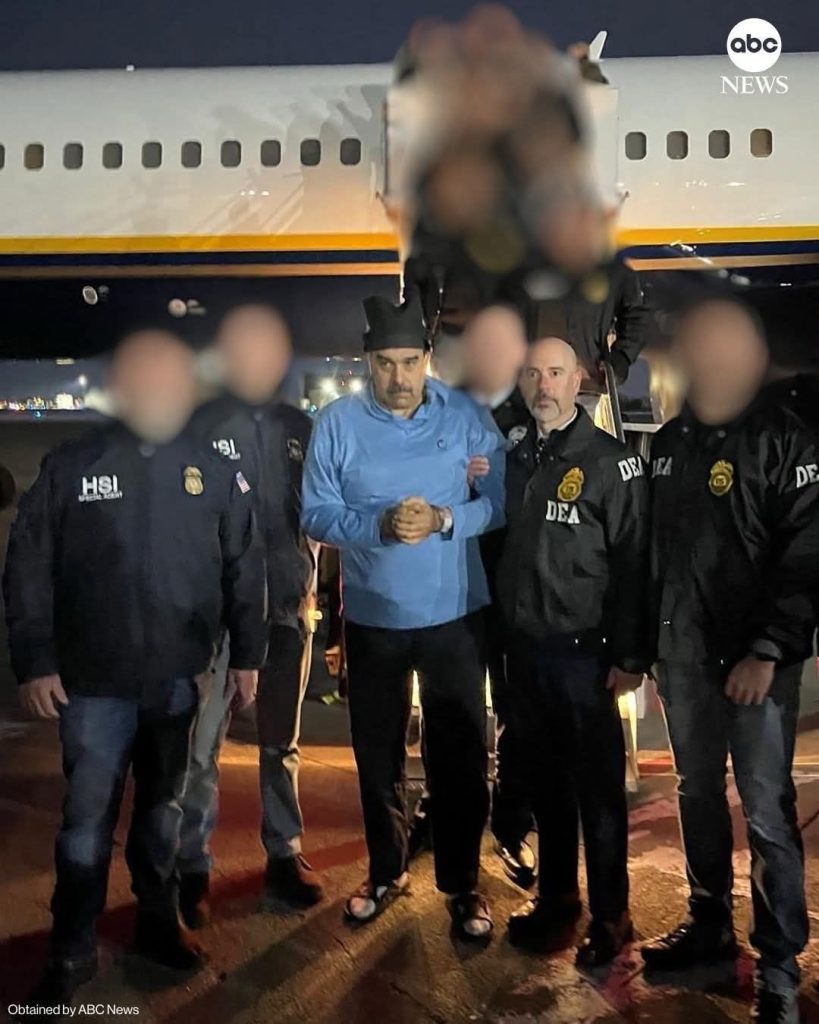
While Venezuelan citizens in diaspora and at home celebrate the US capture of Nicolas Maduro, world leaders react with condemnation and cautions.
United Kingdom: “No Tears” for Maduro
Reacting swiftly to the events in Caracas, British Prime Minister Sir Keir Starmer stated that the United Kingdom “shed no tears” over the end of Nicolás Maduro’s rule, describing him as an “illegitimate president.”
In an official statement issued on Saturday, January 3, 2026, Starmer reiterated Britain’s long-standing support for a political transition in Venezuela, while stressing that the UK played no role in the U.S. military operation. He also indicated plans to engage directly with President Trump and allied leaders to assess the evolving situation.
China: Strong Condemnation, Sovereignty Emphasised
China issued one of the strongest rebukes of Washington, condemning the operation as a “blatant use of force against a sovereign state” and a “naked hegemonic act.”
Beijing stated it was “deeply shocked” by the seizure of Venezuela’s president, arguing that the action constituted a clear violation of international law, the United Nations Charter, and Venezuela’s national sovereignty.
Russia: ‘Armed Aggression’
The Kremlin also condemned the U.S. action, with President Vladimir Putin warning that the situation must be resolved through dialogue to avoid further escalation in the Western Hemisphere.
Russian officials described the operation as an “act of armed aggression,” dismissing Washington’s justification as “untenable,” and demanded immediate clarification on the whereabouts and legal status of Maduro and his wife.
Israel: Open Praise for Trump
In contrast, Israeli Prime Minister Benjamin Netanyahu publicly praised President Trump for what he called “bold and historic leadership.”
Netanyahu hailed the operation as a victory for “freedom and justice,” characterising Maduro’s rule as an “illegal tyranny,” and commended the U.S. military for its execution of the mission.
Saudi Arabia, UAE, and OPEC+ Watch Closely
Saudi Arabia and the United Arab Emirates have not yet issued formal statements, though both countries are expected to discuss the situation during an OPEC+ meeting scheduled for Sunday, January 4, 2026.
Despite political turbulence among member states—including the U.S. capture of Venezuela’s president—OPEC+ sources indicate the group has agreed in principle to maintain steady oil output. The meeting involves eight key producers responsible for roughly half of global oil supply, coming amid concerns over oversupply after oil prices fell more than 18 percent in 2025.
Analysts remain sceptical that political change in Venezuela will result in a rapid increase in oil production.
Nigeria’s Recent U.S. Security Cooperation
Nigeria’s silence is particularly notable in light of recent U.S. military activity on Nigerian soil.
On December 25, 2025, U.S. forces launched precision Tomahawk missile strikes against two Islamic State camps in Sokoto State, northwest Nigeria. U.S. Africa Command (AFRICOM) confirmed the operation targeted ISIS-linked militants and was conducted in coordination with the Nigerian government.
President Trump stated the strikes were aimed at Islamic State elements he accused of targeting Christian communities in the region. Nigerian authorities later confirmed the operation was a joint effort involving intelligence sharing and strategic coordination. No civilian casualties were initially reported.
Operation Absolute Resolve: What Happened in Venezuela
On January 3, 2026, the Trump administration executed Operation Absolute Resolve, a large-scale military operation to capture President Nicolás Maduro.
According to U.S. officials:
- Over 150 aircraft and drones were deployed to disable Venezuelan air defences and provide surveillance.
- A cyberattack cut power to large parts of Caracas to facilitate the raid.
- U.S. Army Delta Force personnel physically apprehended Maduro and his wife at his residence around 2:00 a.m., preventing him from reaching a fortified safe room.
- The pair were flown to the USS Iwo Jima, then to Guantánamo Bay, before being transferred to New York.
- Maduro is currently being held at the Metropolitan Detention Center in Brooklyn.