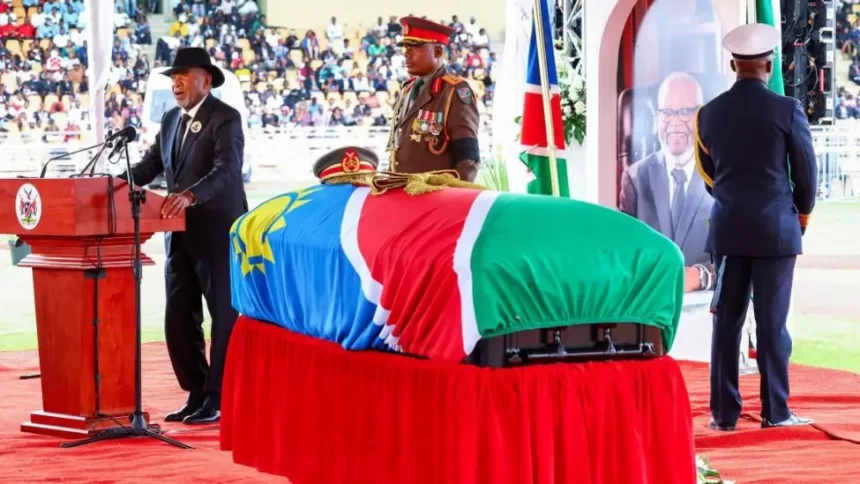
Namibia government has placed a temporary moratorium on state funerals, citing the need to reassess the cost and criteria surrounding official burials following growing public scrutiny over escalating expenses.
9news Nigeria gathered that the decision was announced by Information and Communication Technology Minister Emma Theofelus following a Cabinet meeting earlier this week. The moratorium, which takes immediate effect, is expected to remain in place until April 2026.
Only President Netumbo Nandi-Ndaitwah retains the authority to grant exemptions to the suspension, the government clarified.
Costs spark national debate
Although the government did not directly attribute the decision to cost concerns, the timing follows a wave of criticism in local media over the mounting expenditure on state burials.
In an interview with the BBC, Theofelus confirmed that a dedicated committee, limited to seven members, will be tasked with reviewing the ‘criteria and processes associated with bestowing official funerals’.
The review panel is expected to present its recommendations before the end of the moratorium in 2026.
Funeral spending soars
According to a report by the Windhoek Observer, official funerals cost the government a staggering N$38.4 million (about $2.2 million) during the 2024/2025 financial year alone.
This marked a dramatic rise compared to the N$2.1 million spent on 23 funerals in the 2022/2023 financial year.
The Observer also revealed that around N$30 million was spent solely on transporting the remains of Namibia’s founding president, Sam Nujoma, across the country prior to his state funeral in February 2025.
Nujoma, who passed away at the age of 95, remains a revered figure in Namibian history. He was instrumental in leading the country’s struggle for independence from South African rule and co-founded the South West Africa People’s Organisation (Swapo) in the 1960s.
Following independence in 1990, Nujoma became Namibia’s first president and held office until 2005. His funeral was widely viewed as a unifying national moment, drawing large crowds and extensive ceremonial tributes.
Discussions about curbing the financial burden of official funerals are not new. Calls for a review date back to 2021, especially during the height of the Covid-19 pandemic when national resources were strained and questions were raised over state spending.
While the presidency has yet to comment on the Cabinet’s latest decision, the suspension marks a significant shift in how Namibia may honour public figures in future. (Much credit to Africabriefing and BBC)