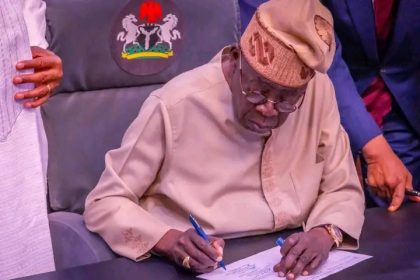
Fresh controversy has erupted in Edo State following claims that the number of registered voters at the polling unit reportedly associated with Governor Monday Okpebholo has risen dramatically from 397 in 2024 to 4,783 in 2026
The alleged increase, representing a rise of more than 1,000 per cent, has triggered questions among political observers and members of the public who are demanding clarification on how such a significant change could occur within a relatively short period.
The development comes at a time when the credibility, transparency and integrity of Nigeria’s voter registration process are again attracting intense public attention ahead of the 2027 general elections.
According to the figures circulating in political and social media circles, the polling unit reportedly had approximately 397 registered voters in 2024, but the number is now being presented as 4,783 registered voters in 2026.
If the figures are confirmed by the Independent National Electoral Commission (INEC), the difference would amount to an increase of 4,386 registered voters*, raising legitimate questions about the circumstances surrounding the dramatic growth.
However, it is important to establish whether the figures being compared relate to exactly the same polling unit, ward and registration area, and whether the 2026 figure represents the final voter register or a preliminary/current registration figure.
INEC has continued voter registration and related processes in Edo State. Reports in 2026 indicated that 131,165 new voters were registered in Edo, demonstrating that the state’s voter population has been expanding.
But the central question being raised by critics is whether the reported increase at the governor’s particular polling location can be explained by legitimate voter transfers, newly registered voters, polling-unit adjustments, or other administrative changes.
The development has inevitably taken on political significance because Governor Okpebholo is one of the state’s most prominent political figures and is expected to remain a major player in Edo politics ahead of 2027.
Political opponents and concerned citizens are therefore asking for greater transparency.
Some are asking:
How did the number move from 397 to 4,783?
Were thousands of voters transferred into the polling unit?
Was the polling unit merged with another unit, or were polling boundaries altered?
Does the 4,783 figure represent registered voters, eligible voters, or another category in INEC’s database?
These questions do not, by themselves, establish wrongdoing. Rather, they underscore the need for the electoral authorities to provide clear information capable of dispelling speculation.
The Independent National Electoral Commission remains the appropriate institution to clarify the matter.
INEC’s records should be able to establish the historical and current number of registered voters attached to the polling unit, the number of transfers into and out of the unit, new registrations, deletions, corrections, and any changes resulting from polling-unit reorganisation.
The commission has previously warned Nigerians against multiple registration, while allowing eligible voters to register and transfer their registration in accordance with electoral regulations.
Consequently, any dramatic increase in a particular polling unit should be capable of being explained through the commission’s voter-registration records.
No Evidence Yet Linking Governor to Any Irregularity
It is also important to stress that the reported figures do not constitute evidence that Governor Monday Okpebholo personally manipulated the voter register or committed any electoral offence.
There is currently no verified evidence establishing that the governor caused or authorised any irregularity in the alleged increase.
The controversy is primarily about the figures themselves and whether they are accurate, properly contextualised and genuinely refer to the same polling unit.
That distinction is crucial in responsible journalism.
Transparency Needed Ahead of 2027
With Nigeria already entering a politically sensitive period ahead of the 2027 elections, unexplained discrepancies in voter-registration figures can easily fuel suspicion and political tension.
The best way to address the controversy is therefore not through political accusations but through verifiable electoral data.
INEC could settle the matter by publishing or confirming the relevant polling-unit details, including the previous voter population, new registrations, transfers, deletions, and the current number of registered voters.
Until such clarification is obtained, the reported jump from 397 to 4,783 should be treated as a claim requiring verification rather than a proven case of electoral manipulation.
Beyond Governor Okpebholo’s polling unit, the controversy raises a broader question about Nigeria’s voter-registration system:
Can Nigerians trust the accuracy and transparency of the voter register ahead of the 2027 elections?
As political parties intensify preparations for the next general election, every unexplained figure has the potential to become a political flashpoint.
For now, all eyes are on INEC to explain whether the astonishing figure of 4,783 registered voters is genuine, how it was arrived at, and what administrative changes, if any, account for the reported increase from 397 voters in 2024.