A senior official of the German Football Association has urged European football to seriously consider boycotting the 2026 World Cup following recent actions and statements by United States President Donald Trump.
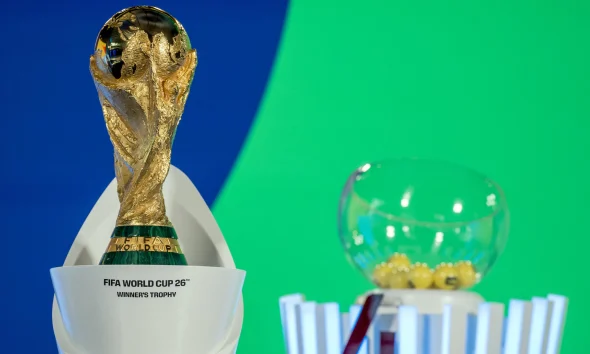
The tournament is due to be staged this summer across the United States, Canada and Mexico, with the US hosting the bulk of the matches. Of the 104 games scheduled, 78 will take place on American soil.
Tensions have risen sharply between Washington and several European capitals after President Trump threatened to acquire Greenland, an autonomous territory governed by Denmark. The remarks sparked anger across Europe, particularly in Copenhagen.
The situation worsened when the 79-year-old president also warned that he would impose tariffs on eight European countries, including Germany, after they opposed his stance.
Although Trump later softened his position on the proposed tariffs, diplomatic relations remain strained.
A vice-president of the German FA and president of Bundesliga club St Pauli, Oke Gottlich, believes the moment has arrived for football authorities to confront the issue head-on.
“I really wonder when the time will be to think and talk about this [a boycott] concretely,” Gottlich told Hamburger Morgenpost.
“For me, that time has definitely come.”
The comments have drawn mixed reactions across Europe. The French government said it is not currently in favour of a boycott, while the Danish Football Association said it is “aware of the current sensitive situation”. Denmark are expected to attempt qualification for the finals through the play-offs.
Gottlich pointed to historical precedent, recalling the US-led boycott of the 1980 Olympic Games after the Soviet Union invaded Afghanistan.
“What were the justifications for the boycotts of the Olympic Games in the 1980s?” he said.
“By my reckoning, the potential threat is greater now than it was then. We need to have this discussion.”
The German FA has previously clashed with FIFA over political expression on the global stage. At the 2022 World Cup in Qatar, Germany and six other European nations planned to have their captains wear the OneLove armband in support of diversity and inclusion.
FIFA intervened shortly before the tournament, warning players they would be booked if they wore the armband. Instead, the governing body fast-tracked its own No Discrimination campaign, allowing captains to wear a Fifa-approved armband throughout the competition.
German players responded by covering their mouths during the team photograph before their opening match against Japan. Then, head coach Hansi Flick said the gesture was “to convey the message that FIFA is silencing” teams.
“Denying us the armband is the same as denying us a voice. We stand by our position,” the DFB said at the time.
Gottlich argued that football cannot pick and choose when to take a moral stance.
“Qatar was too political for everyone and now we’re completely apolitical? That’s something that really, really, really bothers me,” he said.
“As organisations and society, we’re forgetting how to set taboos and boundaries, and how to defend values.
“Taboos are an essential part of our stance. Is a taboo crossed when someone threatens? Is a taboo crossed when someone attacks? When do people die?
“I would like to know from Donald Trump when he has reached his taboo, and I would like to know from [DFB president] Bernd Neuendorf and [Fifa president] Gianni Infantino.”