As the country grapples with another economic crisis, some wonder what has changed since Mugabe was ousted from power.
Harare, Zimbabwe – Two years ago Thursday, under cover of darkness, members of Zimbabwe’s military rolled their tanks into the capital Harare intent on ousting then-President Robert Mugabe from power.
The late leader, who had ruled the troubled Southern African country since its liberation from Britain in 1980, was largely seen as the author of economic policies that had decimated the livelihoods of ordinary Zimbabweans – a legacy that included hyperinflation that led the country to ditch its worthless sovereign currency in favour of the United States dollar.
In the euphoria that greeted Mugabe’s house arrest during what some call a “coup” and others call a “military intervention”, hundreds of thousands gathered in the capital. The jubilant masses embraced and took selfies with soldiers who were lauded as heroes for liberating the country from an infamous regime that would harass, threaten and arbitrarily arrest critics and activists.
Today, those celebrations are a distant memory as Zimbabwe grapples with yet another economic crisis. And while many question whether Mugabe’s ouster two years ago really changed anything, others beg for patience for reforms to take root.
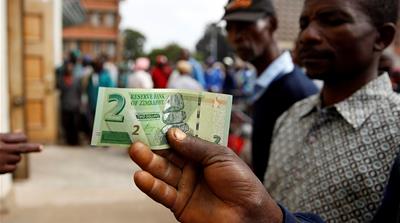
Various monetary reforms this year have been geared toward shoring up a new Zimbabwean dollar that entered circulation this week [File: Philimon Bulawayo/Reuters]
Open for business
Mugabe was succeeded by Emmerson Mnangagwa as leader of the ruling Zimbabwe African National Union-Patriotic Front (ZANU-PF) party, and as president of Zimbabwe.
A Mugabe loyalist, Mnangagwa entered office on the promise that he would undo Mugabe’s ruinous economic legacy.
One of his first acts as president was to launch an “open for business” initiative designed to entice foreigners to invest in the country. The move marked a reversal from Mugabe, who had shown a general disregard for property rights and compelled foreign investors to cede controlling equity stakes in businesses with a net asset value of $1 or more.
Tackling fiscal deficits was another item on the agenda. Finance Minister Mthuli Ncube cut spending and introduced policies designed to wean Zimbabwe off the US dollar and restore monetary sovereignty.
One of the most dramatic reforms occurred in June, when the government outlawed the use of US dollars in local transactions. The move was designed to prepare the ground for a next-generation Zimbabwean dollar that started circulating this week.
The new currency is landing in an economic maelstrom.
In August, according to the International Monetary Fund, Zimbabwe’s inflation rate hit 300 percent – the highest in the world.
Wages have remained stagnant while food and fuel prices have soared. Cash shortages – a problem for years – have worsened and foreign currency is hard to come by.
Meanwhile, foreign direct investment in Zimbabwe is negligible at a mere $745m last year, according to the United Nations Conference on Trade and Development. And a severe drought has exacerbated an already dire situation, decimating the country’s maize yields and leaving many households in need of aid.
In his October pre-budget paper, Ncube said the country’s economy is set to contract by 6.5 percent this year, thanks to power outages largely stemming from the drought.
Kipson Gundani, an economist and founder of the CEO Africa Roundtable, says that while Mnangagwa inherited some of the current economic problems, decisions made on his watch have also contributed to the downturn.
“If you look at the level of money creation since the guy took over, you will realise that this is a function of the Mnangagwa regime alone on inflation,” Gundani told Al Jazeera.
Gift Mugano, an economics professor at Zimbabwe Ezekiel Guti University, said the government’s economic reforms were doomed to fail because they were implemented without a supporting institutional framework.
“What has to be appreciated is that Zimbabwe was trying to model its reforms around Rwanda,” Mugano told Al Jazeera. “Rwanda has the Rwanda Development Board, and here they were trying to have the Zimbabwe Investment and Development Agency and that has not taken off two years later.”
But Simon Khaya Moyo, spokesperson for ZANU-PF, says that the government’s reform efforts have been hobbled by problems beyond its control, such as drought and sanctions that predate Mnangagwa’s administration.
In the early 2000s, the US and the European Union imposed sanctions on dozens of ZANU-PF members and entities for alleged human rights abuses and electoral fraud.
“There are problems that we don’t have control over, such as low electricity generation and the drought,” Moyo told Al Jazeera. “[The] government is doing a lot of things and some of these could be done faster, but there are other things standing in the way such as sanctions.”
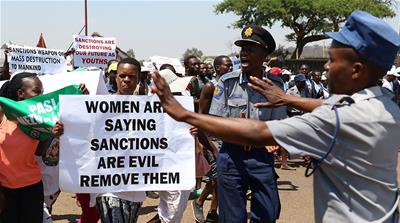
In October, thousands of government supporters turned out to march in protest against US and EU sanctions [File: Philimon Bulawayo/Reuters]
Dashed hopes
Caught in the crosscurrents of the country’s economic crisis are ordinary Zimbabweans, including people who endorsed the ouster that ushered Mnangagwa into power.
“We were used,” said Eric, a wholesaler who asked Al Jazeera to withhold his surname to protect his privacy. “They got what they wanted: Mugabe out of office.”
John, a book vendor in the capital who asked Al Jazeera to change his name to protect his privacy, said things are more difficult now than they were two years ago.
“People can’t afford a decent meal. People who have normal jobs don’t earn a decent living anymore,” he said. “Samp [inexpensive, crushed corn grains] is the new rice in town. I eat maputi [roasted corn] to survive most of the time because I can’t afford the food in town.”
William, an informal trader whose name has been changed to protect his privacy, also expressed frustration with the current government.
“Things have plunged to new levels,” he told Al Jazeera. “Electricity is expensive, water is not available in the city, transport is too expensive and money is just hard to come by.”
But others believe Mnangagwa’s government simply needs more time to turn the economy around.
“Our economy couldn’t ever rise without some fundamentals being addressed,” Farai Marapira, a ZANU-PF supporter, told Al Jazeera. “Chief amongst this was the perennial budget deficit. This was the main issue that caused austerity to be introduced. Now ahead of time austerity is over because we can now generate surplus.”
Marapira believes the country is now in a position to start raising salaries for state workers.
“We are able to do this now without borrowing. That’s the hidden success many refuse to see.”
Protests and PR
Mnangagwa’s government has spent millions of dollars in scarce public funds on foreign lobbyists and public relations firms to rehabilitate its image abroad and to convince the US and EU to lift sanctions, the Zimbabwe Independent reported last month.
“The sanctions are still in place and they are targeted and they block lines of credit for the country and there is the issue of our diamonds,” said ZANU-PF’s Moyo. “They claim forced labour is being used to mine the diamonds in Marange. This is not true.”
But it’s not just a faltering economy that’s battering the government’s image. The same security forces who posed for selfies with the masses two years ago have come under fire for human rights abuses.
During nationwide protests in January sparked by a dramatic fuel price hike, Zimbabwe’s security forces used “excessive lethal force” – including firing live ammunition at protesters, killing 17 people, Human Rights Watch documented.
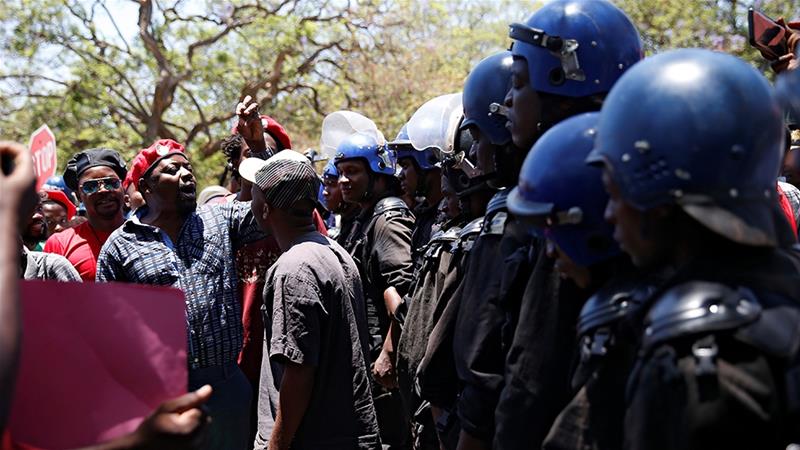
In August, anti-riot police assaulted hundreds of anti-government protesters demonstrating against economic hardships, deteriorating living standards and corruption.
This month, baton-wielding police officers blocked a handful of government workers from marching to the Ministry of Finance and Economic Development’s office to present a petition against low wages.
And the opposition Movement for Democratic Change Alliance (MDC) was recently barred by the police from protesting against what its members feel is an economic meltdown in the country.
Meanwhile, In October, a march against western sanctions organised by ZANU-PF drew thousands of Zimbabweans.
Those who protested were given fried chicken, French fries and a soft drink from a popular fast food outlet- a luxury meal in a country ravaged by hunger.
The government spent an estimated four million Zimbabwean dollars ($200,000) on October’s anti-sanctions marches, Zimbabwe’s independent newspaper NewsDay reported.
“The PR stunt is not going to help ZANU-PF at all because Emmerson Mnangagwa’s regime is unrepentant and keeps making the same mistakes, violating citizens’ rights,” Stephen Chuma, spokesperson for the MDC youth league, told Al Jazeera.
But for some observers, no amount of spin can rekindle the hopes that had sparked such joy in the hearts of millions two years ago.
“The coup was the beginning of an end, essentially,” said Ibbo Mandaza, a political scientist and the founder of a local think-tank, Sapes Trust. “There is no way these guys [Mnangagwa’s government] can turn things around now.”
SOURCE: AL JAZEERA NEWS