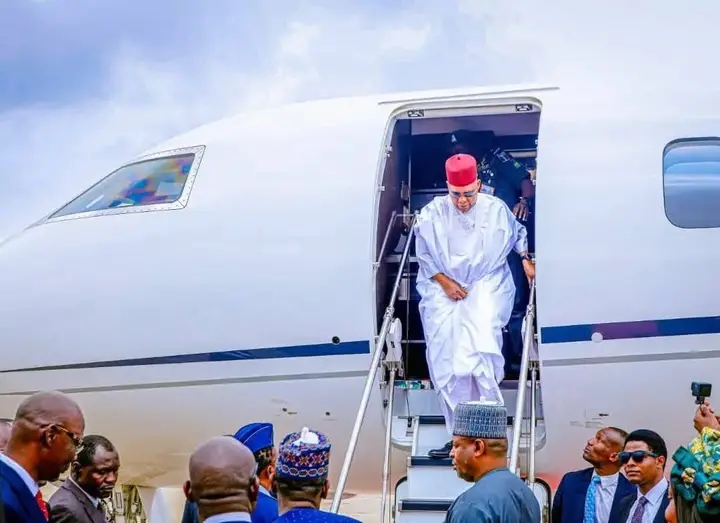
On a lighter note, Senator Kashim Shettima has “over-travelled this Nigeria.” Of course, the rate at which he criss-crosses this country and still remains healthy, strong and agile, as if each day he is only just starting, is no doubt intriguing.
He is either in Kano in the morning to receive a new defector, in Ekiti in the afternoon for a commissioning, or in Lagos at some economic forum in the evening. While this should be enough for a whole week for a man teetering towards 60, trust that you will certainly wake up to the news of Senator Shettima’s trip to Taraba or Delta, if not South Africa or Switzerland. It is never-ending.
But traveling is not a project, policy or even execution. In fact, the legendary Gani Fawehinmi, for this same reason, named Former President Obasanjo the Globetrotter-in-Chief! To this end, many would almost see no value in it. Let some of us not even hear the cost involved in these trips; they will definitely go whacko.
But in substance, in a country as diverse and complex as Nigeria, every one of these trips could be that one strong rope needed to further tie this country together.
On the surface, the trips could be for a funeral, wedding, or launching of projects. Surely, many of us will struggle to find meaning in this, but they are long-term investments in Nigeria’s unity, cohesion and integration. They distribute a widespread sense of belonging, ownership and importance across the country’s diverse quarters.
As for the foreign trips, especially as they are always primarily about trade/commerce, energy or the like, they help to bring Nigeria’s presence to the global big table. Countries can’t run in isolation. And when the country is as important as Nigeria—populous, with large diaspora communities, and up for large-scale business—this is no longer an option. But this article is not even about discussing their motives or impact. The interest is in the energy going into it.
For instance, how does he cope with things like jet lag, air suction and general stress? And you know, Shettima would not sleep on the plane, certainly. He would want to read airborne to try to grab a few quotations for a scheduled speech, or would be working with his aides to memorize the names/bios of his hosts, or even greetings in Ibibio, Tangale or Kibaku.
And the sagacity, as well as the ebullience with which he hops into the plane every morning after several long trips just the previous day, leaves you to wonder what his behind-the-scenes routine is. How does he de-stress within very short intervals and take on even more within eye blinks?
What is his diet? Who is his gym coach, if he has one, and how do they manage to keep to their daily or weekly routines? His dietician and doctor? I am asking because he is a Kanuri man. You cannot separate him from ndalai, biski and man shanu (cow ghee). In fact, his Fulani aides may have already forced fura da nono into his menu.
Certainly, stress, when accumulated over a long term, affects general cognition, memory and general wellbeing. Nobody needs any doctor to tell him or her that. But it is curious: Shettima would be hosting high-level meetings for hours, then shortly after deliver speeches, sometimes unrehearsed, in the midst of all these without any sign of stress, fatigue or malfunction.
For many, travelling is a hobby, and even if it is so for VP Shettima too, it has now become a service. There is definitely a time at which this becomes tiring, and even as a hobby, one is no longer driven to it. And so the only fuel that keeps one going in this kind of situation is a sense of service. And when service comes, there is no holding you back: you give your all with enthusiasm, vigor and consistency.
It is for this that, in the long term, a book about VP Shettima, to unmask the man behind the name, is necessary. The daily routine. The rugged behind-the-scenes and chaos that manage to come out clean for the spectator. The outrageous daily calendar. The diet. The mornings and nights. All of them!