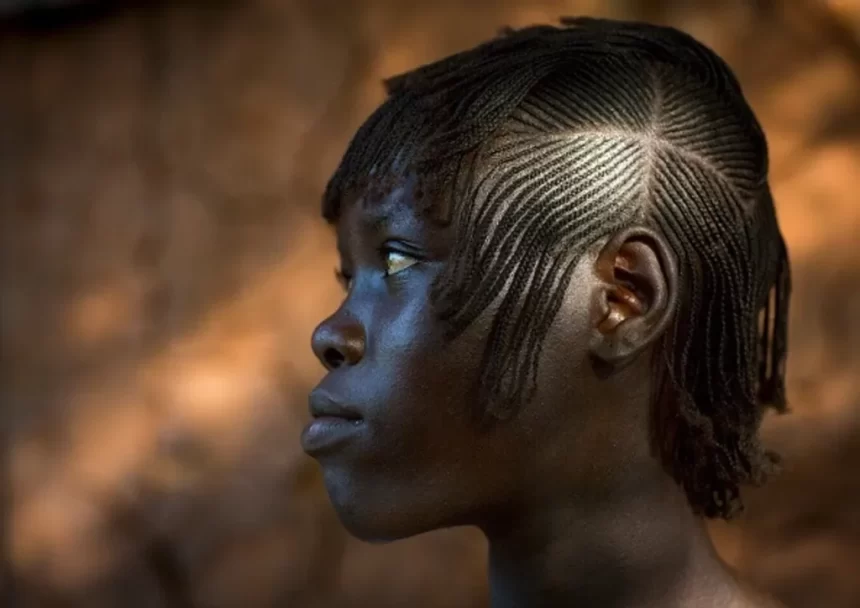
LONG before the term ‘protective style’ entered modern beauty vocabularies, African women were coding liberation into their hairstyles.
In the late 16th century, enslaved Africans are believed to have used cornrows as maps — not metaphorically, but quite literally. While their white plantation owners scoffed at the ‘primitive’ hairdos, those same braids quietly carried coded directions to freedom, locations of safe houses, and markers of resistance.
Now, centuries later, women like Khadija Musa Sele in Kenya keep that tradition alive — not to escape captivity, but to honour identity.
Sunday braids, everyday pride
Khadija takes her three daughters to Msusi Safi salon in Nairobi’s Eastleigh every Sunday. Her goal? A ‘neat look’, but one that’s deeply rooted in culture.
‘The two younger ones braid the Milazo – they’re easy to manage,’ she tells TRT Afrika. ‘My eldest prefers the Kilimanjaro style, which has a hanging tail. I like just two Milazos or one knot.’
For Khadija, braiding is more than aesthetics. It’s a statement. A continuation of an unbroken chain linking her family to generations past.
Braids that once spoke status
Long before European colonisation attempted to erase African culture, braided hairstyles played a central role in signalling social hierarchy. Across Africa, the placement, pattern, and complexity of braids indicated age, marital status, tribe, and wealth.
Between the 16th and 19th centuries, these intricate designs evolved across regions. The Swahili Milazo in East Africa finds echoes in West Africa’s Zane, while Shuku introduces stylised patterns. Kilimanjaro styles, popular in Kenya, run along the scalp and end in tails near the nape. Others, like Da Brat, twist hair into rope-like coils.
Braiding has always been both art and language.
From survival to red carpet
The braid has not just survived — it has thrived. Today, celebrities like Beyoncé, Burna Boy, and Lupita Nyong’o carry African styles into the mainstream spotlight, elevating cornrows and twists to global fashion status.
But this visibility comes with a cost. Modern beauty standards, shaped by colonial hangovers and globalised media, have pushed straight hair and synthetic wigs as aspirational norms. Many Africans now reach for hot combs and chemical relaxers — often at the expense of their hair’s health.
Khadija is clear in her refusal. ‘I won’t use chemicals on my children’s hair for anything. They’re dangerous and can make hair fall out.’
Her stance reflects a growing natural hair movement across Africa and its diaspora, reclaiming not just hair, but history.
Still woven with meaning
Despite waves of slavery, colonialism and now consumerist beauty pressures, cornrows endure. They no longer map escape routes — but they still map identity, resistance, and memory.
For Khadija, the act of braiding her daughters’ hair is a weekly ritual of care and continuity. For many around the world, it’s a political and cultural choice.
Braids are more than hair. They are history. They are heritage. And they still speak — even when no one is listening.