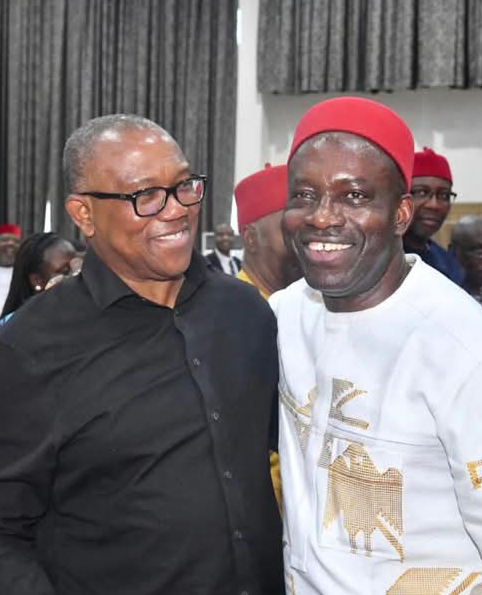
- Accountability must rest on documents, dates, figures and verifiable transactions—not insinuations repeatedly recycled into the public space.
By Mazi Etofolam Felix Osuji mni fca
The continuing attempt to make Peter Obi’s administration, which ended more than twelve years ago, a recurring subject of contemporary Anambra governance is becoming an unfortunate embarrasing distraction from the more important question before the people which is what measurable legacy is the government of today building for the Anambra of tomorrow? Every administration is entitled to examine the records it inherited, and no former governor should be insulated from legitimate scrutiny. But accountability must rest on documents, dates, figures and verifiable transactions—not insinuations repeatedly recycled into the public space. If liabilities incurred during Peter Obi’s tenure are still being serviced in 2026, the responsible course is straightforward: publish the loan agreements, the dates they were contracted, the amounts originally borrowed, the purposes for which they were obtained, the repayment schedules, subsequent restructurings, and the outstanding balances. Let the documents speak.
Peter Obi has publicly challenged the allegation, maintaining that when he left office he was not owing salaries, pensions, gratuities, processed contractor obligations or suppliers whose payments had become due. That creates a factual dispute which cannot responsibly be resolved through political rhetoric. Government possesses the records. It therefore carries the responsibility of placing the complete documentary trail before the public. Anambra people deserve evidence sufficiently detailed to distinguish obligations actually contracted by an administration from externally funded programmes, counterpart arrangements, subsequent commitments, inherited liabilities and debts that may have undergone restructuring after that administration left office.
More fundamentally, governance cannot become an endless argument with history. Professor Chukwuma Soludo has now had years in office and possesses the intellectual pedigree, executive authority and public resources to establish a legacy capable of standing independently. The enduring measure of his administration will not be how effectively it interrogated Peter Obi, Willie Obiano or any other predecessor. It will be what happened to Anambra’s schools, hospitals, roads, security, businesses, employment opportunities, public finances and institutions under his own stewardship. Where a predecessor established something worthwhile, statesmanship requires improving upon it. Where something failed, leadership requires correcting it. Neither task demands diminishing the individual who previously occupied the office.
Indeed, Peter Obi himself responded to earlier criticism from Soludo with a remarkably useful philosophy of governmental continuity: whatever he could not complete, his successor had the opportunity to improve. That is how democratic government ought to evolve. One administration lays foundations; another strengthens them, corrects mistakes and moves society further forward. The political relationship between the two men has long contained disagreement—Soludo himself described their differences in 2022 as “fundamentally political” while referring to Obi as his brother. That acknowledgement should encourage a debate based on records rather than an enduring contest between personalities.
There is therefore a higher responsibility upon those who speak officially for the Anambra State Government. Dr. Law Mefor, as Commissioner for Information and Value Reformation, should recognise that his office is an institution of the state, not merely an instrument for political combat. His own published intervention in November 2025 portrayed the relationship between Soludo and Obi in distinctly combative terms, describing Soludo as someone who “punches multiply harder” when provoked. Whatever the political differences between the two leaders, official communication should elevate public discourse through facts, context and restraint. Where an assignment risks transforming a state information apparatus into a platform for prolonged political confrontation, professional judgment should favour verifiable information and institutional dignity.
Professor Soludo does not need Peter Obi diminished for Soludo’s achievements to be recognised, just as acknowledging anything worthwhile in Obi’s eight years as governor does not diminish the incumbent administration. Both records can stand before the people. Let every road, school, hospital, investment, loan, revenue figure and development outcome be documented and subjected to the same standard. Let legitimate shortcomings in Obi’s record be acknowledged where the evidence establishes them, and let the achievements of the Soludo administration similarly receive their due recognition. That is a far more credible approach than allowing the political conversation of 2026 to remain trapped in disputes originating in an administration that ended in 2014.
Anambra should also resist turning legitimate differences between prominent Igbo leaders into permanent internal warfare. Political disagreement is inevitable; institutional hostility is not. The obligation of leadership is larger than the personalities occupying office at any particular moment. Rather than asking citizens continually to revisit yesterday’s quarrels, the present government should invite them to examine today’s results and tomorrow’s possibilities. The strongest answer Professor Soludo can give to any predecessor is not a negative narrative about that predecessor but a demonstrably stronger Anambra State.
Ultimately, history will require separate accounts from Peter Obi and Chukwuma Soludo. It will examine what each inherited, what each did with the resources available to him, what each built, what each left behind and how the lives of Anambra people changed during his stewardship. Neither man can write the other’s final historical verdict. That belongs to evidence, to the people and, eventually, to history itself. The wiser course therefore is simple: publish the facts where questions genuinely exist, correct the past where necessary, preserve what worked, improve upon it and build a legacy worthy of the future.
You have disgraced the Anambra and Igbo people enough. You are, notwithstanding the fact that you are a Governor, expected to use your office positively to protect the future of your people, especially Anambra people specifically and Igbosin general.
Mazi Etofolam Felix Osuji mni writes from Owerri