Nigeria’s Minister of Aviation and Aerospace Development, Festus Keyamo, has come under renewed criticism over his comments on the African Democratic Congress (ADC) leadership crisis and the role of the judiciary, with critics questioning what they describe as his attempt to assume the responsibilities of the Attorney-General of the Federation and Minister of Justice.
The controversy follows Keyamo’s reaction to the November 5, 2026, judgment of the Federal High Court in Abuja, which nullified the national leadership of the ADC led by former Senate President David Mark and affected decisions taken under the leadership, including the party’s presidential primary that produced former Vice-President Atiku Abubakar as its candidate.
Reacting to criticism of the judgment, Keyamo cautioned opposition politicians against attacking judges and attempting to intimidate the judiciary whenever court decisions go against their political interests.
He subsequently declared that the heavens would not fall if Atiku Abubakar failed to appear on the ballot in the 2027 presidential election.
The minister also cited the Supreme Court judgments that removed the All Progressives Congress (APC) from power in Zamfara State in 2019 and nullified the party’s governorship victory in Bayelsa State in 2020, arguing that the ruling party accepted those decisions without attacking the judiciary.
However, his intervention has generated questions about the consistency of his position on judicial independence, political influence and the conduct of public institutions.
Former presidential aide and senator Babafemi Ojudu criticised Keyamo’s intervention in an article titled Festus, Let Us Preserve the Country, arguing that the minister’s comments could heighten political tensions and undermine democratic tolerance.
Similarly, constitutional lawyer and former chairman of Nigeria’s National Human Rights Commission, Professor Chidi Anselm Odinkalu, challenged Keyamo’s position in an opinion article published on November 16.
Odinkalu argued that defending the judiciary should not mean discouraging legitimate criticism of controversial judicial decisions, particularly when such decisions have significant implications for Nigeria’s democratic process.
He also raised concerns about the relationship between political interests and judicial decisions, warning against the weaponisation of judicial authority.
The ‘On Your Mandate’ controversy
The criticism of Keyamo has also revived questions about the use of President Bola Tinubu’s campaign song, On Your Mandate We Shall Stand, at official government functions.
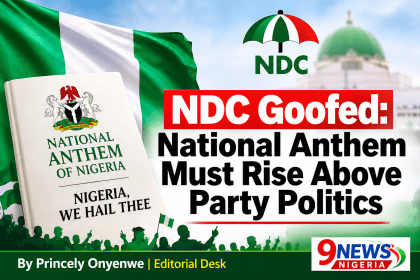
On November 15, Keyamo defended the singing and playing of the song at presidential events, insisting that it was never performed in place of Nigeria’s legally recognised national anthem.
According to the minister, the national anthem is always rendered first, while Tinubu’s supporters subsequently sing the political song to celebrate the President.
He also explained that the Police Band sometimes plays the instrumental version of the song to herald the President’s arrival or address, describing the practice as part of established presidential protocol.
Keyamo, however, criticised the Nigeria Democratic Congress (NDC) over the singing of Nigeria’s former national anthem, Arise, O Compatriots, at a political gathering in Lagos, describing the action as suggestive of secessionist tendencies.
His position has prompted further questions about whether the same standards of political neutrality and institutional responsibility should apply to government officials and political actors across party lines.
Questions over the legislature and judiciary
The debate has also brought back memories of the March 2025 incident in which members of the Lagos State House of Assembly sang On Your Mandate We Shall Stand after meeting President Tinubu at the Presidential Villa in Abuja.
The lawmakers reportedly sang the political anthem for several minutes as they emerged from the meeting, which was held amid the leadership crisis in the Lagos Assembly.
The incident raised questions about the relationship between elected lawmakers, political loyalty and the independence of the legislature.
There was also controversy surrounding the 2025 All Nigeria Judges Conference, where a similar tune was played as President Tinubu approached the podium.
However, the National Judicial Institute (NJI) subsequently dismissed reports that judges collectively sang the political song.
In its clarification, the institute explained that the Guards Brigade Band independently played the tune as part of its ceremonial protocol, while judges merely stood to acknowledge the President.
The NJI maintained that no judge sang or chanted the political song and reaffirmed the judiciary’s commitment to constitutional neutrality.
Keyamo’s response and the separation of responsibilities
Keyamo, through his Special Adviser on Media and Research, Gabriel Emameh, has defended his comments, insisting that he was protecting the integrity of the judiciary and explaining the legal implications of the ADC judgment.
The minister also accused Ojudu of misrepresenting his position because of what he described as hostility towards President Tinubu.
He maintained that opposition politicians should respect court decisions rather than resort to public attacks against judges.
Nevertheless, the controversy raises an important constitutional question about the distinction between a minister’s political opinions, his professional standing as a Senior Advocate of Nigeria and the institutional responsibilities of the Attorney-General of the Federation.
Under Section 150 of the Nigerian Constitution, the Attorney-General of the Federation is a distinct constitutional office responsible for the Federal Ministry of Justice and the legal affairs of the federation.
Although Keyamo, as a Senior Advocate of Nigeria, is entitled to express professional opinions on legal matters, his position as Aviation Minister does not make him the country’s chief law officer.
Ultimately, the debate goes beyond Keyamo’s choice of words or his defence of President Tinubu’s administration.
It concerns the need for consistency in defending democratic institutions, protecting judicial independence, respecting legislative autonomy and ensuring that political loyalty does not overshadow the responsibilities attached to public office.
As the 2027 general elections approach, Nigerians will increasingly scrutinise the conduct of political officeholders and the independence of institutions expected to serve the country without partisan considerations.