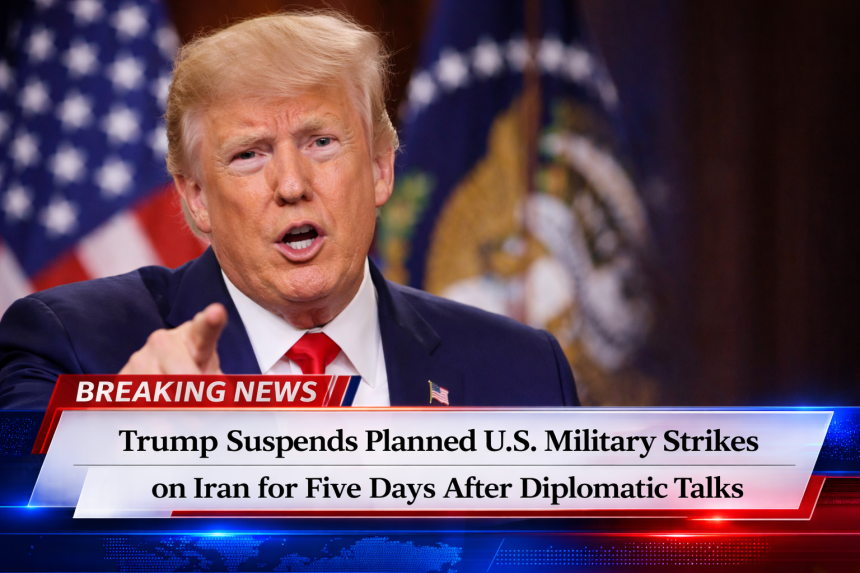
U.S. President Donald Trump has announced a temporary suspension of planned American military strikes against Iranian power plants and energy infrastructure for five days, following what he described as “very good and productive conversations” with Tehran aimed at resolving hostilities in the Middle East.
In a statement posted on his Truth Social platform and monitored by 9News Nigeria’s foreign correspondent, Trump said the decision followed “in-depth, detailed, and constructive conversations” between officials of both countries over the past two days, with further negotiations expected to continue throughout the week.
He stated that he had instructed the U.S. Department of War to postpone “any and all military strikes against Iranian power plants and energy infrastructure for a five-day period,” subject to the outcome of the ongoing diplomatic engagements.
The development marks a significant shift from earlier threats by the U.S. President, who had issued a 48-hour ultimatum to Iran to reopen the strategic Strait of Hormuz or face devastating strikes targeting the country’s energy facilities.
48-Hour Ultimatum Raised War Fears
Trump’s earlier warning had sharply escalated tensions in the already volatile Middle East conflict. He had threatened to “obliterate” Iran’s power plants if Tehran failed to restore full access to the Strait of Hormuz — a critical global shipping corridor for oil and gas supplies.
The ultimatum triggered widespread concern across international markets and diplomatic circles, with fears mounting that a direct confrontation between Washington and Tehran could widen the ongoing regional war.
Iran responded firmly to the warning, declaring through its Revolutionary Guards that it would completely close the Strait of Hormuz if U.S. forces carried out attacks on Iranian energy infrastructure.
Tehran also warned that energy facilities and strategic assets belonging to U.S. allies in the Gulf region could become legitimate targets in the event of American strikes.
Strategic Importance of the Strait of Hormuz
The standoff over the Strait of Hormuz remains central to the current crisis.
The narrow maritime corridor, located between Iran and Oman, serves as one of the world’s most critical energy chokepoints, carrying roughly 20 million barrels of oil per day — about one-fifth of global petroleum consumption.
Any sustained disruption to shipping through the route is widely considered capable of triggering a global energy shock, pushing fuel prices higher and destabilising international trade and financial markets.
Recent tensions around the passage have already driven oil prices above $100 per barrel amid fears of supply shortages and wider regional escalation.
Global Economic Concerns Intensify
Energy analysts warn that a full closure of the Strait of Hormuz could produce severe consequences for the global economy, including supply chain disruptions, inflationary pressures, and reduced economic growth across major importing nations in Asia, Europe, and beyond.
Because the corridor handles a significant share of both crude oil and liquefied natural gas exports from Gulf producers such as Saudi Arabia, Iraq, Kuwait, Qatar and the United Arab Emirates, its closure would affect multiple continents simultaneously and potentially trigger a worldwide fuel supply crisis.
Financial markets have remained on alert amid uncertainty over whether diplomacy between Washington and Tehran will succeed in preventing further escalation.
Diplomatic Window Opens — For Now
Trump’s announcement of a five-day pause in planned strikes is being interpreted by observers as a short but critical diplomatic window that could determine whether the crisis moves toward de-escalation or returns to confrontation.
While negotiations continue behind closed doors, analysts caution that the situation remains fluid and highly sensitive, with both sides maintaining strong military positions across the region.
For now, the temporary suspension of planned U.S. strikes has slightly eased immediate fears of direct attacks on Iran’s energy infrastructure, even as the broader confrontation over the Strait of Hormuz continues to pose serious risks to global stability and fuel supply chains.
Report by Obinna Ejianya (9News Nigeria – Melbourne, Australia)