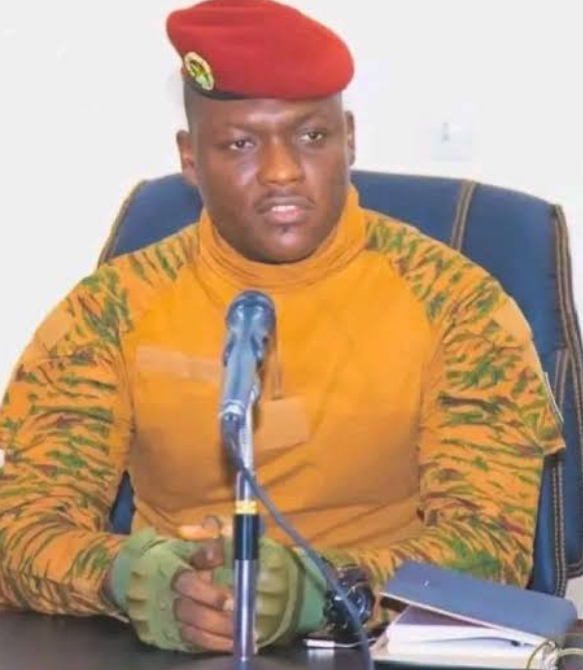
Burkina Fasos military leader, Captain Ibrahim Traore, has intensified his confrontation with influential Muslim scholars, declaring that what he describes as “radical Islam” has no place in the country and warning that “the battle has begun” against extremism.
Speaking to religious leaders, Traore insisted that Islam should spread through peaceful example rather than coercion or violence.
“If this is your Islam, we will fight it. Extremists must change. If they do not, the battle has begun”
His remarks underscores widening rift between the government and parts of Burkina Faso’s Muslim community. Once an important source of support for the military leader, several influential Sunni scholars are now at odds with the authorities over the Religious Freedoms Law, the detention of prominent imams and the government’s campaign against religious extremism.
Traore argued that religion should spread through example rather than coercion or violence. He also questioned why some Muslims opposed the new legislation and warned that imams who used sermons to promote extremist ideas would be suspended.
At the same time, he pledged state support for scholars who advocate what he described as a peaceful interpretation of Islam, while accusing foreign powers of exploiting religion to destabilise Burkina Faso.
His remark s come amid growing tensions between Traore’s administration and sections of the country’s Muslims community, many whom had previously supported the military government.
Traore also announced plans to recall Burkinabe students studying Islamic Law in Arab countries, claiming hundreds of thousands were pursuing religious education abroad without acquiring practical skills.He warned that those who refuse to return could risk losing their Burkinabe citizenship.
The government says the Religious Freedoms Law, adopted in June, is aimed at strengthening the country’s secular character.
It introduces penalties for practices classified as religious abuses, including the force begging of children and financial irregularities by religious organisations.
The legislation has drawn strong criticism from some Muslim leaders.
Renowned Sunni scholar Imams Mohamed Ishaq Kindo was arrested after opposing the proposed law, while another cleric, Imams Mahmoud Barro, was detained earlier under similar circumstances.
Authorities also shut down a major Sunni mosque in Ouagadougou after protests demanding Kindo’s release, with reports indicating that dozens of his supporters were taken to a military camp for what officials described as civic training.
Analysts say that dispute marks a significant breakdown in relations between Traore and influential Muslim scholars whose support helped strengthen his government after he seized power. They warn that alienating former allies could weaken his political standing even as Burkina Faso continues to battle a persistent jihadist insurgency.
Meanwhile, Traore recently received Israel’s new ambassador to Burkina Faso, Simon Seroussi, in Ouagadougou, a move seen by observers as signalling closer security cooperation between Israel and Alliance of Sahel States, comprising Burkina Faso, Niger and Mali.