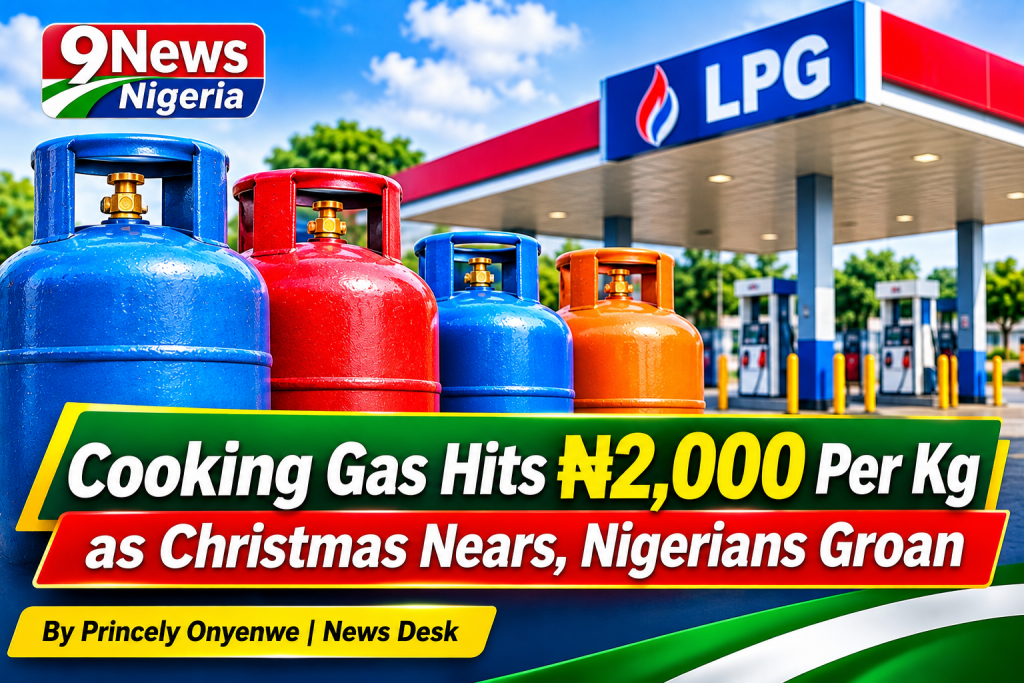
By Princely Onyenwe | News Desk
OWERRI, IMO STATE — The cost of cooking gas has surged across Nigeria, with consumers in several locations now paying between ₦1,480 and ₦2,000 per kilogramme, worsening the financial pressure on households already battling rising food prices, transportation costs and other essential expenses ahead of the Christmas festivities.
Market reports as of Monday, November 23, 2026, indicate that the price of Liquefied Petroleum Gas (LPG), popularly known as cooking gas, has climbed significantly from previous levels of approximately ₦1,300 per kilogramme in some markets, with retail prices now approaching ₦2,000 in high-cost locations.
The development has raised fresh concerns about the affordability of domestic energy, particularly as Nigerian families prepare for the traditional Christmas spending period when demand for rice, meat, fish, onions, vegetables, transportation and other household necessities typically increases.
A regional market assessment shows significant variations in cooking gas prices across the country’s six geopolitical zones, with transportation expenses, supply constraints, depot prices and differences in retail distribution contributing to the disparity.
In the South-West, covering Lagos, Ogun, Oyo, Osun, Ondo and Ekiti states, prices range from approximately ₦1,480 to ₦1,900 per kilogramme. Lagos has some of the lower recorded prices at major outlets, including NIPCO, where the product reportedly sells for about ₦1,480, while smaller neighbourhood retailers charge as much as ₦1,800 to ₦1,850. In parts of Ogun State, prices reach ₦1,900.
In the North-Central, including the Federal Capital Territory, Abuja, Kwara, Kogi, Niger, Benue, Plateau and Nasarawa states, consumers pay between approximately ₦1,550 and ₦2,000 per kilogramme. Abuja’s satellite communities record some of the highest prices, with smaller retailers reportedly charging up to ₦2,000, while major outlets sell between ₦1,550 and ₦1,650.
The South-South, comprising Rivers, Delta, Edo, Akwa Ibom, Cross River and Bayelsa states, records prices between approximately ₦1,500 and ₦1,850 per kilogramme. Despite the region’s proximity to major petroleum and gas infrastructure, consumers are not insulated from rising retail costs.
In the South-East, covering Imo, Abia, Anambra, Enugu and Ebonyi states, cooking gas reportedly sells between ₦1,600 and ₦1,850 at major refilling plants, with smaller retailers charging up to ₦1,950 per kilogramme.
The North-West, comprising Kano, Kaduna, Katsina, Sokoto, Kebbi, Zamfara and Jigawa states, records prices ranging from approximately ₦1,680 to above ₦1,950 per kilogramme, particularly in locations where long-distance transportation increases distribution expenses.
Similarly, the North-East, covering Borno, Yobe, Adamawa, Bauchi, Gombe and Taraba states, records some of the highest reported retail prices, with consumers paying between approximately ₦1,750 and above ₦2,000 per kilogramme in some interior markets.
The figures represent reported retail market prices rather than a uniform government-approved national price list. Actual prices vary between licensed gas plants, major distributors and neighbourhood retailers.
The financial implications are particularly alarming for ordinary households. At the prevailing market rates, refilling a 5kg cylinder could cost between ₦7,500 and ₦10,000, while a standard 12.5kg cylinder could require between ₦18,750 and ₦25,000, depending on the location and retailer.
The situation is particularly concerning in Abuja, where a News Agency of Nigeria (NAN) market survey on Sunday, November 22, established that cooking gas was selling between ₦1,600 and ₦2,000 per kilogramme. Some residents disclosed that the rising cost had forced them to ration their gas or combine it with charcoal and other traditional cooking methods.
Interestingly, the latest development comes amid assurances from the Nigerian Midstream and Downstream Petroleum Regulatory Authority (NMDPRA) that cooking gas prices had started declining by between ₦300 and ₦400 per kilogramme following interventions to improve supply and distribution.
However, the prevailing retail prices reported across several locations suggest that the expected relief has yet to translate into affordable prices for many consumers.
The situation also raises questions about Nigeria’s enormous natural gas resources and the country’s ability to convert its mineral wealth into affordable domestic energy.
According to the Nigerian Upstream Petroleum Regulatory Commission (NUPRC), Nigeria’s total gas reserves stood at 215.19 trillion cubic feet as of January 1, 2026, comprising 100.21 trillion cubic feet of associated gas and 114.98 trillion cubic feet of non-associated gas.
Yet, figures reported by Vanguard on Monday indicate that the domestic market received an average of 2.04 billion cubic feet of gas daily, representing 41.3 per cent of total national gas supply during the first ten months of 2026, while Nigeria LNG Limited received the remaining 58.7 per cent.
The figures have renewed concerns about domestic gas availability, processing capacity, distribution infrastructure and the commercial conditions determining how much gas reaches Nigerian consumers.
For Imo State, the contradiction deserves particular attention.
Imo is among Nigeria’s oil- and gas-producing states, and its petroleum resources have featured prominently in discussions about the economic potential of the South-East. However, claims that Imo possesses the largest gas deposits in Africa should not be presented as established fact without independently verified state-level reserve figures.
The more fundamental question is why communities in resource-bearing states, including Imo, continue to face expensive domestic energy despite the country’s enormous natural gas endowment.
Why should Nigerian households pay nearly ₦2,000 for a kilogramme of cooking gas in a country with over 215 trillion cubic feet of gas reserves?
As Christmas approaches, the pressure could extend beyond cooking gas to food prices, transportation fares and other household necessities, further stretching the purchasing power of ordinary Nigerians.
With the festive season traditionally associated with increased household spending, the latest development presents another serious test for the Federal Government, petroleum regulators and gas marketers.
Nigerians are not merely asking how much gas the country possesses. They want to know why that abundance has not translated into affordable cooking energy for the people.
If Nigeria is blessed with such enormous gas resources, why must ordinary citizens continue to struggle to afford the very energy beneath their feet?
For more inquiries on this news report contact 9News Nigeria on +234 08036856526