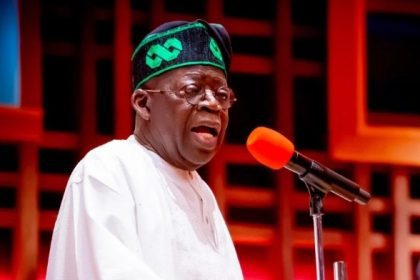
President Bola Ahmed Tinubu has asked the Nigerian Senate to approve a revised 2026 federal budget that will reduce government expenditure by ₦3.147 trillion, bringing the total budget from ₦68.323 trillion to ₦65.176 trillion.
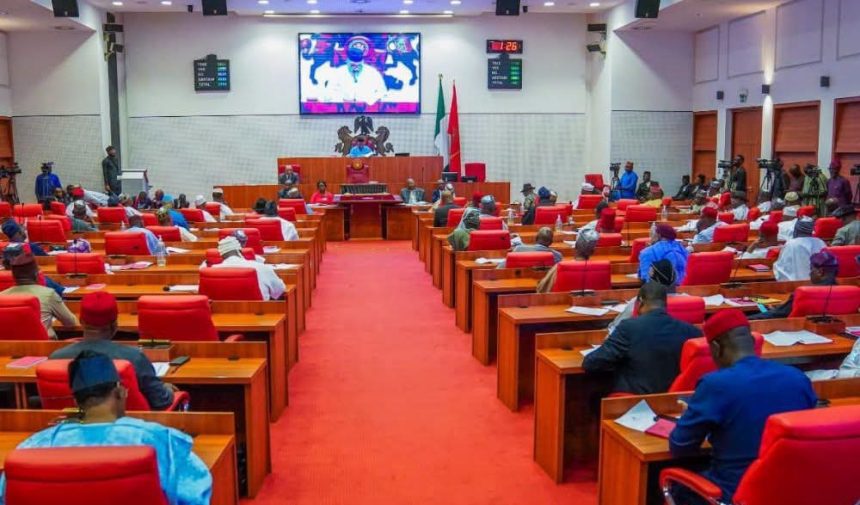
The request was disclosed by Senate President Godswill Akpabio during plenary on Tuesday, November 24, 2026, after he read a presidential letter seeking legislative approval for the proposed changes.
Akpabio subsequently referred the correspondence to the Senate Committee on Rules and Business for further legislative consideration.
The proposed amendment, titled Transmission of FGN 2026 Appropriation Repeal and Re-enactment Bill and Revised 2026 Federal Government Fiscal Framework, is intended to realign government spending with existing obligations and available resources.
Under the revised fiscal framework, projected Federal Government revenue, including receipts from government-owned enterprises, stands at ₦33.720 trillion, while aggregate capital expenditure is pegged at ₦26.232 trillion.
However, despite the proposed ₦3.147 trillion reduction in total expenditure, the Federal Government has retained its projected fiscal deficit of ₦31.457 trillion, representing approximately 5.64 per cent of Nigeria’s Gross Domestic Product (GDP).
The government’s planned new borrowing has also remained unchanged at ₦29.218 trillion.
This comprises ₦18.428 trillion in domestic borrowing and ₦10.790 trillion in external borrowing.
The President explained that the proposed changes would address outstanding government financial obligations, including certain expenditures incurred by the Nigerian National Petroleum Company Limited (NNPCL) on behalf of the Federation.
The revised framework also seeks to address underprovided debt-servicing obligations, recognise previously issued capital warrants and supplementation commitments, and provide refunds to Ministries, Departments and Agencies (MDAs) and special government accounts.
Road Projects, Agriculture Get Priority
Tinubu further disclosed that most of the capital allocations to MDAs under the revised budget consist of funds already authorised for implementation.
However, additional provisions have been introduced for selected national priorities, particularly the completion of critical road projects, protection of agricultural production and reduction of production costs.
Other priority areas include improving farm yields, expanding market access and addressing water-related vulnerabilities across the country.
Proposed $7.7bn Foreign Loan Remains Within Existing Borrowing Plan
The President also clarified that the proposed $7.7 billion external borrowing, estimated at approximately ₦10.368 trillion, would finance an existing foreign borrowing provision.
According to the revised fiscal framework, the loan would not increase the government’s overall borrowing limit.
The external borrowing component remains ₦10.790 trillion, while domestic borrowing is projected at ₦18.428 trillion.
Background to the 2026 Budget Revision
The latest proposal comes after President Tinubu signed the ₦68.323 trillion 2026 Appropriation Act into law on April 17, 2026.
The original budget allocated approximately ₦32.287 trillion to capital expenditure, ₦15.427 trillion to recurrent expenditure, ₦15.809 trillion to debt servicing and ₦4.799 trillion to statutory transfers.
The proposed reduction represents another adjustment to the 2026 fiscal plan, following an earlier upward review by the National Assembly to accommodate additional capital commitments and priority projects.
With the latest request, the Federal Government is seeking to reduce overall expenditure while retaining its existing deficit and borrowing targets.
The revised appropriation will require legislative approval before it can take effect.
Akpabio said the Senate would carefully examine the implications of the proposed changes, particularly their impact on existing government commitments and the funding of capital projects.