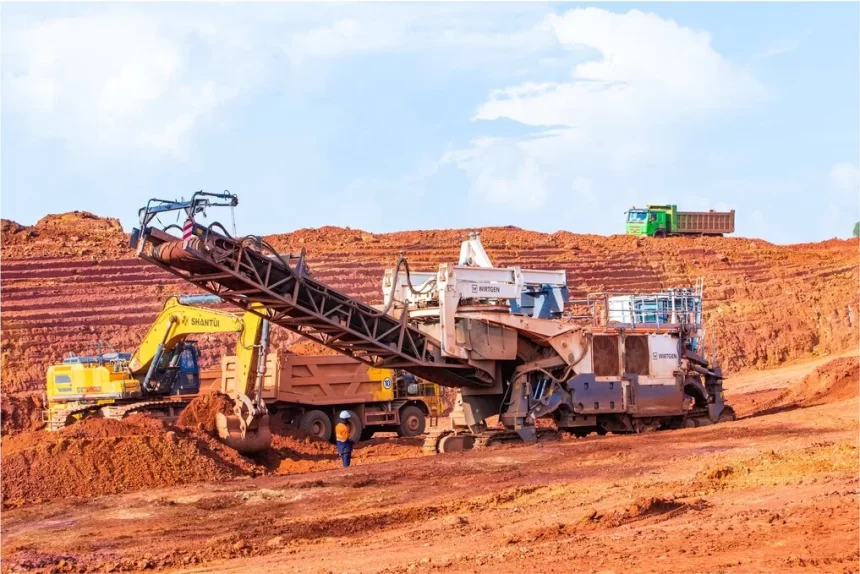
Ghana has cancelled a $1.2bn bauxite mining lease previously awarded to local contractor Rocksure International, as the government shifts focus to global partnerships to unlock the country’s vast mineral potential.
According to three sources familiar with the matter, the decision affects the Nyinahin Hills deposit in central Ghana, which holds around 376 million metric tons of bauxite—used as feedstock for aluminium. The government is now courting international investors, including Dubai-based Emirates Global Aluminium (EGA) and several Chinese firms, in a bid to fast-track development.
As reported by Reuters, the strategic pivot comes amid frustration over delays and missed opportunities in monetising Ghana’s estimated 900 million metric tons of bauxite—the seventh-largest known reserve globally.
Rocksure lease invalid under 2019 court ruling
Rocksure’s lease formed the basis for a joint venture with the state-owned Ghana Integrated Aluminium Development Corporation (GIADEC), called the Asante Bauxite Company. Under that structure, Rocksure controlled 70 percent, with GIADEC and the Ghanaian government holding 20 percent and 10 percent, respectively.
However, the lease had never been ratified by parliament—a constitutional requirement. A 2019 Supreme Court ruling, known as the ‘Exton Cubic’ decision, rendered all such unratified leases legally void.
‘By the Exton Cubic ruling, without ratification, you have no lease,’ one source told Reuters, adding that the Ministry of Lands and Natural Resources had formally communicated the cancellation to Rocksure.
GIADEC declined to comment due to ongoing negotiations. The lands ministry also did not respond to inquiries. Rocksure, for its part, did not issue a formal response. One source noted that while GIADEC had exited the joint venture, Rocksure had not yet received an official termination letter.
Global players enter the fray
With the Rocksure deal off the table, GIADEC is actively seeking new partners. Emirates Global Aluminium (EGA), which recently lost its bauxite licence in Guinea after delays in constructing a refinery, has emerged as a top contender.
EGA signed a memorandum of understanding with GIADEC in June 2025 to assess development opportunities in Ghana. In an emailed statement to Reuters, the company said:
‘EGA has expressed interest in jointly developing bauxite opportunities in Ghana and is currently assessing the technical and commercial parameters of such collaboration.’
While no binding agreement has yet been signed, EGA confirmed that sourcing bauxite from Ghana aligns with its strategy to diversify aluminium production inputs.
Sources close to the negotiations revealed that EGA had previously explored Ghanaian investments in 2022 but pulled back to avoid straining its position in Guinea. ‘They didn’t want Guinea to feel they were shifting focus to Ghana,’ one source said.
Extraction targeted for early 2026
The bauxite-rich Nyinahin area, known as Block B, is now the focal point of GIADEC’s plans. Talks with potential partners are said to be at an advanced stage, and the corporation aims to begin extraction and bauxite off-take in the first quarter of 2026.
‘We’re looking at all options to see which one serves the interest of the nation,’ one source close to the discussions told Reuters.
Despite its leadership in gold production, Ghana trails behind regional rivals like Guinea in bauxite extraction and processing. The hope is that a world-class investor can finally unlock Ghana’s aluminium value chain.
The Ghana Chamber of Mines forecasts a boost in national bauxite output from a record 1.7 million tons this year to 2 million tons in 2025.