By Princely Onyenwe | Editorial Desk
There is a difference between managing an industrial dispute and allowing it to degenerate into an embarrassment for an institution. What is currently happening at Imo State University (IMSU), Owerri, deserves the urgent attention of Governor Hope Uzodinma. The continued closure of one of Imo State’s most prestigious institutions, with students stranded at home for more than three months, is becoming increasingly difficult to justify.
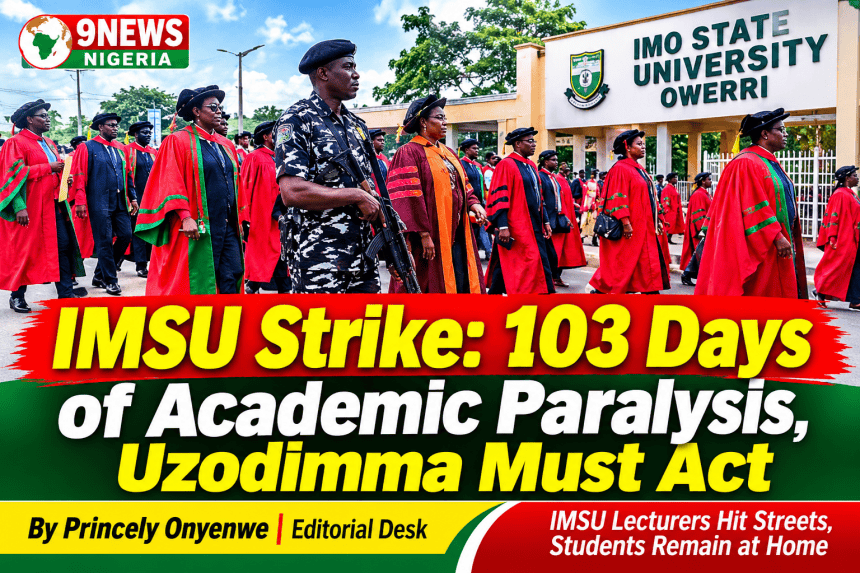
The question is no longer whether there is a strike at IMSU. The evidence is now visible, as lecturers have taken their grievances beyond the university premises to the streets of Owerri, demonstrating the seriousness of an industrial dispute that has continued despite repeated calls for government intervention.
On Thursday, November 19, 2026, members of the Academic Staff Union of Universities (ASUU), IMSU chapter, staged a protest, demanding government intervention over unresolved welfare issues and the implementation of the 2025 Federal Government-ASUU agreement.
This development should put an end to the confusion surrounding the existence of the industrial action. When the Students’ Union Government President initially raised the alarm, calling on Governor Uzodinma to intervene, his concerns appeared to receive insufficient public attention. Subsequently, the ASUU-IMSU leadership corroborated the situation, insisting that the university’s academic activities could not return to normal without addressing the union’s grievances.
For clarity, ASUU-IMSU commenced its indefinite strike on August 10, 2026. As of November 21, the industrial action has lasted approximately 103 days. This is not a minor disagreement that can be dismissed through public statements or administrative assurances. It is a prolonged institutional crisis with direct consequences for thousands of students, parents and the future of the university.
The union’s demands are also more extensive than a simple request for salary increases. According to statements presented by the ASUU-IMSU leadership, the grievances include implementation of the 2025 Federal Government-ASUU agreement, payment of September and October 2026 salaries at the revised rate, and a written, time-bound commitment to settle salary arrears covering January to August 2026.
Other outstanding issues include promotion arrears reportedly dating back to 2016, earned academic allowances allegedly unpaid since 2009, 21 months of withheld check-off dues and other staff entitlements. The union has also raised concerns about university autonomy and the continued operation of IMSU under the Treasury Single Account arrangement. It is further demanding the constitution of a committee for the election of Heads of Departments in line with applicable provisions of the agreement.
Another contentious issue is the union’s demand for the cancellation of examinations and postgraduate defences allegedly conducted during the industrial action. These are specific issues requiring institutional engagement, financial clarification and responsible government intervention. They cannot all be resolved through political assurances without verifiable commitments.
Indeed, on October 26, ASUU-IMSU Chairman, Comrade Stephen Oguji, disclosed that the union had written seven letters to the university administration, held two engagements with management, written three letters to the Governing Council and participated in two engagements with relevant stakeholders. Yet, according to the union, these efforts had failed to produce a satisfactory resolution.
The situation becomes even more troubling when viewed against the experience of other universities. ASUU-IMSU reported that several institutions which embarked on similar industrial actions had resolved their disputes, while IMSU remained on strike. Why should Imo State University be different?
It is against this background that the public outcry by the Students’ Union Government President and subsequent intervention appeals from concerned Imolites deserve serious consideration. The intervention of radio personality Nonso Nkwa, who criticised what he described as the government’s lackadaisical attitude towards the crisis, has also contributed to public discussion. His position reflects a growing concern among residents who believe that the continued closure of the university is unacceptable.
However, the responsibility does not rest on the government alone. University management and ASUU must also demonstrate the willingness to negotiate, make reasonable concessions where necessary and prioritise the academic future of the students. Nevertheless, government leadership is indispensable in resolving this matter.
Governor Hope Uzodinma must understand that the consequences of this strike extend beyond lecturers’ salaries and institutional administration. Students are losing valuable academic time, parents are carrying additional financial burdens, examinations have become uncertain, and the university’s academic calendar is increasingly endangered. Some students may eventually face delayed graduation, disrupted career plans and extended periods before completing their programmes.
A university is not merely a government institution; it is an investment in the intellectual and economic future of society. Allowing its academic activities to remain paralysed for more than three months sends an unfortunate signal about the priority attached to education in the state.
We must also be careful not to turn this matter into a political argument between supporters and critics of the Uzodinma administration. The lecturers’ grievances should be examined on their merits, just as the government’s financial and administrative position deserves a fair hearing.
There is, however, a dangerous tendency to confuse the public by suggesting that normal academic activities are ongoing when the union responsible for teaching has declared an indefinite strike. Whatever administrative arrangements may have been made, they cannot substitute for a sustainable resolution involving the academic staff.
The government must therefore move beyond political communication and embrace practical engagement. We acknowledge that the state has financial obligations across several sectors, including the wider civil service. However, the existence of competing obligations does not justify leaving a state-owned university in prolonged academic uncertainty. The government should establish what is genuinely outstanding, determine what can be paid immediately, negotiate a realistic payment schedule for arrears and communicate its decisions transparently.
It is equally important to distinguish the lecturers’ specific salary structure and entitlements from those applicable to other categories of civil servants. The objective should be a lawful and sustainable settlement, not an indiscriminate comparison of different public-sector employment arrangements.
Our position is simple: IMSU lecturers deserve attention, students deserve their education, and Imo taxpayers deserve accountability. Governor Uzodinma should personally ensure that the relevant ministries, university management, Governing Council and ASUU leadership return to the negotiation table with a clear timetable for resolving the dispute.
We acknowledge reports from government sources that the matter is receiving political attention and that the Governor is expected to give his consent to a resolution. Such assurances are welcome, but assurances alone cannot reopen a university. What matters now is an official, measurable and implementable agreement.
We urge the students to remain peaceful, parents to exercise patience and all stakeholders to support constructive engagement. Imolites should continue their legitimate businesses without allowing the crisis to generate unnecessary tension. However, nobody should mistake public patience for acceptance of prolonged academic disruption.
The November 19 protest has made the situation impossible to ignore. The responsibility now rests on the Imo State Government to demonstrate leadership, restore confidence and prevent further damage to the academic future of IMSU students. Governor Hope Uzodinma, the time for action is now. How much longer must IMSU students remain at home before their future receives the urgency it deserves?
For more inquiries on this editorial report contact +234 08036856526