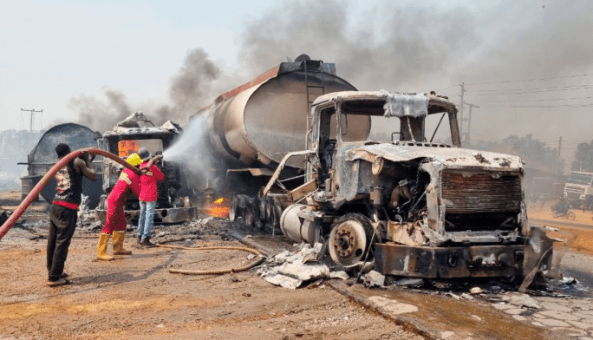
Stakeholders in the oil and gas industry have proffered solutions to the incessant petroleum tanker accidents and fire outbreaks which claimed many lives in Nigeria.
9News Nigeria, reports that the Nigerian Midstream and Downstream Petroleum Regulatory Authority, NMDPRA, in Abuja, convened a stakeholders’ engagement on measures to mitigate oil tanker accidents.
The Chief Executive officer, NMDPRA, Farouk Ahmed, said the incidents were avoidable and unnecessary, in view of the measures emplaced to mitigate the occurrence.
He therefore listed the measures to include: Minimum Industry Safety Training for Downstream Operators (MISTDO), which include training and retraining of drivers, motor boys, and all personnel involved in downstream operations.
Ahmed said the measures also included the installation of anti-spill safety valves on all petroleum product tanker and implementation of safe-to-load initiatives.
Others were colour coding and branding of all tankers, spot checks by Federal Road Safety Corps (FRSC) on fatigued drivers and broadcast of post-crash emergency numbers and first responders to cordon-off accident sites.
He also noted that the Authority was conducting public sensitisation on the dangers of scooping the volatile hydrocarbons at accident sites, regular meeting with stakeholders and regulating route management by designating routes and commuting times.
Ahmed therefore emphasised on determination of appropriate truck carrying capacity, given the negative impact on the roads.
These requirements, he said, were resolved by the industry collectively, pursuant to learnings from previous accidents and safety studies conducted to ensure that energy distribution was conducted in a safe and secured manner.
“It is therefore unacceptable for any operator to conduct business in contravention of established protocols and safety requirements.
“It is these contraventions, coupled with the poor conditions of our transportation infrastructure that are leading to the unnecessary accidents and unfortunate loss of lives and properties.
“The fact that these accidents keep recurring is indicative of noncompliance by the industry with the established safety measures or that the measures are defective.
“Consequently, we demand that all parties should ensure strict compliance with the established safety requirements,” Ahmed said.
He recalled that in 2022, four tanker accidents were recorded that led to seven fatalities and three injuries, adding that the number of incidents decreased in 2023 to two, resulting in 24 fatalities and five injuries.
Ahmed said the number of accidents recorded in 2024, increased to 11 incidents, with 341 fatalities and 124 injuries, while five accidents had been recorded, with 121 fatalities and 79 injuries from January to dare.
In recent times, Nigeria witnessed a surge in petroleum tanker accidents, which resulted to fire outbreaks, destruction of lives and properties.
About 70 persons lost their lives during a tanker accident at Dikko Junction in Niger, and 20 others killed in Enugu incident.