By Princely Onyenwe | News Desk
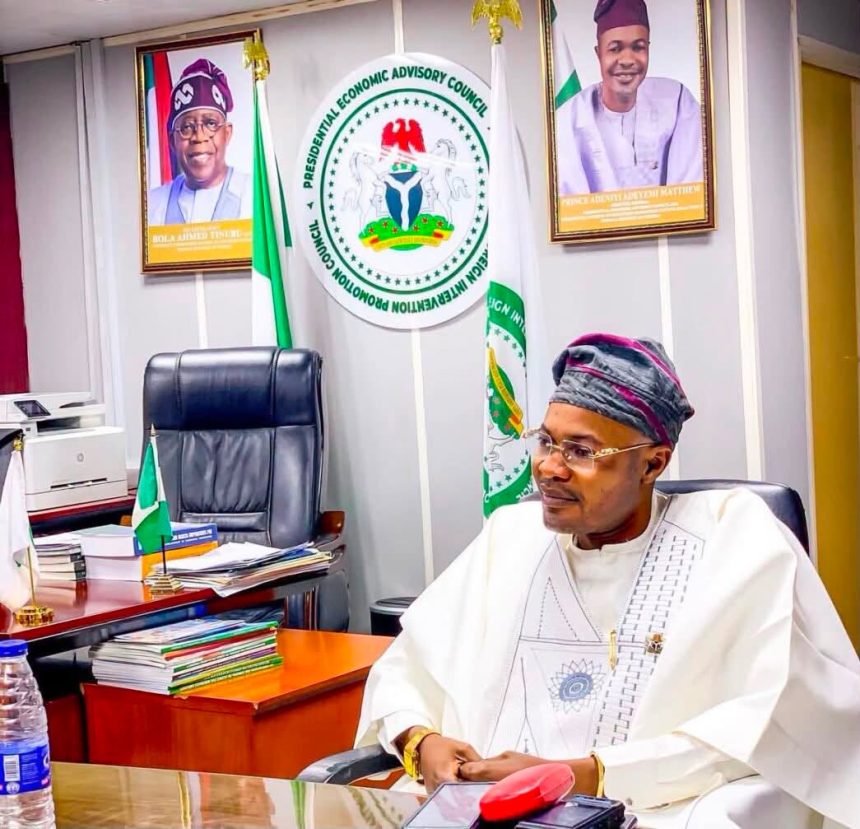
The Presidency has issued a detailed statement defending the Chief of Staff to the President over allegations linking his office to a purported Presidential Economic Advisory Council, insisting that the agency is fictitious and that its alleged director-general, Prince Adeniyi Adeyemi Matthew, is an impostor currently facing criminal prosecution.
In a statement released on Tuesday by the Special Adviser to the President on Information and Strategy, Bayo Onanuga, the Presidency said the Office of the Chief of Staff first alerted security agencies in October 2025 after officials of the Nigerian Investment Promotion Council raised concerns over another body allegedly operating as a federal agency.
According to the statement, the Chief of Staff petitioned the Department of State Services (DSS) and the Nigeria Police Force on October 17, 2025, alleging that forged appointment letters bearing fake signatures, official seals and reference numbers were being used to present a non-existent government agency known as the Presidential Foreign Intervention Promotion Council.
The Presidency alleged that Adeyemi falsely presented himself as the director-general of the organisation, operated from an office within the Federal Secretariat in Abuja, held meetings with foreign diplomats and sought diplomatic support from the Ministry of Foreign Affairs for visa processing.
The statement further disclosed that the Ministry of Foreign Affairs had independently sought clarification from both the Office of the National Security Adviser and the Office of the Chief of Staff after concerns were raised over Adeyemi’s engagements with ambassadors without official authorization.
According to the Presidency, the Office of the Secretary to the Government of the Federation also requested clarification, after which the Chief of Staff denied issuing any appointment letter, stressing that appointments to federal agencies fall under the constitutional responsibilities of the Secretary to the Government of the Federation.
The statement said police investigations led to Adeyemi’s arrest in Abuja on October 27, 2025, and that searches conducted at his office and residence allegedly uncovered forged documents and materials used in operating the purported agency.
According to the police findings cited by the Presidency, investigators allegedly discovered multiple bank accounts linked to fictitious organisations and claimed that Adeyemi fraudulently obtained a Central Bank account through false representations. The Presidency, however, stated that investigators found no evidence that government funds had been transferred into the account.
The police subsequently filed an eight-count charge against Adeyemi and two others at the Federal High Court, Abuja, in November 2025, with the matter scheduled for hearing later this month.
The Presidency also referenced an earlier incident in 2016, alleging that Adeyemi had previously claimed to represent a youth organisation purportedly affiliated with the United Nations, a claim it said was later disowned by the UN.
Reacting to renewed public debate surrounding the case, the Presidency urged Nigerians to avoid drawing premature conclusions, noting that the matter is already before the court and should be allowed to proceed through the judicial process.
Adding that the allegations contained in the Presidency’s statement represent the official position of the Federal Government and law enforcement agencies. Under Nigerian law, every accused person remains presumed innocent until proven guilty by a competent court.
Legal analysts note that the criminal proceedings before the Federal High Court will provide the appropriate platform for the evidence presented by investigators and any defence by the accused to be tested.
Meanwhile, 9News Nigeria reports that the controversy has generated widespread public concern because it touches on the integrity of government institutions, document authentication and public trust.
On the forgoing therefore, some technocrats interviewed by 9News Nigeria stated that if the Presidency’s allegations are substantiated in court, the case would expose significant weaknesses in document verification and institutional safeguards. Conversely, the judicial process remains the only avenue for determining the veracity of the allegations and the culpability of those involved.
The development also highlights the importance of stronger inter-agency coordination, improved verification of official appointments and greater public awareness regarding fake government agencies and forged documents.
Speaking further , sources from the state house told 9News that certain recommendations will be followed to restore public confidence and reduce political tension in the country which includes the following: Allowing the Federal High Court to determine the matter strictly on the evidence presented, ensuring security agencies conclude investigations transparently and professionally.
The sources further added that strengthening verification systems for government appointments and official correspondence, encouraging citizens, investors and diplomatic missions to verify government appointments through appropriate official channels before engaging with individuals claiming public office, avoiding misinformation, political speculation and prejudicial commentary while the matter remains before the court will build strong societal confidence in the country.
At press time, the Presidency has maintained that the case is a criminal matter involving alleged forgery and impersonation, while the court is expected to determine the facts and liability.
For inquiries on this news contact 9News Nigeria on +234 08036856526