By Ibraheem A. Waziri |#06-06-2026
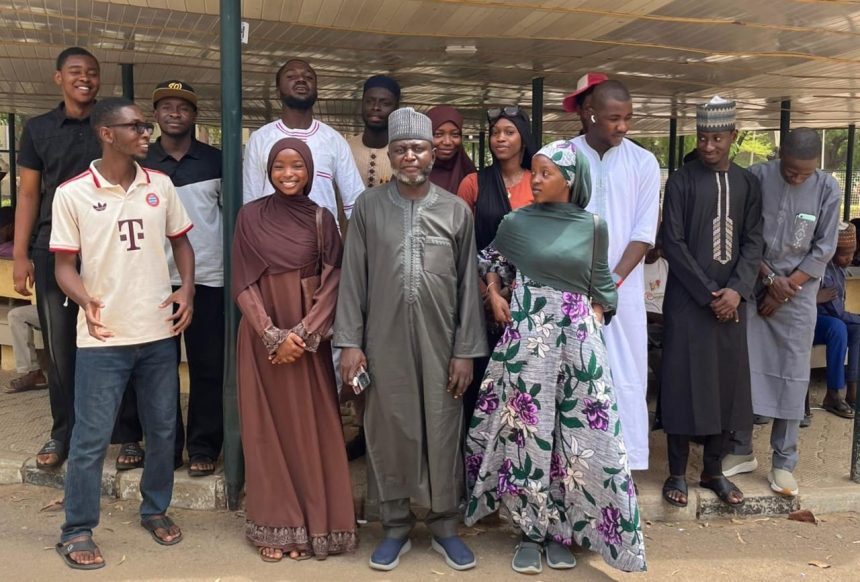
The biweekly discussion session of the Students Interactive Forum held on 5 April 2026, themed “Operation Epic Fury: Who Is on the Right Side of History?”, offered more than a debate on contemporary geopolitics. It functioned as an intellectual space where participants interrogated their assumptions, re-evaluated normative positions, and confronted the uneasy realities of global power politics. What emerged was not consensus but clarity: that international conflicts rarely lend themselves to moral binaries, and that national interests often override universal ethical claims.
A noteworthy methodological intervention by the moderator shaped the discussion meaningfully. Participants were encouraged not only to argue from religious, ideological, or moral standpoints—whether as Nigerian Muslims, Christians, or otherwise—but also to situate their arguments within a Nigeria-like stake in the conflict. This requirement subtly but firmly shifted the debate from abstract moralism to applied political reasoning. It compelled participants to ask not merely who is right, but what such “rightness” means for Nigeria’s interests, positioning, and future orientation in the international system.
The ensuing exchange of arguments revealed the fluidity of political judgment when exposed to competing narratives. Participants occupied and abandoned positions ranging from pro–America/Israel to pro-Iran, often acknowledging moments of intellectual dissonance and reconciliation. This oscillation underscored a critical feature of political deliberation: that informed engagement often complicates certainty rather than resolves it.
Perhaps the most incisive theoretical contribution came from Rahmah – obviously an International Studies major- whose observation framed the international system as fundamentally anarchic—a dog-eat-dog arena in which states pursue advantage with limited regard for truth, justice, or morality. Her point resonates strongly with classical realist thought, particularly the notion that power, not principle, remains the primary currency of international relations. In this view, ethical discourse, while not entirely absent, is frequently instrumentalised to justify actions taken for strategic self-interest.
Building on this realist insight, the suggestion was made that a deeper appreciation of the conflict requires an examination of the foundational narratives that animate each principal actor. States do not merely pursue interests in a vacuum; they do so through historically constructed identities that shape their sense of purpose and legitimacy.
The United States, for instance, has long styled itself as a Western, Protestant, Anglo-Saxon polity, imbued with a sense of exceptionalism and a perceived moral mandate to shape the global order. Israel grounds its national identity in an ancient religious text and a strong sense of tribal and historical continuity, blending theology, memory, and statehood into a singular narrative. Iran draws heavily on its Shiʿi Islamic heritage, articulating resistance, martyrdom, and moral defiance as central elements of its political identity. Saudi Arabia, in turn, locates its legitimacy primarily in its Sunni Islamic identity and custodianship of sacred Islamic sites.
These narratives are not ornamental; they are constitutive. They inform how states interpret threats, define allies, justify violence, and imagine victory. Even actors not directly involved in a given conflict—such as China, Russia, or Nigeria—operate through their own philosophical attributions, unity bases, and civilisational self-understandings. Engagement or non-engagement is rarely neutral; it is filtered through deeply embedded conceptions of history, destiny, and national purpose.
This analytical turn raises a profound question for Nigeria: What are we? Who are we? Where do we come from, and where do we want to go? Unlike many states with relatively coherent foundational narratives, Nigeria’s identity remains contested, layered, and unfinished. Is Nigeria a mere geographic expression, an administrative inheritance of colonialism, or an emerging civilisational project still in the process of self-definition?
The importance of this question cannot be overstated. A nation’s capacity to navigate international conflicts meaningfully depends not only on its economic strength or security apparatus but also on its clarity of purpose. Without a shared understanding of what Nigeria represents and aspires to become, foreign policy risks becoming reactive, incoherent, or opportunistic.
Ultimately, life—whether for nations or individuals—transcends the pursuit of economic abundance or physical security. These are enabling conditions, not ends in themselves. The more enduring question concerns what is done with stability and prosperity once attained: the values enacted, the institutions built, and the meaning ascribed to power. In this sense, the discussion on Operation Epic Fury served as a mirror, reflecting not only global tensions but also Nigeria’s unfinished conversation with itself.