By Patrick Markey and Tarek Amara
REDAYEF, Tunisia (Reuters) – For years, trains ferried millions of dollars in phosphate past Nouredine Ezzidine’s Tunisian town, where young men like him idle their days in cafes over cigarettes and coffee, desperate for work.
After seven years with no job, the mechanics graduate had had enough. He joined protesters who saw one option to make demands on the government: No jobs for us, no phosphate for you.
With a tree trunk and a make-shift tent, Ezzidine’s group blocked the small-gauge railway from Redayef mine. Ten months later, the blockade is still in place and mountains of washed, sandy, phosphate rock — used in fertilizers and industry — are now piled up waiting for export.
Tunisia was the sole political success story of the “Arab Spring” protest movement that swept the Arab world in 2011: the one country where a long-serving authoritarian leader was toppled without triggering violence or civil war.
But six years after the uprising swept President Zine El Abidine Ben Ali into exile, Tunisia’s much-praised model of democratic transition is souring for many like Ezzidine.
The phosphate industry provides money for the government but few local jobs. Blockades like the one in Redayef have interfered with the trade, one of many protests across the country illustrating the depth of frustration.
“There are no opportunities here, just phosphate,” Ezzidine said, outside the locked gate of the Redayef loading bay that usually ships 20 percent of Tunisia’s phosphate exports. “Riches from here pay for projects everywhere, but what about jobs for us here?”
In Tunis, protesters have camped for months outside one ministry to demand work. Elsewhere they have threatened to commit suicide in front of local government offices. Unions have been warning of strikes over job freezes.
A sit-in interrupted gas exports this year by Petrofac, a British company that threatened to pull out of the country if it could not operate, until the state ended the protests in September with a promise of more jobs.
Prime Minister Youssef Chahed is under pressure from international lenders to deliver more reforms and spending cuts, a package softened by credits for jobless youth, rural development and hiring in the phosphate industry.
But past governments failed to find a formula to fully control the deficit while managing the fragile social peace. Attempts to push through much-needed fiscal reforms often ended in political inertia and mixed results.
The budget deficit will creep up from 5 percent in 2015 to 6.5 percent this year, mostly due to public wages. Officials see new bank and investment laws helping growth, but a past attempt to push through higher vehicle taxes met with riots.
For Western partners, Tunisia remains a beacon in a region rife with conflict. Since 2011, billions of dollars in credits and loans helped shore up Tunisia’s economy.
Approving a $2.9 billion loan in September, the IMF praised Tunisia for streamlining bureaucracy and promoting the private sector, but said attempts to tackle public wages and control spending were falling behind.
It’s a delicate time. Foreign debt payments of $3 billion loom next year, the public hiring freeze is meeting union resistance and new taxes are testing the patience of Tunisians who already say the government has done too little too late.
In the marginalized south — heartland of the protests against Ben Ali in 2011 — many dismiss Chahed’s cabinet in the north as out of touch, a remnant of former Ben Ali regime elites spouting promises they cannot deliver.
Riots broke out in the south in January and April this year.
“After the revolution, we thought the social and economic (issues) would be central,” said Abedramane Hdili, at the FTDES rights group that monitors protests. “We have a class of disenfranchised people with no opportunity. Tunisia may pay a heavy price.”
BACKSEAT ECONOMICS
Economic reforms took a backseat during a period of political compromise in the early days after the revolution, when squabbling between secularists and Islamists over the direction of the country threatened to scuttle Tunisia’s democratic experiment.
Then came the attacks: Islamic State targeted tourism, gunning down foreigners at a Tunis museum and carrying out a bloody massacre at a beach resort last year. A sector that makes up 8 percent of the economy was badly damaged and is still recovering.
Unemployment has been constantly in double digits. It was 15.6 percent in September, and twice as high in rural communities. Graduates make up a third of the jobless.
In office since August, Chahed, a French-trained agriculture specialist and ally of President Beji Caid Essebsi, promises his government will be improve the fortunes of the youth. Public finances, corruption and security are at the top of his list.
Calling for “exceptional decisions and sacrifices,” he sees more revenue coming from stability in vital industries like phosphate and from a crackdown on fiscal evasion. He wants new taxes, subsidy cuts and a freeze on public wage hikes to control the deficit.
A new program called “Dignity Contract” will encourage employers to hire unemployed youth, with the government shouldering two thirds of the 600 dinars ($267) a month wage.
“Everyone has to make a sacrifice because it’s a difficult time,” Chahed told the Achourouk newspaper. “If we can’t all save our house, it’s going to collapse in on all of us.”
But new taxes are unpopular, and talk of trimming the public sector wage bill — at 13.5 percent of GDP proportionately one of the highest in the world — is sensitive in a country where many cling to the Ben Ali-era view that the state should act as one of the main providers of employment.
Already his plans to freeze public sector wage hikes and hiring have been rejected by the UGTT, a powerful labor union, which warned about the threat to social peace. The UTICA business association also rejected a new tax.
Many middle-class Tunisians are asking why should they bear more taxes, wage freezes and job cuts, when they say Chahed needs to tackle graft, especially among his wealthy backers.
A new proposed tax on swimming pools was quickly derided on social media as a populist attempt to show the rich will sacrifice as much as the poor and middle class.
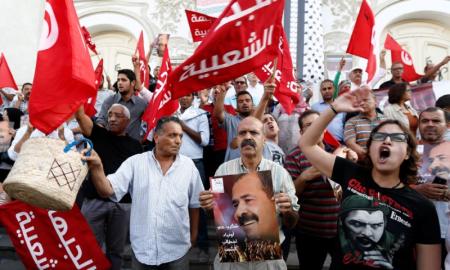
“A hiring freeze will just double our problems,” said Abd el Monem Chedli, an unemployed graduate at a protest with several hundred people in Tunis against austerity. “It means more unemployment and more pressure.”
‘ECONOMIC TERRORISTS’
Nowhere are those frustrations keener than in the south and in places like Redayef, a dusty town of one-story buildings surrounded by scrubland and desert, where small agriculture and contraband gasoline are the chief ways to earn a living.
Camped out in a squalid hut, the phosphate protesters know the symbolism of blocking a key national resource. Critics label them “economic terrorists” for sabotaging state revenues. They say they have no choice.
Most of the two dozen demonstrators are graduates who say they were excluded from recent hiring rounds. Most have been without work for more than five years, living off family. Another group of protesters hold the nearby train station, where diesel engines and lines of wagons filled with rock sit idled.
After promising a hard line with protesters, Chahed proved more pliant. He has revived around 70 percent of phosphate production after ending other protests and announcing the hiring of nearly 3,000 more workers at state-run Gafsa Phosphate.
It’s a fragile deal in a key sector that supplies revenue, jobs and foreign reserves.
At Redayef, police tried to take back a diesel engine only to be thwarted by protesters. Some have been arrested. But the government seems reluctant to crack down on a town that once rebelled against Ben Ali in 2008.
Graffiti on the walls states: “No work, No Phosphate” and “Work, Freedom, Dignity,” the slogan of the 2011 uprising.
“The government is far from us, working in their air conditioned offices, they don’t know about here,” said Mohamed Shabab, a jobless graduate. “Why don’t they send in the army? Because they know we are right.”
Two hours’ drive away, in the oasis town of Jemna, locals took economic matters into their own hands during the 2011 revolution by claiming control of a 180-hectare state-run date palm plantation. They argue the land belonged to them before the French colonial era.
They have put in place a local board of trustees running the plantation, which has returned profits from date auctions back to the community, buying an ambulance, renovating the school and rebuilding a covered market for the town.
Now Chahed’s government is coming to collect. Jemna leaders say that after five years, authorities have ruled their project and its auctions illegal because it is on state land.
“Everything we have done here is what the state should have done for us. We are a state within the state,” Jemna project founder Tahir Tahari said. “They are against this social economy we’ve set up. They want to deny us, that’s all.”
(Reporting by Patrick Markey)