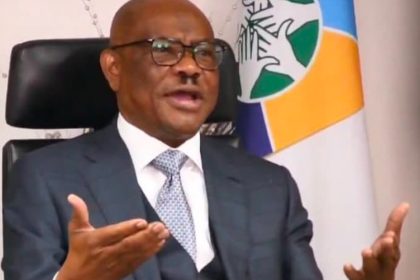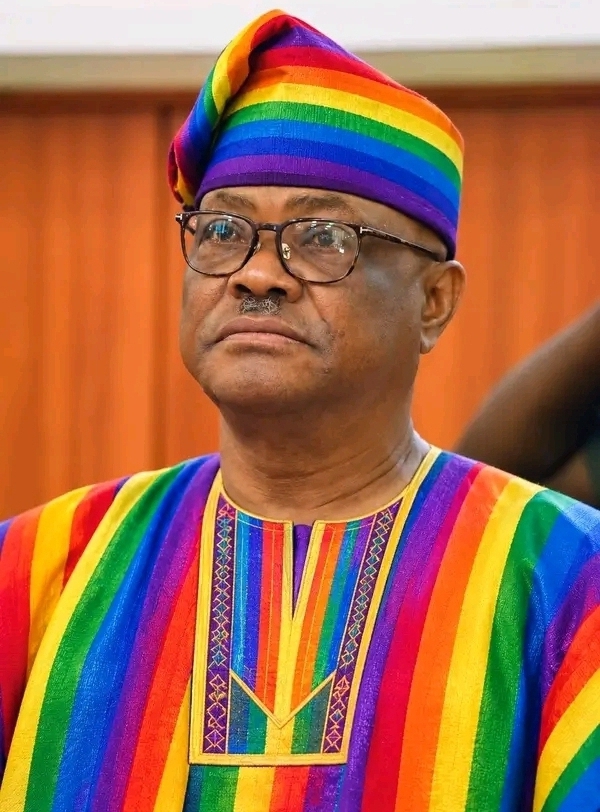
BORI, RIVERS STATE — Minister of the Federal Capital Territory (FCT), Nyesom Wike, reportedly faced a hostile reception in Bori, headquarters of Khana Local Government Area of Rivers State, after sections of the audience challenged his comments on Ogoni political representation during a Rainbow Coalition meeting.
The incident occurred on Tuesday, November 24, 2026, during a political mobilisation meeting organised to canvass support for President Bola Tinubu’s re-election in the 2027 general elections.
According to reports by The Southern Examiner and The Front Rank, sections of the audience booed and interrupted Wike’s address, eventually forcing an abrupt end to the gathering.
The confrontation reportedly followed Wike’s criticism of former Rivers State Governor and former Minister of Transportation, Rotimi Amaechi, whom he accused of failing to advance Ogoni political interests despite spending 16 years in influential public offices.
Wike reportedly questioned why Amaechi did not support an Ogoni candidate to succeed him as governor in 2015 or promote an Ogoni governorship candidate during his political influence in the build-up to the 2023 elections.
However, his remarks reportedly provoked objections from some participants, who questioned why he was criticising Amaechi while the APC’s own 2027 governorship candidate was not from Ogoniland.
The audience reportedly challenged the minister to explain the apparent contradiction between his criticism of Amaechi and the political choices of the Rainbow Coalition.
The disagreement also brought the governorship ambition of Dr Gabriel Baritulem Pidomson, the African Democratic Congress (ADC) candidate, into the discussion.
Pidomson, an Ogoni indigene from Gokana Local Government Area, is among the candidates cleared by the Independent National Electoral Commission (INEC) for the 2027 Rivers governorship election.
Meanwhile, the APC’s governorship candidate is Kingsley Ogundu Chinda, a political ally of Wike.
INEC’s published candidate list confirms both Chinda’s APC candidature and Pidomson’s ADC candidature, giving further context to the controversy surrounding Ogoni representation.
According to the reports, Wike reportedly attempted to regain control of the meeting, including addressing participants in the Khana language, but the interruptions continued.
The gathering subsequently ended in disorder, although claims that the minister was physically chased out of Ogoniland have not been independently established.
WIKE’S TINUBU MOBILISATION CAMPAIGN
The Bori confrontation came a day after Wike addressed another gathering of Ogoni political leaders, traditional rulers, women and youths in Khana LGA on Monday, November 23.
At that meeting, the minister urged the people of Ogoniland to support President Tinubu’s second-term ambition, arguing that political alliances should be judged by their ability to attract development rather than ethnic sentiments or personal relationships.
He cited the establishment of the Federal University of Environment and Technology and the Bori-Bonny Road project as evidence of the benefits of Rivers State’s political relationship with the Tinubu administration.
Wike also defended the Rainbow Coalition, describing it as a political alliance established to mobilise support for Tinubu rather than an arrangement for sharing governorship or legislative positions.
The Paramount Ruler of Bori Nortem Community, Dr Lenu Saro Igbara, had publicly commended Wike’s political mobilisation strategy and expressed confidence in the coalition.
OGONI REPRESENTATION EMERGES AS 2027 CAMPAIGN ISSUE
The reported confrontation underscores the sensitivity of political representation in Ogoniland as political parties intensify preparations for the 2027 elections.
The three major Ogoni local government areas of Khana, Gokana and Tai remain politically significant in Rivers State, particularly in discussions about equitable representation, infrastructure and environmental development.
The emergence of Pidomson as the ADC governorship candidate has also placed Ogoni representation within the broader contest for political power in the state.
For Wike and the Rainbow Coalition, the incident presents a challenge to their efforts to consolidate grassroots support for Tinubu and the APC ahead of the elections.
It also raises questions about the consistency of political leaders’ appeals for ethnic and community support when their own party arrangements come under scrutiny.
As the 2027 elections approach, the debate in Rivers State is increasingly extending beyond party affiliations to questions of political inclusion, accountability, development and the right of communities to have a meaningful stake in governance.