By Princely Onyenwe | News Desk
The Vice-Chancellor of the Federal University of Technology, Owerri (FUTO), Prof. Ikechukwu Nosike Simplicius Dozie, has called for stronger cooperation between the university and its host communities to confront insecurity, land-related challenges and other threats to the institution’s development.
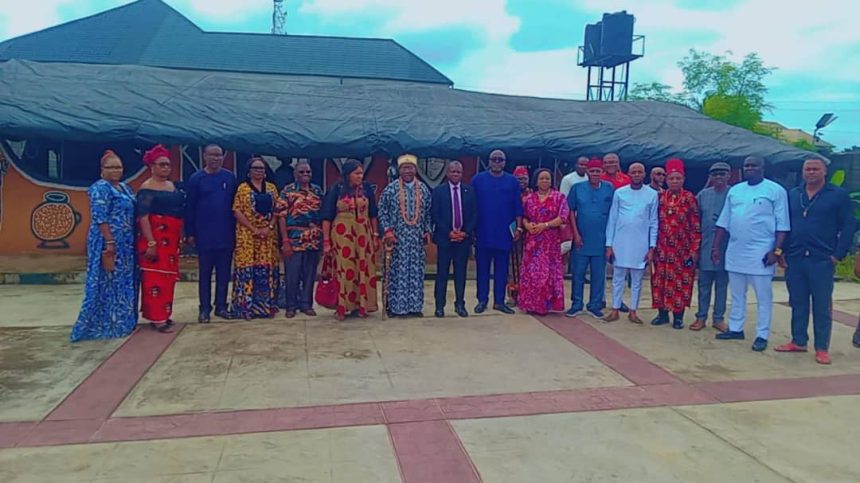
Prof. Dozie made the call during a courtesy visit to Umuoma community in Nekede, Owerri West Local Government Area of Imo State, where FUTO management engaged traditional rulers, community leaders, youth and women representatives, clergy and other stakeholders.
The meeting provided an opportunity for both sides to examine issues affecting the university and its immediate environment, including insecurity, alleged theft of university property, alleged illegal sand mining, land encroachment, traffic congestion, infrastructure, livelihood concerns and the need for stronger university-community relations.
The Vice-Chancellor stressed that FUTO should be regarded as a collective heritage whose protection requires the commitment and cooperation of both the institution and its host communities.
Participants expressed concern over reports of theft of university property and urged communities around the institution to play a more active role in safeguarding the university’s assets.
Security featured prominently in the discussions, with stakeholders raising concerns over kidnapping and other criminal activities within and around the university environment. They called for increased community vigilance and closer cooperation with security agencies.
Local vigilante groups were urged to intensify lawful community security efforts, including bush-combing exercises, while residents were encouraged to provide useful information to security agencies and support legitimate efforts to protect lives and property.
Another major concern was alleged illegal sand mining in parts of the university environment, particularly areas around the FUTO Senate building and other structures. Stakeholders warned that continued mining could undermine the physical and environmental integrity of university property.
Community leaders called for anyone allegedly involved in the activity to be identified and engaged through peaceful and lawful channels, while traditional authorities were urged to continue sensitising residents on the need to protect the university environment.
The meeting also examined concerns over FUTO’s extensive land holdings and alleged encroachment. Participants warned that continued occupation or exploitation of university property could undermine the institution’s expansion and long-term development plans.
Traffic congestion within the university environment also came under scrutiny, with stakeholders expressing concern that some motorists increasingly use internal FUTO roads as through-routes. They called for appropriate measures to regulate vehicular movement and prevent the campus from becoming a major transit corridor.
The absence of a comprehensive perimeter fence around the university was equally identified as a security and administrative concern, particularly given the need to properly demarcate and protect institutional property.
However, the community linked some of the land-related challenges to livelihood difficulties confronting its people.
HRH Omadike explained that some members of the community had lost access to traditional sources of livelihood, urging FUTO and its host communities to explore sustainable alternatives that could reduce economic pressures and discourage further encroachment.
He also appealed to FUTO management to revisit an outstanding agreement between the university and the community which, according to him, had remained unresolved for years.
Omadike said discussions on the agreement had been ongoing since the tenure of Prof. Dozie, but that the document had yet to be concluded and signed by the university. He urged the present administration to reopen discussions and work towards a mutually acceptable resolution.
Beyond security and land issues, the community called for greater attention to entrepreneurship, infrastructure and corporate social responsibility, stressing that a stronger developmental partnership with FUTO could create opportunities for young people and improve livelihoods.
Some participants who spoke to 9News Nigeria said deeper collaboration between the university and its host communities could also help address some of the social and economic pressures associated with insecurity.
The issue of admission into professional programmes was also discussed, with community members advised to properly guide prospective students and parents on the competitive nature of such courses.
Applicants were encouraged to consider suitable alternative programmes where necessary rather than limiting their educational aspirations to a few professional disciplines.
The engagement further highlighted the importance of maintaining an effective communication channel between FUTO and its host communities.
Participants acknowledged the role of the university’s Community Liaison Office and urged it to remain proactive in sustaining dialogue, addressing grievances and resolving emerging concerns before they escalate.
Pharmacist Ajoku was specifically encouraged to strengthen liaison activities and improve communication between the university and its host communities.
The Traditional Ruler assured the Vice-Chancellor of Umuoma’s willingness to cooperate with FUTO management, stressing that the community would pursue dialogue rather than confrontation in resolving areas of disagreement.
He maintained that mutual understanding, responsible engagement and continuous communication remained essential to building a safer and more productive environment around the university.
Omadike thanked Prof. Dozie for visiting the community, describing the engagement as a welcome opportunity for both sides to openly address issues affecting their relationship.
He reiterated the community’s readiness to cooperate with FUTO management, stressing that the wellbeing of the university and its host communities remained interconnected.
The Vice-Chancellor was accompanied by members of the FUTO management team, including Deputy Vice-Chancellors and other senior officials.
The Umuoma delegation comprised members of the Umuoma People’s Assembly, traditional title holders, clergy, women and youth groups, who turned out in large numbers to receive the university delegation.
Speaking on behalf of Nekede indigenes in the diaspora, Dr Oparaku of Umudibia Nekede, President of Oga N’Ihiu Nekede, USA and Canada, expressed appreciation to both the Umuoma community and FUTO management for the engagement.
He said the outcome of the meeting would be communicated to Nekede indigenes abroad, noting the importance of keeping the diaspora community informed about developments involving the university and its host communities.
The visit also featured cultural displays by Umuoma women and the Igba Ndi Eze dance group, who performed during the reception for the FUTO delegation.
The engagement reinforced the need for a stronger and more sustainable partnership between FUTO and its host communities to confront insecurity, protect university land and property, curb alleged illegal mining, improve infrastructure, address livelihood concerns and preserve the institution as a shared heritage for present and future generations.