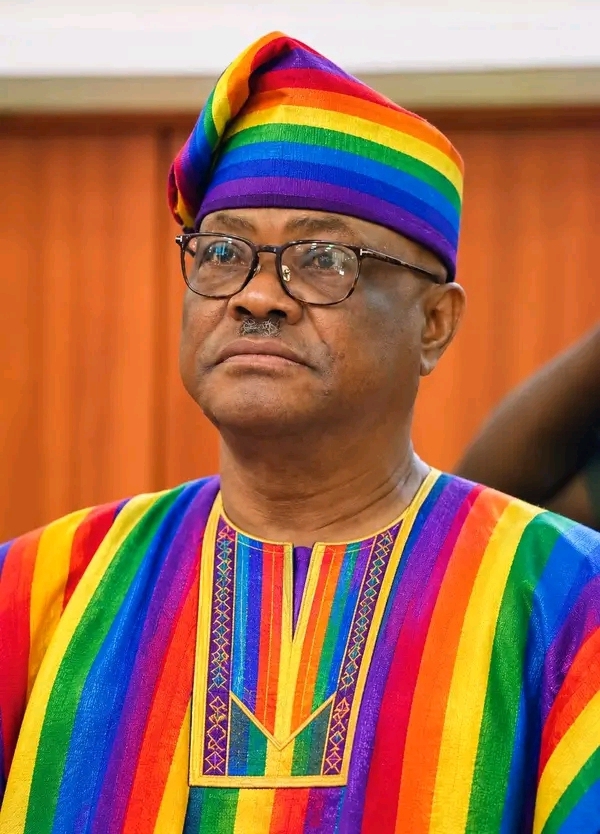
The emerging political alliance being associated with former Rivers State Governor and Minister of the Federal Capital Territory, Nyesom Wike, has opened a new chapter in Nigeria’s increasingly fluid party politics ahead of the 2027 general elections.
The phenomenon, described as “Wikeism,” is not a formal political ideology. Rather, it refers to a political style built around negotiation, personal networks, strategic alliances, confrontation and the ability to operate across party boundaries.
The concept has become increasingly associated with the proposed Rainbow Coalition, a cross-party political arrangement that Wike has presented primarily as a platform for mobilising support for President Bola Ahmed Tinubu’s re-election in 2027.
Wike’s political strategy challenges the traditional assumption that politicians must support the same party’s candidates at every level of an election.
Under the model, a politician could retain membership of one political party while supporting another party’s presidential candidate, while continuing to back candidates of their own party in governorship and legislative contests.
The roots of the strategy can be traced to the G5 governors’ revolt within the Peoples Democratic Party ahead of the 2023 presidential election.
After losing the PDP presidential primary to Atiku Abubakar, Wike became the leading figure among five governors who opposed aspects of the party’s presidential campaign strategy.
The group demanded greater internal balance within the PDP and objected to the continued leadership of Iyorchia Ayu while Atiku, a northerner, was the party’s presidential candidate.
Although Wike remained a PDP member, he did not support the party’s presidential candidate and instead backed Tinubu, the candidate of the All Progressives Congress, who eventually won the 2023 presidential election.
The Rainbow Coalition represents a broader version of that political strategy.
Unlike the G5, which operated largely as an internal rebellion within the PDP, the Rainbow Coalition seeks to bring politicians from different political parties together around a common presidential objective.
The arrangement raises questions about the traditional relationship between party loyalty and electoral support in Nigeria.
Supporters of the concept can point to political flexibility and cross-party cooperation as potential advantages. Such arrangements could create channels for negotiation among politicians who would otherwise remain on opposing sides.
But the strategy also presents institutional challenges.
Critics have questioned what happens to party discipline when politicians belong to one party while openly supporting another party’s presidential candidate.
Some APC governors have also expressed concerns about parallel political structures and their possible effect on the party’s candidates and organisational machinery.
Another major issue is the personalisation of political influence.
Wike’s political strength has been closely associated with his personal networks and relationships across different political circles. While such networks can provide political leverage, they can also raise questions about whether the structures being created can survive beyond the individual who built them.
The emerging political arrangement therefore goes beyond a disagreement between individual politicians.
At its core is a broader question about Nigerian democracy: Who should control electoral mobilisation—the formal political party or influential political actors and their networks?
Wike’s political trajectory has demonstrated the ability of an individual politician to maintain significant influence beyond formal party structures.
His tenure as Rivers State governor, leadership of the G5 and subsequent appointment as FCT Minister under a federal government controlled by another political party have reinforced his unusual position within Nigeria’s political landscape.
The Rainbow Coalition now represents another test of that influence.
Its central proposition is that politicians can cooperate across party lines on the presidential election while maintaining their separate political identities and contesting other electoral positions independently.
Whether that model strengthens political cooperation or creates deeper divisions within Nigeria’s party system remains a question for the 2027 electoral cycle.
The larger significance of Wikeism may ultimately depend on whether it remains a personality-driven political network or develops into a broader model of coalition-building, political bargaining and cross-party cooperation.
For now, the Rainbow Coalition has become one of the more significant experiments in Nigeria’s evolving pre-2027 political landscape, bringing the relationship between power, party loyalty, personality and political alliances into sharper focus.