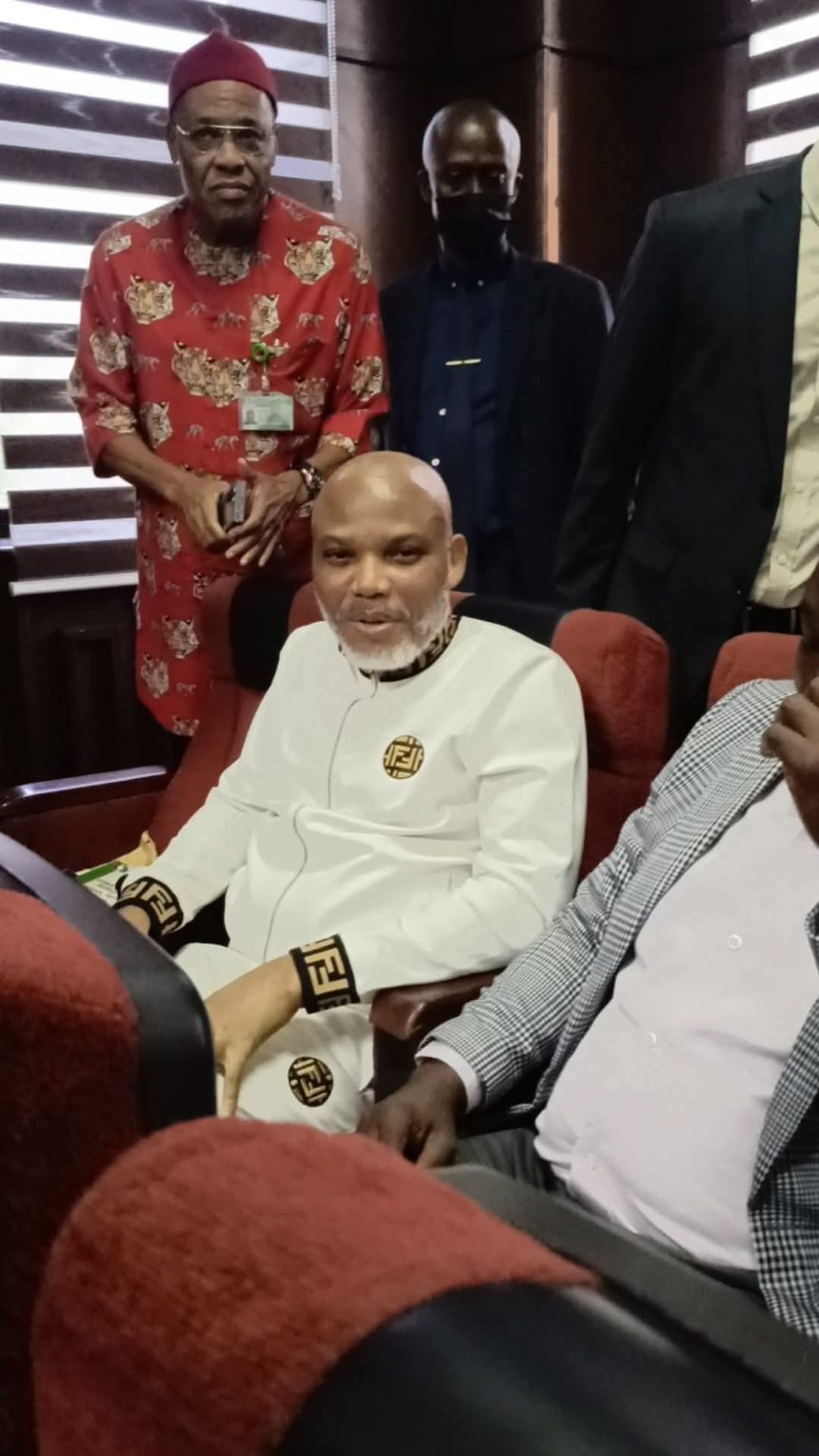
The detained leader of the Indigenous People of Biafra (IPOB), Nnamdi Kanu, has abandoned his earlier plan to present witnesses in his defense, insisting that there are no valid charges pending against him before the Federal High Court in Abuja.
At Monday’s proceedings before Justice James Omotosho, Kanu declared that after thoroughly reviewing the case file, he found “no legitimate charge” against him that warrants a defense.
He therefore informed the court that he would no longer be calling witnesses as earlier intended.
Kanu, who is facing terrorism-related charges brought by the Federal Government, is standing trial on an amended seven-count charge bordering on alleged acts of terrorism, incitement and promotion of secessionist activities.
The charges stem from his activities as the IPOB leader between 2015 and 2021, including alleged radio broadcasts calling for the disintegration of Nigeria and the creation of a sovereign Biafra State.
The IPOB leader was initially arraigned in 2015 before Justice Binta Nyako of the Federal High Court, Abuja, on a five-count charge bordering on treasonable felony.
After being granted bail in April 2017, he fled the country following a military invasion of his residence in Abia State later that year.
He was subsequently re-arrested in Kenya in June 2021 and extradited to Nigeria to face trial.
The charges were later expanded and amended in 2022, with the government accusing him of “knowingly promoting acts of terrorism” through his radio broadcasts and online communications.
However, in October 2022, the Court of Appeal in Abuja struck out several counts and discharged Kanu of terrorism charges, ruling that his extraordinary rendition from Kenya was unlawful.
The Federal Government subsequently appealed the decision to the Supreme Court, which in December 2023 overturned the Court of Appeal’s ruling, restoring the terrorism trial before the Federal High Court.
Since then, proceedings have continued with various legal arguments over the validity of the charges and the jurisdiction of the court.
Kanu’s latest position, that there are “no legitimate charges” against him appears to signal a strategic legal gamble aimed at forcing the court to either dismiss the case outright or compel the prosecution to justify its claims.
Justice Omotosho, in response, directed Kanu to file a written statement formally outlining his position and serve the document on the prosecution.
The judge also advised him to consult criminal law experts to fully understand the implications of refusing to present a defense.
The court adjourned proceedings to November 4th, 5th, and 6th, 2025, to allow both parties to file and adopt their final written addresses before a decision is made.
Kanu’s latest move could determine the next phase of one of Nigeria’s most politically charged trials, as the court will now decide whether the evidence presented so far establishes a prima facie case or if the prosecution has no valid grounds.