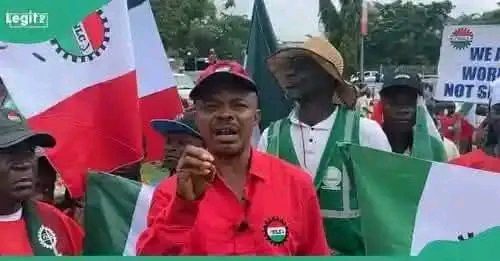
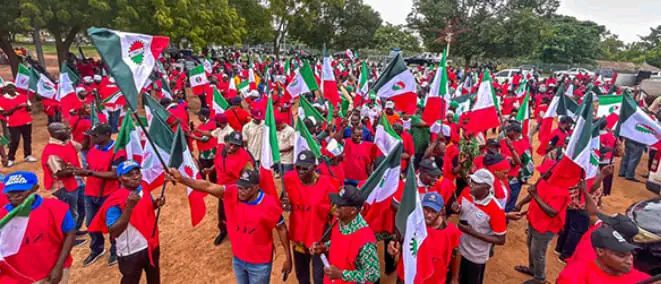
The Nigeria Labour Congress NLC, and the Federal Government workers have demanded an urgent review of the National Minimum Wage, insisting that the current N70,000 is no longer sustainable.
They made demand, following the bold steps taken by several states across the country, to increase the minimum wage of their workers above N70,000 benchmark, in response to the prevailing economic realities.
The labour unions and workers who spoke to News Agency of Nigeria in a separate interviews contended that, in the face of galloping inflation and rising cost of transportation, housing, and other essential services, the N70, 000 minimum wage could no longer sustain them.
It will be recalled that President Bola Ahmed Tinubu signed the new National Minimum Wage Bill into law in July 2024, raising the minimum wage from N30,000 to N70,000.
The amended law applies to the entire country, including the federal government, states, and local governments, and the private sector.
However, on August 27, 2025, Imo State increased the minimum wages from N70,000 to N104,000, along with corresponding increases in the entire salary structure for the state’s civil servants.
The State Governor, Hope Uzodimma, had said that the salary review arrived during a meeting with organized labour was part of efforts to improve the welfare of workers.
Before the bold and applauded step by Governor Uzodimma, some other states had implemented higher minimum wages for the workers.
On October 16, 2024, Governor Babajide Sanwo-Olu of Lagos State announced a minimum wage increase to N85,000, with a promise to further raise it to N100,000 in 2025.
Rivers State equally approved N85,000 minimum wage on October 18, 2024, while Bayelsa, Niger, Enugu, and Akwa Ibom approved N80,000 for their workers.
Ogun, Delta States are implementing N77,000 minimum wage, Benue, and Osun States raised the wage to N75,000, while Ondo State pegged its own at N73,000.
Acting General Secretary of the NLC, Mr. Benson Upah, told NAN on Sunday in Abuja that inflation has eroded the value of the N70,000 minimum wage, leaving many workers unable to meet basic needs.
“The truth is that N70,000 is not sustainable under the present economic situation.
“Workers are under immense pressure, and unless the government responds quickly, the crisis of survival will only be worsen.
“We have since engaged the Federal Government on this matter at different times and fora”, he said.
-9News Nigeria