By Princely Onyenwe
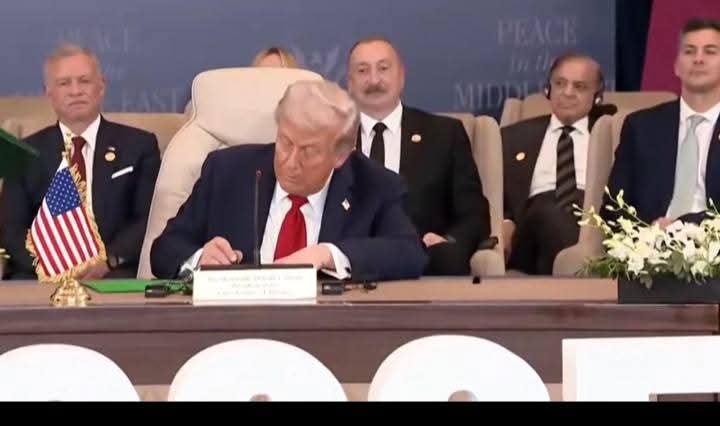
President Donald Trump and Iranian President Masoud Pezeshkian have signed a historic Memorandum of Understanding (MoU) aimed at ending months of hostilities between the United States and Iran, marking what could become one of the most significant diplomatic breakthroughs in the Middle East in recent years. The agreement was formally endorsed during a high-level engagement in Versailles, France, with French President Emmanuel Macron playing a key diplomatic role in facilitating the process.
The memorandum seeks to establish an immediate cessation of military operations between both nations and their allies, ending a conflict that has disrupted global energy markets, threatened international shipping routes, and heightened fears of a wider regional war. According to officials familiar with the agreement, the MoU is designed as a framework for a broader peace settlement expected to be negotiated over the next 60 days.
A major highlight of the agreement is the reopening of the strategically vital Strait of Hormuz, one of the world’s most important maritime corridors through which nearly one-fifth of global oil supplies pass. The closure and disruption of the waterway in recent months contributed to rising shipping costs, energy market instability, and concerns over global economic growth.
Under the terms of the memorandum, Iran has committed to restoring safe passage for commercial vessels through the Strait of Hormuz while the United States has agreed to ease certain restrictions tied to Iranian oil exports. Analysts say the reopening of the waterway could help stabilize crude oil prices and reduce inflationary pressures affecting economies across Europe, Asia, Africa, and the Americas.
The agreement also addresses concerns surrounding Iran’s nuclear programme. While a final settlement remains under negotiation, Tehran has reportedly reaffirmed its commitment not to develop nuclear weapons and has agreed to cooperate with international oversight mechanisms as discussions continue.
Officials from both countries described the memorandum as a confidence-building measure rather than a final treaty. The parties are expected to engage in intensive diplomatic talks in Switzerland over the coming weeks to convert the framework into a binding and enforceable international agreement.
Global financial markets reacted positively to news of the breakthrough. Oil prices fell sharply after investors interpreted the reopening of Hormuz and the prospect of increased Iranian oil exports as signs that energy supplies could normalize in the months ahead. Energy traders and economists have welcomed the development as a step toward restoring stability in global markets.
Despite the optimism, several analysts caution that the deal remains fragile. Key issues including sanctions relief, nuclear verification, regional security arrangements, and the role of Iranian-backed groups across the Middle East remain unresolved and could still complicate negotiations.
For President Donald Trump, the agreement represents a major foreign policy achievement and an opportunity to present himself as a peacemaker after months of escalating tensions. Iranian leaders have similarly portrayed the deal as a victory for diplomacy and national sovereignty.
If successfully implemented, the US-Iran Memorandum of Understanding could reshape the geopolitical landscape of the Middle East, ease pressure on global energy markets, and open a new chapter in relations between two nations whose rivalry has defined regional politics for more than four decades.
Meanwhile, the coming weeks will determine whether the Versailles agreement becomes a lasting peace accord or merely a temporary pause in a long-running conflict. Our readers will here more from our subsequent publications.
For inquiries on this news contact 9News Nigeria on +234 08036856526