- APC governors reject political alliances seen as threatening Tinubu’s 2027 bid
By Princely Onyenwe | Political Desk
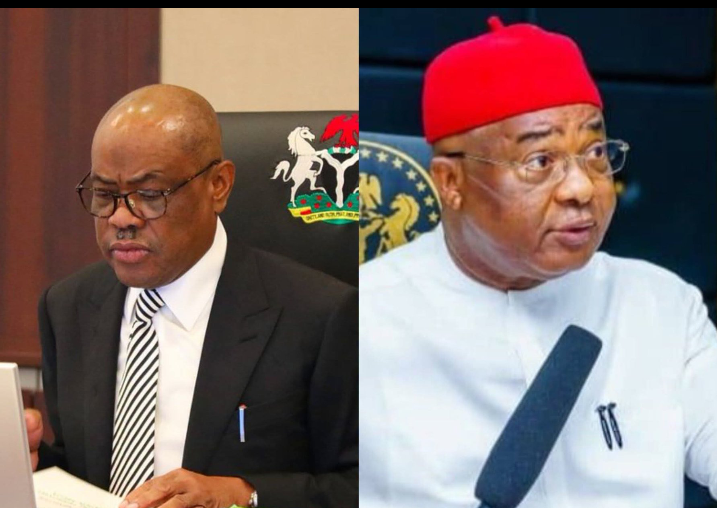
ABUJA — The political confrontation between Minister of the Federal Capital Territory, Nyesom Wike, and Imo State Governor and Chairman of the Progressive Governors Forum, Hope Uzodinma, has intensified following the APC governors’ rejection of political alliances they believe could undermine President Bola Tinubu’s 2027 re-election bid.
The latest exchange has placed Wike and Uzodinma at the centre of a widening political argument over party loyalty, political alliances and the role of APC governors in determining the direction of the party ahead of the 2027 general elections.
Wike has continued to defend his political engagements and his proposed “Rainbow Coalition,” insisting that his support for President Tinubu does not amount to support for APC candidates in other elections. Uzodinma, speaking as chairman of the Progressive Governors Forum, has maintained that APC governors will not support any arrangement capable of weakening the party or its candidates.
The development has generated sharp political reactions, with the central argument from the APC camp being that Wike should respect the position of the Progressive Governors Forum and concentrate on his responsibilities as FCT Minister rather than engage in an escalating confrontation with serving APC governors.
More importantly, the institutional responsibility currently carried by Uzodinma arguably surpasses Wike’s in political dimensions. Uzodinma is not merely speaking as an individual politician; he is an elected state governor and chairman of the forum representing APC governors across the country. His latest position was delivered on behalf of the governors after their meeting in Abuja.
Wike, by contrast, currently serves as Minister of the Federal Capital Territory in the Federal Government. His political influence is substantial, but his ministerial responsibility is principally executive and administrative, while Uzodinma simultaneously carries the constitutional responsibility of governing Imo State and the political responsibility of leading the collective forum of APC governors.
That distinction matters. Political disagreements are inevitable, but public office also carries institutional boundaries. A minister may pursue political interests and express support for a presidential candidate, but that does not automatically confer authority over elected governors or their party structures.
Uzodinma’s response therefore cannot reasonably be treated as merely a personal quarrel with Wike. The APC governors have formally taken a position, and Uzodinma, as their forum chairman, communicated that position publicly.
Wike has nevertheless escalated the exchange. In his latest response, he reportedly questioned Uzodinma’s political standing and said the Imo governor should consider himself fortunate that Wike is not a member of the APC.
That statement has further personalised an already sensitive political dispute while Imolites and south east politicians are calling on Minister Wike through 9News Nigeria medium to apply caution and respect Governor Hope Uzodinma’s responsibility in the stability and substance of governance delivery.
The issue now is whether the confrontation will remain a battle of political rhetoric or develop into a wider struggle involving the structures, candidates and alliances that will shape the 2027 elections.
Wike’s supporters maintain that his political engagements are legitimate and that his support for Tinubu should not require him to support every APC candidate. The APC governors, however, have made their own position clear: they intend to protect the party and its candidates while supporting Tinubu’s re-election bid.
For Wike, the FCT portfolio remains a major national responsibility. For Uzodinma, the responsibilities extend across Imo State governance and the collective political interests represented by the Progressive Governors Forum.
That difference in institutional responsibility should encourage restraint rather than endless political exchanges. However, the politicking stage has come, it will be advisable for Nigerian politicians to talk less and do more and for the electorates to vote wisely irrespective of party affiliations.
Wike has built a formidable political reputation over the years, while Uzodinma now occupies a position that places him at the intersection of state governance and the collective leadership of APC governors. Neither position requires personal hostility to make a political point.
As the 2027 political season gathers momentum, the wiser course would be for political actors to allow their respective institutions and mandates to speak for them. Wike can pursue his political convictions, while Uzodinma and the APC governors can defend their party’s candidates and structure.
The emerging lesson from the confrontation is simple: political influence does not erase institutional responsibility, and political disagreements should not become an excuse for disrespect between holders of public office.
For inquiries on this news report contact 9News Nigeria on +234 08036856526