By Princely Onyenwe | 9News Nigeria
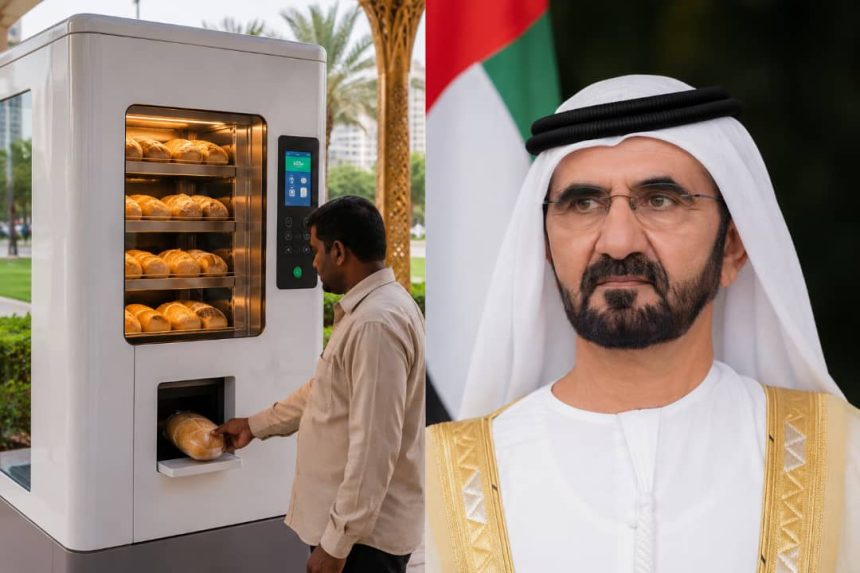
DUBAI, UNITED ARAB EMIRATES – Dubai’s innovative “Bread for All” initiative is attracting renewed international attention as smart vending machines continue to provide freshly baked bread free of charge to people in need, demonstrating how technology and compassion can combine to combat hunger while preserving human dignity.
Contrary to widespread social media claims that the programme is a government policy providing free bread to every resident, available information shows that the initiative is a targeted charitable programme established to support low-income workers, struggling families and other vulnerable members of society through a community-backed food assistance system.
Launched in 2022 under the Mohammed bin Rashid Global Centre for Endowment Consultancy (MBRGCEC) in partnership with the Awqaf and Minors Affairs Foundation and supported by Aswaaq supermarkets, the “Bread for All” project operates through smart vending machines strategically located across Dubai.
At the press of a button, the machines dispense freshly baked bread free of charge to those in need, while members of the public can also make donations through the machines or dedicated digital platforms to sustain the initiative.
Inspired by the vision of Sheikh Mohammed bin Rashid Al Maktoum, Vice President and Prime Minister of the United Arab Emirates and Ruler of Dubai, the programme was introduced to strengthen food security and social solidarity. During the COVID-19 pandemic, Sheikh Mohammed declared that no one in the UAE should sleep hungry, a vision that has continued to inspire humanitarian projects across the country.
Unlike many conventional welfare programmes, Dubai’s bread initiative removes much of the stigma often associated with seeking assistance. Beneficiaries are not required to complete lengthy application forms or publicly justify their circumstances. Anyone genuinely in need can simply approach the machine and receive fresh bread within minutes, while donors can contribute seamlessly to help sustain the programme.
The initiative has earned praise from humanitarian organisations and development experts as governments around the world continue searching for innovative ways to address rising food insecurity amid inflation, economic uncertainty and increasing living costs. The United Nations has consistently warned that hundreds of millions of people globally continue to face moderate or severe food insecurity, making community-driven interventions such as Dubai’s increasingly relevant.
For Nigeria and many African countries, the initiative offers valuable lessons. While governments continue investing in roads, bridges and other physical infrastructure, millions of vulnerable citizens still struggle to afford daily meals.
Carefully designed public-private partnerships involving governments, businesses, religious organisations and charitable foundations could complement existing social intervention programmes and help ensure that vulnerable households have access to basic food items in a manner that preserves dignity rather than dependency
Information gathered has it that the greatest strength of Dubai’s “Bread for All” initiative is not merely the distribution of bread but the demonstration that modern technology, philanthropy and responsible governance can work together to improve lives. In an era when many cities compete to build iconic skyscrapers and ambitious mega-projects, ensuring that no one goes to bed hungry may be among the most meaningful measures of genuine development.
As global conversations increasingly focus on poverty reduction, food security and sustainable development, Dubai’s free bread initiative continues to stand out as a practical example of how innovation and compassion can coexist. It also reinforces the principle that sustainable development is measured not only by economic growth but by how effectively societies care for their most vulnerable citizens.
Editor’s Note: Although Dubai’s “Bread for All” initiative is not a universal government entitlement for every resident, it represents an innovative model of charitable food assistance supported by government-affiliated institutions, businesses and public donations. As Nigeria continues to confront food inflation and rising living costs, similar community-based initiatives could complement existing social welfare programmes and strengthen the nation’s efforts to reduce hunger while preserving the dignity of beneficiaries.