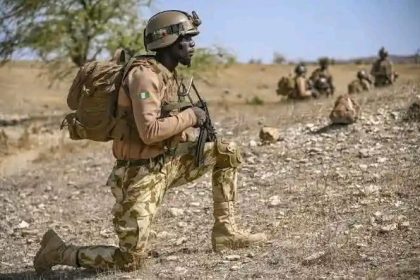
The Nigerian military has sends a strong warning to the Boko-Haram terrorist group, calling on them to surrender or face total elimination.
The theatre commander, Operation Hadin Kai, Major General A. E Abubakar said this during a press briefing on Tuesday in Maiduguri.
He said the remaining terrorists should surrender and benefit from the humane treatment being extended to those who have already laid down their arms.
However, the General has also confirmed a series of recent attacks by the terrorists in the Northeast region, including in Rann, Dikwa, and Gajiram communities of Borno State.
He said that the military has been restrategizing it’s operations in an effort to tackle the situation, noting that the terrorists’ recent attacks are mere propaganda to portray themselves as still relevant and a threat.
This is coming after the recent resurgence of Boko-Haram terrorists’ activities in the northeast, where they have so far carried multiple attacks on vulnerable communities as well as military formations.
“In the last 2 months, we have been re-strategizing and reorganising. The COAS was here just a week ago and several changes have been made in theatre. I am one of such changes, having just taken over command 3 weeks ago.
“Additional platforms and personnel are being inducted into the theatre. What the terrorists have resorted to doing is carrying out multi pronged attacks on several isolated and vulnerable deployments, and using it as propaganda which is why we are also reviewing our deployments.
“Yesterday alone, there were attacks in Rann, Dikwa and Gajiram. All these attacks were defeated apart from Rann where they succeeded in penetrating to an extent, leading to the loss of 4 personnel,” General Abubakar explained.
While assuring the public of the military’s commitment to eradicating terrorism in the region, the commander explained that these recent incidents are not indicative of a resurgence of the insurgents to their former strength.
He pointed to the deteriorating security situation in the greater Sahel region as a major factor contributing to the resurgence of attacks.
He said that the ransacking of barracks and the subsequent proliferation of weapons across Nigeria’s porous borders are also re-energizing the terrorists’ capabilities.
According to him, the military observed a concerning adaptation in the terrorists’ tactics, particularly the introduction of armed drones for attacks since November of last year.
The noted the difficulty in detecting these drones using conventional radar technology, drawing a parallel to their use in conflicts like those in Israel and Ukraine.
“Two years ago, we were ready to say that the conflict was over, but the deterioration in the security among Sahel states has also affected us,” he said.
He equally underscored the complex nature of the conflict and the vast operational area, citing the Timbuktu Triangle, an area larger than Rivers and Osun States combined, as an example of the challenging terrain.
General Abubakar however, emphasized that significant progress has been made in restoring normalcy compared to the situation of five to ten years ago, citing the return of nearly 20,000 Internally Displaced Persons (IDPs) to Malam Fatori and Kukawa as recent successes.
Highlighting the ongoing operations across multiple fronts, he stated that over 20 terrorists were neutralized and arms recovered last week, while reiterating the military’s firm resolve to achieve a decisive victory against terrorism in the shortest possible time.
He also highlighted the improved morale of the troops due to recent welfare initiatives implemented by the military leadership.
Similarly, the Chief of Army Staff had recently visited the theatre, leading to several changes in operational command, including the assumption of duty by the current Theatre Commander three weeks ago.
Additional personnel and equipments were also deployed to the region.
While calling on the general public to support the fight against terrorism, General Abubakar noted that security is a collective responsibility, echoing the need for citizens to actively assist the military in identifying and apprehending insurgents.
He cited the recent interception of 13,000 litres of PMS destined for terrorist enclaves as an example of the crucial role community vigilance plays in disrupting terrorist activities.