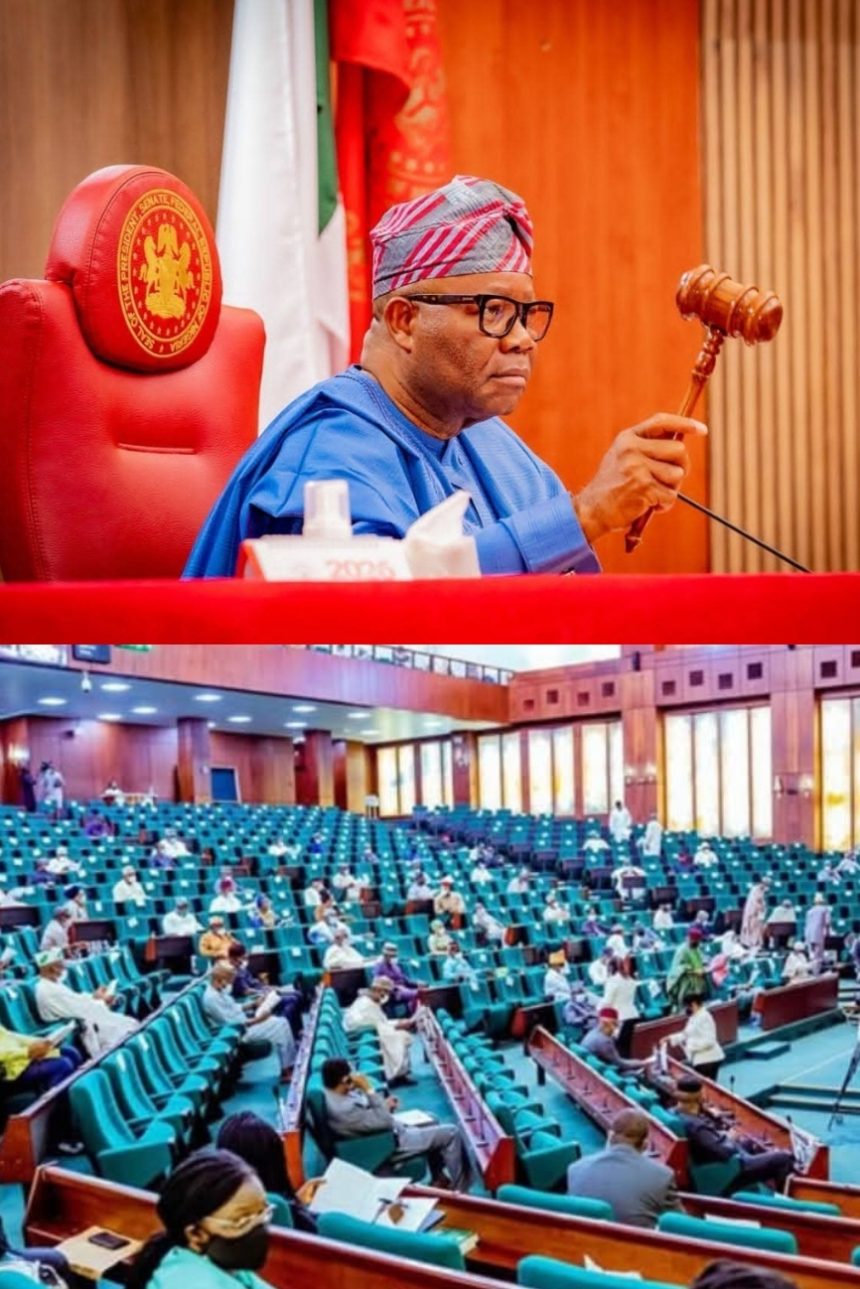
The National Assembly under the leadership of Senate President Godswill Akpabio has emerged as Nigeria’s least trusted public institution, overtaking the Nigeria Police Force, according to the 2026 Social Cohesion Report released by the Africa Polling Institute (API).
The report, presented during a National Social Cohesion Dialogue in Abuja, revealed that 77 per cent of Nigerians expressed little or no confidence in the National Assembly, placing the federal legislature at the bottom of the nation’s institutional trust rankings.
The findings come amid public scrutiny of the performance, cost and activities of lawmakers under the current leadership of the 10th National Assembly.
Presenting the report, API Executive Director, Prof. Bell Ihua, disclosed that Nigeria’s Social Cohesion Index rose to 48.8 per cent, representing a two-point improvement from the previous survey and the highest level recorded since the assessment began.
Despite the improvement, the report noted that the country’s social cohesion level remains below the 50 per cent benchmark regarded as a sign of strong national unity and stability.
The survey further showed that 72 per cent of Nigerians expressed little or no trust in President Bola Tinubu’s administration, while 73 per cent said they had limited confidence in the judiciary.
Religious and traditional institutions ranked higher in public trust, with 51 per cent and 45 per cent of respondents respectively expressing confidence in them.
The API survey, conducted between January and February 2025 with support from the Ford Foundation, involved 5,315 Nigerians aged 15 and above across all states and senatorial districts through face-to-face interviews conducted in English, Pidgin, Hausa, Igbo and Yoruba.
The report showed that 46 per cent of Nigerians said they were proud of their national identity, while 44 per cent identified equally with both their ethnic group and Nigeria. Another 29 per cent said they felt more attached to their ethnic identity than the country.
On civic responsibility, 71 per cent of respondents said they were willing to make sacrifices for Nigeria’s collective interest, while 77 per cent expressed readiness to work with people from different ethnic backgrounds to promote unity.
The survey also highlighted support for gender inclusion, with 69 per cent of Nigerians agreeing that women should occupy leadership positions in politics and business, while 60 per cent said they would support a female presidential candidate.
However, concerns over national division remain high, as 48 per cent of respondents believed Nigeria is more divided now than four years ago. Political differences were identified as the major source of division, followed by ethnic and religious tensions.
On migration, 55 per cent of Nigerians said they would relocate abroad with their families if given the opportunity, although 61 per cent remained hopeful that the country’s future would improve.
The institute recommended the creation of a National Social Cohesion Commission and the establishment of Social Cohesion Desks across government ministries, departments and agencies to strengthen national unity, improve public trust and promote peaceful coexistence.