By Obinna Ejianya (9News Nigeria – Melbourne, Australia)
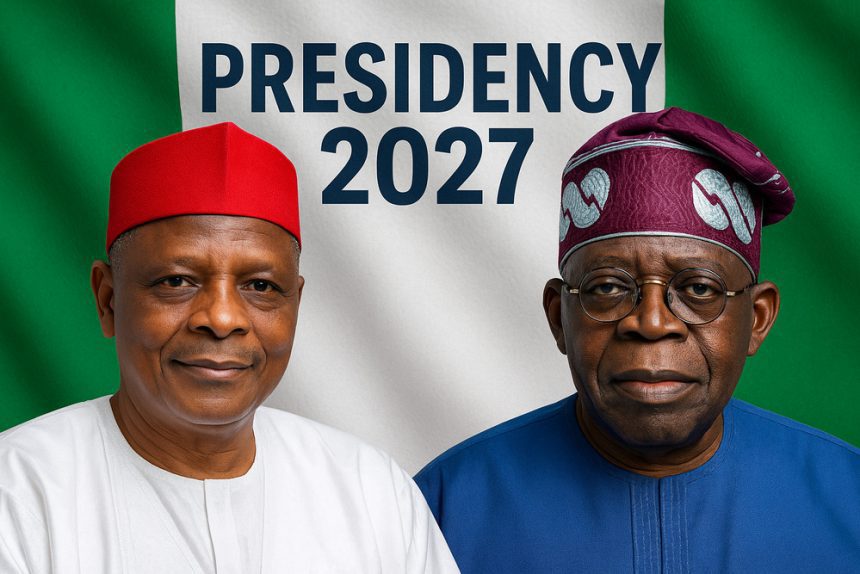
Though Nigeria remains two years away from the 2027 general elections, President Bola Ahmed Tinubu is already laying the political chessboard for a second-term victory — and this time, he is determined to avoid the stiff opposition and close margins that defined his 2023 contest. Haunted by the challenge mounted by Peter Obi and the disruptive energy of the Obedient Movement, Tinubu is making bold moves to eliminate any surprises ahead. At the heart of this strategy is Kano — a crucial northern stronghold with nearly six million registered voters — and a controversial, calculated sacrifice: the removal of APC National Chairman, Abdullahi Ganduje.
Ganduje, 75, tendered his resignation from the APC chairmanship on June 27, 2025, officially claiming it was to attend to health matters. But insiders close to the presidency and APC hierarchy suggest the resignation was anything but voluntary. Investigative findings by 9News Nigeria and corroborated by other political observers point to a behind-the-scenes push from President Tinubu himself, who allegedly saw Ganduje as an obstacle to a broader and more pragmatic electoral strategy.
The core of that strategy lies in wooing Rabiu Musa Kwankwaso, the red-cap-wearing political juggernaut who leads the New Nigeria Peoples Party (NNPP) and commands a fanatical following across Kano and parts of the North. In 2023, Kwankwaso’s NNPP decimated the APC in Kano State, taking nearly all the major elective offices and reaffirming Kwankwaso’s political dominance in the region. Tinubu, who barely secured a national victory in that cycle, cannot afford a repeat of that scenario.
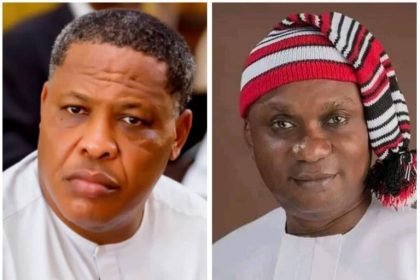
Thus, removing Ganduje — Kwankwaso’s longtime rival — became the first step in Tinubu’s broader reconciliation efforts. Their feud is deep-rooted, personal, and highly public. Kwankwaso, once Ganduje’s political godfather, watched as Ganduje rose to power and eventually turned against him, culminating in years of acrimony, sabotage, and political hostilities. As national chairman, Ganduje was said to have blocked all attempts at reconciling with Kwankwaso or forming any coalition with the NNPP — a stance that became increasingly unacceptable to a President intent on securing Kano at all costs.
But while Tinubu’s move to sideline Ganduje may have opened the door to negotiations, it has not — at least not yet — brought Kwankwaso through it. This is where the President’s political gamble begins to look uncertain. Despite swirling speculation in political circles and overtures from APC leaders, Kwankwaso has not declared any intention to rejoin the APC or form a formal coalition with Tinubu. In fact, multiple statements from the NNPP have flatly denied any plans of defection or alignment.
In a report by Vanguard on June 27, APC insiders confirmed that the party was keeping the door open for Kwankwaso to return, but admitted he had not made any formal move in that direction. Meanwhile, Punch Newspaper quoted the Kano NNPP chairman dismissing defection rumours entirely, asserting that there was no dialogue or agreement underway. Just this week, Daily Post quoted another senior NNPP source as saying unequivocally that “Kwankwaso is not returning to the APC,” stressing that their movement remains independent and focused on its political vision.
This uncertainty casts a shadow over the entire strategy. Tinubu has effectively sacrificed one of his most loyal northern allies, Ganduje — a man who stood firmly with him through the bruising 2023 primaries and general elections — in anticipation of an alliance that remains unconfirmed. Within the APC, particularly among core northern stakeholders and Ganduje loyalists, there is growing unease. Many see the move as not only premature but potentially damaging to the party’s internal cohesion. Ganduje, despite his controversies and corruption allegations, still commands respect among many APC faithful in the north, and his forced exit has unsettled that faction.
Moreover, the optics of appearing to appease Kwankwaso — a former adversary who still leads a rival party — without concrete assurances of defection or coalition, leaves Tinubu politically exposed. If Kwankwaso refuses to cooperate, or worse, uses the APC’s internal crisis to strengthen his own base ahead of 2027, Tinubu’s gamble could backfire spectacularly. He may find himself not only without Kano but also with a fractured APC in the North, weakened by disillusionment and betrayal narratives.
There is also the matter of Vice President Kashim Shettima. Rumours abound that the Tinubu camp may be reconfiguring the 2027 ticket, possibly dangling the VP slot as bait for Kwankwaso. If true, this would add another layer of complication — alienating yet another power base within the APC that supported Tinubu’s rise in 2023.
For now, the President’s political play remains a high-stakes gamble. He has moved decisively to remove internal obstacles and create space for strategic partnerships. But with Kwankwaso yet to step into that space, and party loyalists still reeling from Ganduje’s ouster, the outcome is anything but certain. If Kwankwaso ultimately embraces the alliance, Tinubu may go into 2027 with a formidable northern bloc. But if the courtship fails, the President risks walking into re-election with a deeply fractured base and no guaranteed access to Kano’s six million votes.
In the unforgiving world of Nigerian politics, such gambles either end in brilliance or backfire. The coming months will reveal whether Tinubu’s sacrifice of Ganduje was the price of victory — or the cost of overreach.
By Obinna Ejianya (9News Nigeria – Melbourne, Australia)