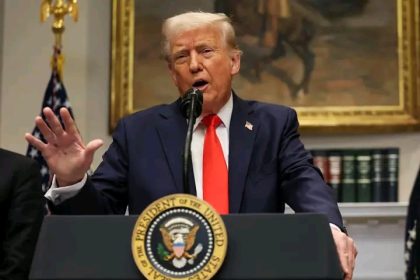
U.S. President Donald Trump’s recent tariff announcement represents a significant shift in U.S. trade policy, with far-reaching implications for global markets and international relations. As countries respond to these tariffs, the potential for a trade war looms large, raising concerns about the future of global trade dynamics
On April 2, 2025, President Trump unveiled a sweeping new tariff policy that is poised to significantly alter the landscape of international trade. This policy, termed “reciprocal tariffs,” introduces a baseline tariff of 10% on all imports, with additional steep rates imposed on specific countries. The announcement has sent shockwaves through global markets and raised concerns about the potential for a trade war, affecting countries across Africa, Australia, Europe, and beyond.
Key Details of the Tariff Announcement
- Baseline Tariff: The new policy establishes a 10% baseline tariff on all imports to the United States. This marks a significant shift from previous tariff structures and is intended to level the playing field for American manufacturers.
- Country-Specific Tariffs: In addition to the baseline rate, the policy imposes higher tariffs on certain countries:
- China: A total tariff rate of 54%, which includes an additional 34% on top of existing tariffs.
- European Union: A 20% tariff on imports from EU countries.
- Vietnam: A 46% tariff.
- Taiwan: A 32% tariff.
- Australia: A 10% tariff, which has drawn significant criticism from Australian officials.
- African Countries: Countries like Lesotho face a staggering 50% tariff, while others may see varying impacts depending on their trade relationships with the U.S.
- Rationale Behind the Tariffs: President Trump framed the tariffs as a necessary measure to protect American jobs and industries, claiming that the U.S. has been “ripped off” by unfair trade practices for decades. He emphasized that the tariffs are not just economic tools but also a matter of national security.
Immediate Market Reactions
The announcement led to a sharp decline in U.S. stock markets, with Dow futures dropping over 900 points (approximately 2.19%) in after-hours trading. Major companies such as Apple, Tesla, and Amazon saw significant declines in their stock prices, reflecting investor concerns about the economic impact of the new tariffs.
Analysts described the situation as “worse than the worst-case scenario” that had been anticipated prior to the announcement [1].
Global Reactions and Implications
European Union
European Commission President Ursula von der Leyen condemned the tariffs, labeling them a “major blow to the world economy.” She warned that the tariffs would disproportionately affect vulnerable populations, leading to increased costs for essential goods such as groceries and medicines. The EU has expressed readiness to negotiate but is also prepared to implement countermeasures against U.S. goods.
Australia
Australia has been particularly vocal in its opposition to the new tariffs. Prime Minister Anthony Albanese criticized the 10% tariff as “totally unwarranted,” arguing that it undermines the strong trade relationship between the two nations. He stated that Australia would not retaliate with its own tariffs, emphasizing a desire to avoid escalating trade tensions. However, he warned that the tariffs could have significant consequences for how Australians perceive their ties with the U.S.
The Australian National Farmers’ Federation expressed “profound disappointment” over the tariffs, stating that they create “unnecessary uncertainty” for the agricultural sector, which relies heavily on exports to the U.S.
African Countries
The impact of Trump’s tariffs on African nations varies significantly. Countries like Lesotho, which exports textiles to the U.S., face a staggering 50% tariff, which could cripple their economy. Other nations may experience varying impacts depending on their trade relationships with the U.S. For instance, South Africa, which has a more diversified trade portfolio, may not be as severely affected but still faces challenges due to the overall economic climate created by the tariffs.
Asian Markets
Asian markets reacted negatively, with significant declines observed in countries heavily reliant on exports to the U.S. South Korea’s government has initiated measures to support affected industries, particularly automakers. China’s commerce ministry has vowed to take “resolute countermeasures” to protect its interests, although specific actions have not yet been detailed.
Other Countries
- United Kingdom: The U.K. government expressed hope for a trade deal to mitigate the impact of the tariffs, emphasizing the importance of maintaining strong ties with the U.S.
- Brazil: The Brazilian government is considering taking the issue to the World Trade Organization (WTO) and has passed a bill allowing for retaliatory measures against countries imposing tariffs on Brazilian goods.
Economic Forecasts
Economists predict that Trump’s new tariffs could disrupt global supply chains, increase inflation, and hinder economic growth. The tech sector, in particular, is expected to be adversely affected due to its reliance on international supply chains, especially those involving China.
The uncertainty surrounding these tariffs is likely to lead to increased market volatility as investors reassess the potential economic fallout.
GDP Impacts
A recent analysis indicates that the tariffs could decrease U.S. GDP by approximately $438.4 billion (1.45%), translating to a loss of about $3,487 per household annually. Other countries, particularly those that export a significant portion of their goods to the U.S., are also expected to experience GDP declines. For example, Mexico could see a 2.24% decrease, while Canada might face a 1.65% drop.
Countries that face relatively high U.S. tariffs and ship a large proportion of their exports to the U.S. experience the largest proportional decreases in GDP. These include Canada, Mexico, Vietnam, Thailand, Taiwan, Switzerland, South Korea, and China. Conversely, countries that face relatively low new tariffs, such as New Zealand and Brazil, may experience slight GDP increases.
The full impact of these tariffs will unfold in the coming months, as nations navigate the complexities of retaliatory measures and economic adjustments.