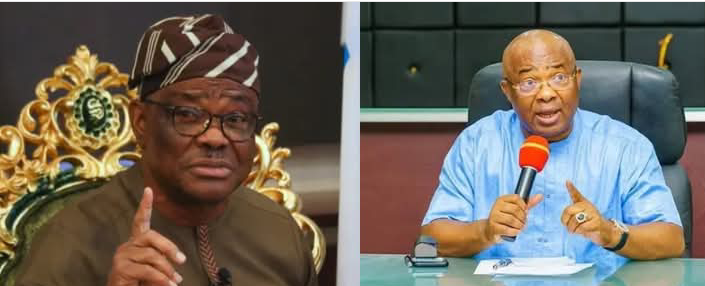
- Wike’s clash with Uzodinma may have opened a wider battle with APC Governors
By Princely Onyenwe | Editorial Desk
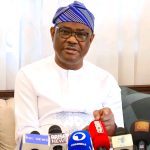
The latest war of words between Minister of the Federal Capital Territory, Nyesom Wike, and Imo State Governor Hope Uzodinma may appear to be another episode in Nigeria’s familiar political drama, but beneath the rhetoric lies a potentially consequential struggle over who will shape the political direction of the 2027 election. Wike fired back at Uzodinma after the Imo governor, speaking as Chairman of the Progressive Governors’ Forum, made it clear that APC governors would not support any political arrangement capable of undermining President Bola Ahmed Tinubu’s re-election bid.
Wike responded in his characteristic combative style, questioning Uzodinma’s electoral pedigree and arguing that politics is no longer about coming from fourth place to become governor, but about mobilisation and winning votes at the polling units. There is political history behind the argument. Uzodinma’s emergence as Imo governor followed the Supreme Court’s 2020 decision that overturned Emeka Ihedioha’s election and declared Uzodinma the rightful winner of the 2019 governorship contest, while he subsequently secured re-election in 2023. Yet the bigger question is whether Wike has chosen the wrong political battle at the wrong time.
Hope Uzodinma is no longer merely defending his personal electoral record. As Chairman of the Progressive Governors’ Forum, he speaks from an institutional platform representing APC governors, many of whom have a direct political stake in the 2027 elections. The forum’s position is now clear: its members want to protect Tinubu’s re-election project while strengthening APC structures and candidates across the country. Wike’s Rainbow Coalition therefore presents a complicated proposition for the ruling party because he insists that supporting Tinubu for president does not necessarily mean supporting every APC candidate contesting governorship and legislative elections.
That is the fundamental fault line. Wike wants to retain his political independence while helping secure Tinubu’s return to the presidency, whereas APC governors naturally want an arrangement that protects not only the President but also the party’s candidates and structures. In practical electoral terms, supporting a presidential candidate while remaining free to influence contests against that candidate’s party creates an uncomfortable political equation. It is therefore unsurprising that APC governors would resist any coalition capable of becoming a parallel political machinery around an incumbent president.
Few politicians in contemporary Nigeria possess Wike’s record of political survival and influence. His role in the G5 governors’ revolt before the 2023 election demonstrated his ability to disrupt established political calculations, while his decision to support Tinubu despite remaining in the PDP showed that he could operate beyond conventional party boundaries. But 2027 is not 2023. Tinubu is now an incumbent president seeking re-election, the APC controls the federal government, and the ruling party has an extensive network of governors, legislators and political structures across the country. The terrain Wike must navigate has therefore changed considerably.
This makes his confrontation with Uzodinma potentially more consequential than an ordinary exchange of political insults. Wike is confronting a governor operating from the institutional platform of the Progressive Governors’ Forum, with the political interests of APC governors tied to the outcome. If he turns his disagreement with Uzodimma into a sustained confrontation with the governors as a bloc, he could inadvertently strengthen the very political establishment he hopes to influence. Elections are rarely won by rhetoric alone; they are won through structures, alliances, mobilisation, candidates and votes.
This is why reactions that the confrontation could “retire Wike” politically should not simply be dismissed, although it would be premature to declare him finished. Nigerian politics has repeatedly shown that politicians written off at one moment can return with renewed influence, and Wike himself has survived political battles that many expected him to lose. Political retirement, however, does not necessarily mean losing an election. It can also mean losing the capacity to dictate political outcomes, broker alliances and determine the direction of events.
That is the real test before Wike as 2027 approaches. If the Rainbow Coalition becomes a formidable political force capable of influencing the presidential, governorship and legislative contests, Wike could emerge from the election as one of Nigeria’s most consequential political power brokers. But if the coalition fails to build sufficient structure while APC governors remain firmly aligned behind Tinubu and the party’s candidates, Wike could discover that personal networks and political charisma have limits when confronted by a coordinated institutional structure.
Uzodinma, therefore, does not necessarily need to defeat Wike in a war of words. His greater advantage is the institutional platform from which he is operating and the network of governors whose interests converge around the APC’s 2027 strategy. Wike understands better than most Nigerian politicians that elections are ultimately about votes, mobilisation and structures. The coming election will provide the clearest test yet of whether his personal political influence can overcome a more coordinated political establishment.
For now, neither Wike nor Uzodinma has won this battle, and declaring Wike politically finished would be premature. But by attacking the Chairman of the Progressive Governors’ Forum, Wike may have transformed what could have remained a disagreement between two influential politicians into a broader confrontation with an organised bloc of governors. If that confrontation deepens, the question may no longer be whether Wike can influence the 2027 election, but whether the 2027 election will mark the beginning of the end of his extraordinary ability to influence Nigerian politics. That is the war Wike must be careful not to lose.