- As Nigeria simmers at home, what exactly is the President doing in Paris?
By Princely Onyenwe | Editorial Desk
ABUJA — President Bola Ahmed Tinubu is in France, but Nigeria has not stopped moving, and that is precisely why his Paris sojourn deserves more than the usual photographs, diplomatic courtesies and carefully worded presidential statements. Tinubu arrived in Paris on September 13 for the second leg of his three-week annual leave in Europe, after spending the first part of the vacation in London. The Presidency had earlier said he would return to Abuja after the leave to join preparations for the January 2027 election.
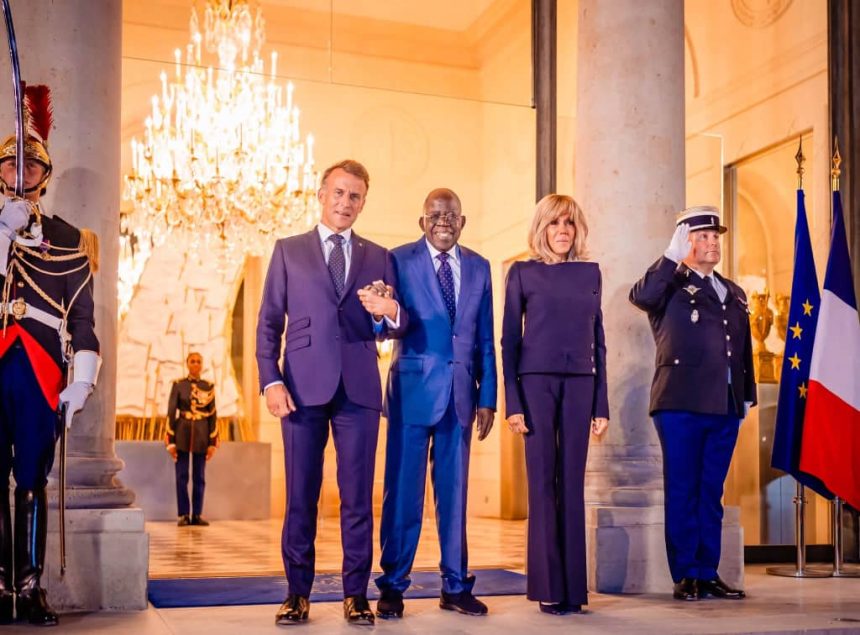
The latest publicised engagement came on Thursday night when French President Emmanuel Macron received Tinubu for a private dinner at the Élysée Palace. According to the Presidency, the meeting reflected the longstanding relationship between Nigeria and France and their shared commitment to strengthening bilateral cooperation. That relationship carries substantial economic weight, with Nigeria-France bilateral trade reaching $4.7 billion in 2025, while Nigeria remains the top destination for French investment in sub-Saharan Africa, according to the State House.
But Nigerians are entitled to ask a straightforward question: what exactly is President Tinubu’s programme in France beyond the private dinner and his annual leave? That question is not an accusation that the President should never travel, nor does it suggest that every presidential engagement must take place in Abuja. It is a legitimate question of public accountability at a moment when Nigeria is dealing with serious economic, security and political pressures.
That question has become even more compelling because the International Chamber of Commerce arbitration tribunal sitting in Paris delivered a major ruling in Nigeria’s favour over the long-running Mambilla power dispute during the President’s stay in the French capital. The tribunal rejected claims with a combined value of about $3.38 billion brought by Sunrise Power and Transmission Company Limited in disputes connected to the project. The tribunal also ordered Sunrise and its promoter to reimburse Nigeria for legal fees and expenses, with reports putting the relevant amount at about $11.8 million.
That is a significant development. A potential financial exposure running into billions of dollars could have imposed a substantial burden on Nigeria, while the Mambilla project itself has remained stalled for years. The arbitration victory therefore deserves recognition, but recognition should not end with celebration. The more important question is what the victory now unlocks for Nigerians in terms of electricity generation, project financing, construction and eventual delivery.
President Tinubu described the ruling as removing the biggest legal hurdle that had hindered the long-delayed Mambilla Hydroelectric Power Project. The project is now associated with an intended capacity of about 1,500 megawatts after its scope was subsequently reduced and rescaled. If the arbitration ruling has genuinely removed the principal legal obstacle, the Federal Government now has an opportunity to demonstrate that a legal victory in Paris can eventually become additional electricity in Nigerian homes, businesses and industries. That is the measurable outcome Nigerians should ultimately demand.
There is also a political dimension to the President’s presence in France that cannot be ignored. The confrontation between FCT Minister Nyesom Wike and APC governors over the Rainbow Coalition and the emerging 2027 political realignment has continued to generate tension. The PUNCH reported on Friday that a senior presidential aide said Tinubu was expected to intervene and possibly broker a settlement while abroad. Because the information came from an unnamed aide who said the President was expected to engage the parties, and has not been announced as a formal item on the President’s official programme, it should be treated as a reported possibility rather than a confirmed presidential assignment.
Nevertheless, the possibility is politically significant. Tinubu is both President of the Federal Republic of Nigeria and leader of the ruling APC. When disagreements involving a serving federal minister and governors of the governing party become increasingly public, the question of presidential intervention naturally arises, particularly as the country moves closer to another election cycle. If the President is using his time abroad to engage the contending sides, Nigerians will ultimately look for evidence that such intervention produces greater political stability rather than another round of political declarations.
Another issue has added to the public conversation surrounding the President’s absence. While Tinubu was in France, Vice President Kashim Shettima was in India representing the President at the 18th BRICS Leaders’ Summit. Shettima participated in high-level sessions and held bilateral discussions, including with Indian Prime Minister Narendra Modi, on trade, investment, crude oil, pharmaceuticals, defence, digital technology, fintech and renewable energy. He subsequently returned to Nigeria on September 15.
The constitutional question should, however, be separated from the political debate. The fact that the President and Vice President were temporarily outside Nigeria did not automatically create a vacancy in either office, nor did it mean that the Senate President simply assumed presidential authority. Section 145 provides for the transmission of a written declaration when the President proceeds on vacation or is otherwise unable to discharge his functions, while Section 146 addresses actual vacancy in the offices of President and Vice President.
The deeper concern is about leadership visibility at a time when Nigerians are demanding answers on several fronts. The country continues to confront insecurity, economic hardship, unemployment, infrastructure deficits and political tensions, while preparations for the 2027 elections are already shaping national political conversations. A President has every legitimate reason to travel for diplomacy, official engagements or rest, but public office also carries an obligation to communicate clearly what such engagements are expected to deliver for the country.
That is why the Presidency should give Nigerians more than photographs and general statements whenever major international engagements take place. If the Macron dinner is opening new opportunities in trade, investment, energy or security, Nigerians should know. If the Mambilla arbitration victory has finally cleared a major legal obstacle to a long-delayed power project, Nigerians should be given a credible roadmap. And if the President is genuinely working to calm the political dispute involving Wike and APC governors, Nigerians should understand the objective and, eventually, the outcome.
President Tinubu may be on annual leave, but Nigeria itself is not on leave. The country continues to face its challenges, and government continues to bear responsibility for addressing them whether the President is physically in Abuja, Paris, London or elsewhere. That reality makes public communication even more important, particularly when major national issues continue to unfold at home.
The question, therefore, should not simply be whether President Tinubu has a right to be in France. He does. Nor should the debate be reduced to whether every foreign engagement is beneficial or every period of annual leave is justified. The more useful question is what Nigeria is gaining from the President’s presence in France at this particular moment, and whether those gains will become visible in the lives of Nigerians.
When Tinubu eventually returns to Abuja, Nigerians will look beyond the photographs from the Élysée Palace. They will want to know what the diplomatic engagement produced, what the Mambilla victory means for the stalled project, whether the political tensions at home have been reduced and, more broadly, whether the President’s time abroad generated outcomes capable of justifying the attention surrounding the trip.
Because expectedly, presidential travel should not be measured merely by the distance covered or the dignitaries encountered. It should be measured by what comes home with the President — in investment, diplomacy, electricity, political stability and tangible national results.