By Princely Onyenwe | Political Desk
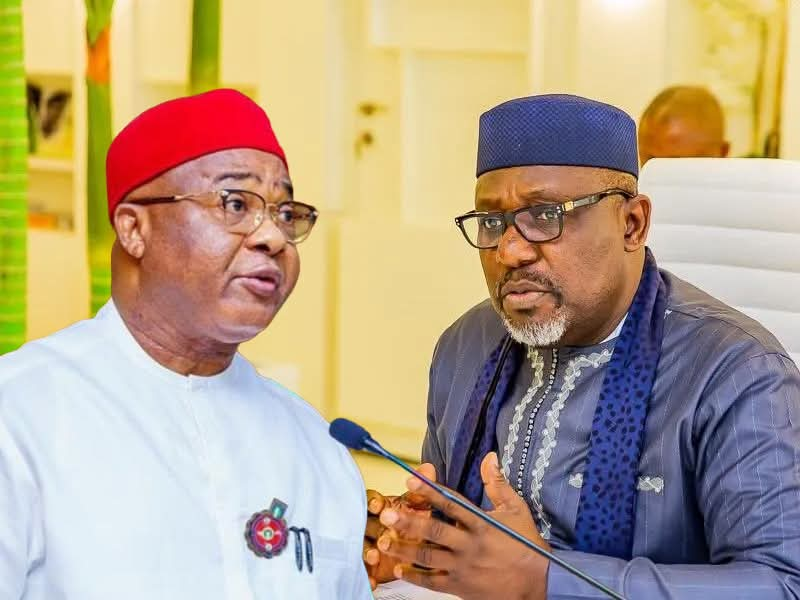
OWERRI, IMO STATE – The political contest between Imo State Governor, Senator Hope Uzodinma, and his predecessor, Senator Rochas Okorocha, over the All Progressives Congress (APC) ticket for Imo West Senatorial District has entered another critical phase following a Federal High Court judgment recognising Okorocha as the winner of the party’s May 18, 2026, senatorial primary.
The judgment, delivered on Thursday, October 29, 2026, by Justice Obiora Egwuatu of the Federal High Court, Abuja, nullified Uzodinma’s nomination as the APC candidate and directed the Independent National Electoral Commission (INEC) to recognise and publish Okorocha’s name as the party’s duly nominated candidate for the January 16, 2027, senatorial election.
The court also restrained Uzodinma from parading himself as the APC candidate for the district, holding that the evidence presented before it established that Okorocha secured the majority of votes cast in the disputed primary.
The legal battle, instituted by Okorocha in suit number FHC/ABJ/CS/1854/2026, followed conflicting accounts of the outcome of the primary election and disagreements over the reports submitted by officials who monitored the exercise.
According to court documents reported by the media, Okorocha’s camp claimed that the former governor secured 150,780 votes against Uzodinma’s 102,158 votes. However, the governor’s camp presented a different result, claiming that Uzodinma won with 230,464 votes while Okorocha scored 1,098 votes.
The conflicting figures became central to the legal dispute, with the court ultimately accepting the evidence supporting Okorocha’s claim and granting the reliefs sought in his suit.
However, the judgment has not ended the political controversy. The Imo State Government has rejected the decision and announced plans to challenge it at the Court of Appeal.
The Commissioner for Information, Public Orientation and Strategy, Declan Emelumba, described the judgment as a miscarriage of justice, arguing that the trial court failed to follow established judicial principles. He also questioned the procedure adopted in determining issues surrounding the disputed primary.
Similarly, the Imo APC chapter has maintained that Uzodinma remains its candidate, insisting that the governor won the party’s primary. The party’s position, communicated through its Publicity Secretary, Onwuasoanya FCC Jones, indicated that its legal department would study the judgment before determining its next action.
The disagreement has therefore created an unusual situation in which the Federal High Court has directed INEC to recognise Okorocha, while the state chapter of the APC continues to affirm Uzodimma’s candidacy.
Beyond the legal contest, the dispute has reopened questions about the political relationship between the two former allies, whose rivalry has continued to shape the political landscape of Imo State.
Okorocha governed Imo State between 2011 and 2019 before representing Imo West in the Senate from June 2019 to June 2023. Uzodinma, who also previously represented the district in the Senate, became governor in January 2020 and secured a second four-year tenure in the November 2023 governorship election, beginning his second term in January 2024.
Another significant dimension of the controversy is the constitutional implication of Uzodimma’s senatorial ambition. His current governorship tenure is expected to run until January 2028, while the 11th National Assembly is scheduled to commence in June 2027. Consequently, should he eventually secure the senatorial ticket and win the election, questions surrounding the constitutional requirements for leaving his governorship position would become relevant.
For the people of Imo State, particularly residents of the 12 local government areas that constitute Imo West Senatorial District, the bigger concern should be the implications of this prolonged political confrontation for effective representation, democratic accountability and development.
The district continues to face expectations around federal infrastructure, employment opportunities, education, healthcare, security and economic empowerment. These are issues that require sustained legislative attention, irrespective of the individual occupying the senatorial seat.
The people also deserve clarity on the circumstances surrounding the disputed primary election. How could two completely different sets of figures emerge from the same exercise, with one account giving Uzodimma 230,464 votes against Okorocha’s 1,098, while the other credits Okorocha with 150,780 votes against Uzodimma’s 102,158?
Such discrepancies raise important questions about transparency, documentation and credibility in political party nomination processes.
While both political camps are entitled to pursue their legal and political interests within the law, the people of Imo should not become spectators in a political contest that ultimately determines who represents their interests at the National Assembly.
As the legal battle moves towards the appellate court, the central question remains: What is the hope of Imolites in a political environment where the struggle for political positions appears to be receiving more attention than the expectations and developmental needs of the people?
For now, the final political outcome remains subject to the continuing legal process.
For more inquiries on this news contact 9News Nigeria on +234 08036856526