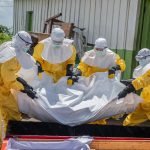
The Federal Government is moving to evacuate Nigeria’s confirmed Ebola patient abroad for further medical treatment as health authorities intensify efforts to contain the disease after identifying 53 primary contacts linked to the case.
The development comes amid heightened surveillance across the country, with the Nigeria Centre for Disease Control and Prevention (NCDC) confirming that Nigeria currently has one confirmed Ebola case. Suspected cases reported in the Federal Capital Territory (FCT) and Rivers State have tested negative.
The patient, whose infection was confirmed on October 20, is currently receiving care in isolation. The NCDC’s latest situation report said she had improved remarkably.
The NCDC said the number of primary contacts linked to the confirmed case has risen from the initial 44 to 53.
NCDC Director-General, Dr Jide Idris, disclosed during a briefing in Abuja that 44 of the contacts were associated with the health facility where the patient was treated, while nine others were identified through further investigation.
The additional contacts include members of the patient’s household, her husband, driver and chef, healthcare workers who attended to her at another medical facility, as well as members of the team involved in collecting samples from her.
The contacts have been listed, categorised according to their level of exposure and placed under public health monitoring.
Importantly, the NCDC said none of the 53 identified contacts had tested positive for Ebola at the time of its latest update.
Health officials are also working to identify possible secondary contacts—people who may have interacted with the primary contacts—so that the chain of potential exposure can be fully established.
Patient Contracted Ebola After Returning From Uganda
The confirmed patient is a 42-year-old woman*who travelled from Uganda through Addis Ababa and arrived in Abuja on October 3, 2026.
According to the NCDC situation report, she developed symptoms several days after her arrival and subsequently sought medical attention at private healthcare facilities.
She reportedly presented with symptoms including fever, diarrhoea, generalised body aches and sore throat. She was later tested after the NCDC was notified, with the National Reference Laboratory confirming Ebola infection on October 20.
The NCDC identified the infection as Ebola disease caused by the Bundibugyo species.
The Ebola scare has also reached Rivers State after health authorities recorded a suspected case on October 23.
However, the NCDC said laboratory testing returned a negative result for Ebola, and that the result had been communicated to the Rivers State authorities.
The development has nevertheless prompted continued vigilance, particularly because Rivers is home to major international and domestic travel routes, ports and other points of entry.
The NCDC has continued to stress that a suspected case does not automatically mean that an individual has Ebola.
As the government works to prevent further transmission, authorities are also examining and strengthening the country’s capacity to manage possible Ebola cases.
The Federal Government is planning to identify and optimise treatment centres in states with designated ports of entry.
The University of Abuja Teaching Hospital has undergone a needs assessment and optimisation for isolation and treatment, while an infection-prevention and control assessment is also planned for Karu General Hospital in Abuja.
Authorities are equally working on referral mechanisms to ensure that suspected cases detected at ports of entry or other locations can be transferred quickly and safely to designated treatment centres.
The Federal Government is also considering financial support for people placed under quarantine.
The NCDC said the government was considering an emergency payment of ₦100,000 per person per week to help contacts who are required to remain in quarantine meet their feeding, accommodation and family-related expenses.
The measure is intended to encourage people under surveillance to comply with public-health requirements without suffering severe financial hardship during the monitoring period.
The Federal Government has also stepped up surveillance at the country’s international airports and other points of entry.
Port Health Services has been working with aviation stakeholders to strengthen screening and investigation procedures, while authorities are expanding surveillance to help identify passengers who may have been exposed to Ebola.
The NCDC has also moved to strengthen laboratory capacity and infection-prevention measures in healthcare facilities.
Officials have urged Nigerians to cooperate with health workers, particularly those involved in contact tracing and monitoring.
The NCDC has repeatedly appealed to Nigerians not to stigmatise people identified as contacts.
Being identified as an Ebola contact does not mean that the person has Ebola. Instead, it means that public-health authorities believe the individual may have been exposed and therefore needs to be monitored for symptoms during the incubation period.
The agency has urged Nigerians to rely on verified information from the NCDC and Federal Ministry of Health and Social Welfare rather than rumours circulating on social media.
As of the latest NCDC situation report dated October 24, Nigeria had recorded one confirmed Ebola case, 53 identified contacts and zero deaths.
The patient remains the country’s only confirmed case, while the suspected case reported in Rivers State tested negative.
The Federal Government’s decision to consider overseas evacuation of the confirmed patient, alongside the expansion of contact tracing, airport surveillance and treatment-centre preparedness, underscores the authorities’ determination to prevent the disease from spreading beyond the index case.
Health authorities are expected to continue monitoring the 53 contacts while investigating additional possible exposures.
For now, officials are urging Nigerians to remain calm but vigilant, observe good hand hygiene, avoid contact with blood or bodily fluids of suspected patients, and immediately report concerning symptoms to health authorities.