By Princely Onyenwe | News Desk
SPACE AND ASTRONOMY — An extraordinary astronomical discovery involving a dead star approximately 1,600 light-years from Earth has provided scientists with fresh evidence of what planetary systems, including our own Solar System, could look like after their parent stars reach the end of their lives.
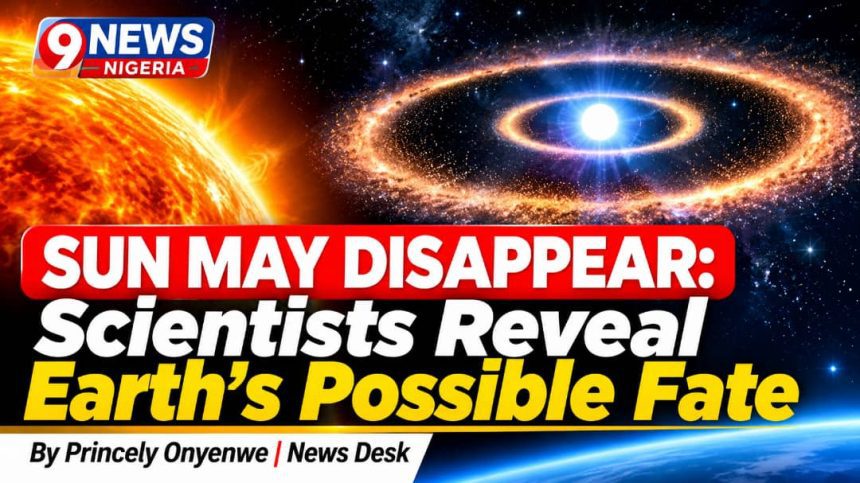
The discovery, published in the prestigious scientific journal Nature Astronomy on October 26, 2026, centres on a white dwarf identified as WD J132800.85–145019.95, commonly known as J1328–1450, which has been found surrounded by two distinct rings of gaseous planetary debris.
The discovery is attracting considerable scientific attention because it represents the first identified example of a white dwarf with two separate gaseous debris rings, challenging previous understanding of how planetary materials are distributed around dead stars.
An international team of astronomers made the discovery using the X-shooter instrument attached to the European Southern Observatory’s Very Large Telescope in Chile.
According to the research, the unusual arrangement consists of two concentric gaseous rings separated by a distinct gap. The inner ring extends from approximately 0.14 to 0.34 solar radii, while the outer ring stretches from approximately 0.54 to 1.93 solar radii.
Before this discovery, astronomers had identified 21 white dwarfs with surrounding gaseous debris discs, but none had demonstrated the distinctive double-ring structure observed around J1328–1450.
The researchers explained that the rings contain elements including calcium, oxygen, magnesium and iron, indicating the presence of material associated with rocky planetary bodies.
More remarkably, scientific analysis revealed that the outer ring is significantly depleted in magnesium compared with the inner ring, suggesting that the materials may have originated from two different planetary bodies with different chemical compositions.
Alternatively, the researchers proposed that the rings could represent different structural layers of a single differentiated planetary object that was disrupted during its interaction with the white dwarf’s powerful gravitational field.
One of the most intriguing aspects of the discovery is the possibility that two rocky planetary bodies survived the dramatic transformation of their parent star.
The research team believes that these objects may be responsible for maintaining the two separate gaseous rings through their interactions with surrounding dust and planetary debris.
Although the objects have not been directly observed, their estimated sizes are particularly remarkable. The smaller body could be comparable to an asteroid, measuring a few kilometres across, while the larger object could potentially reach the size of Pluto or even the Moon.
The researchers believe that these surviving bodies may be embedded within the debris system, interacting with surrounding materials and generating the gas responsible for the unusual ring structures.
The discovery provides further evidence that planetary systems do not necessarily disappear completely when their central stars exhaust their nuclear fuel and undergo dramatic transformations.
However, beyond the discovery itself, astronomers believe the system could offer an important scientific window into the distant future of our own Solar System.
Scientists estimate that the Sun, which is approximately 4.6 billion years old, will exhaust the hydrogen fuel in its core in roughly five billion years, triggering a series of changes that will transform it into a red giant.
During this phase, the Sun is expected to expand enormously, potentially engulfing the innermost planets, including Mercury and Venus.
The fate of Earth remains scientifically uncertain, with different models examining whether the expanding Sun will eventually swallow the planet or whether orbital changes associated with the Sun’s mass loss could allow it to escape direct engulfment.
Nevertheless, even if Earth survives being physically consumed, the enormous increase in solar radiation and temperature during the red giant phase would make the planet uninhabitable.
Eventually, the Sun is expected to shed its outer layers, leaving behind its dense central remnant as a white dwarf.
This is essentially the evolutionary stage represented by J1328–1450, although the discovery does not establish that our Solar System will necessarily develop an identical double-ring structure.
According to the research, planetary remnants, asteroids and other rocky objects that survive the death of their parent stars could eventually be disturbed by gravitational forces, drawn towards the white dwarf and torn apart.
Their remains could then form debris discs containing gas and dust, similar to the extraordinary structure now observed around J1328–1450.
The findings therefore provide an important opportunity for scientists to investigate how planetary systems evolve, survive and eventually disintegrate as their host stars approach the end of their stellar lifetimes.
The lead researcher, Nicola Pietro Gentile Fusillo, and other members of the international research team have highlighted the importance of the discovery in understanding the complex structures that can emerge around white dwarfs.
The study, titled A Double Debris Disc Around a White Dwarf Sculpted by Two Planetary Bodies, adds a significant new dimension to ongoing investigations into the evolution of stars and planetary systems.
For humanity, the discovery carries a profound astronomical implication: the Sun that sustains life on Earth today will not shine in its present form forever.
However, scientists stress that these events are expected to unfold billions of years from now, not in the foreseeable future.
The central question raised by the discovery is no longer simply what happens when a star dies, but what becomes of the planets, moons and other celestial bodies that once revolved around it.
And if rocky planetary remnants can survive the death of a star, could the distant future of our own Solar System look remarkably similar to what astronomers are now observing around J1328–1450?
For more inquiries on this news report contact 9News Nigeria on +234 08036856526