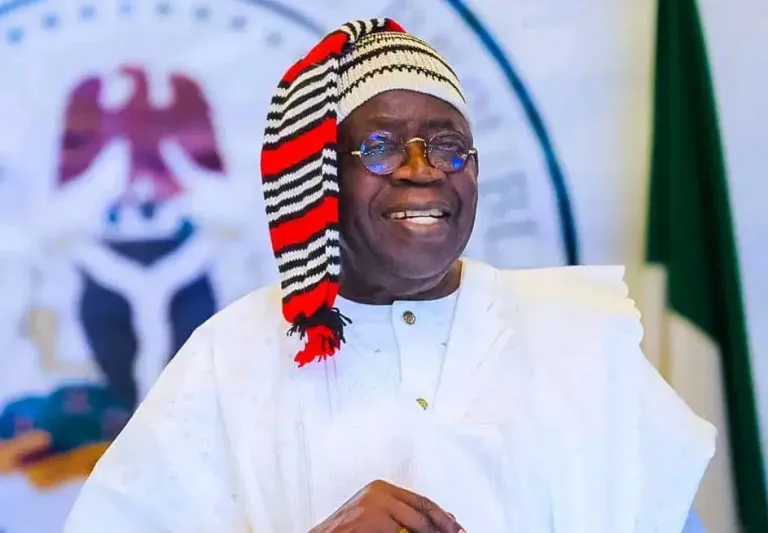
President Bola Ahmed Tinubu has unveiled a sweeping infrastructure agenda that channels trillions of naira into projects spanning all six geopolitical zones.
The figures released by the Presidential Communications Team reveal a striking distribution pattern that underscores Tinubu’s push for balance rather than concentration of projects in any single region.
The North-West emerges as the largest recipient, with ₦5.97 trillion, about 40 percent of total allocations dedicated to a mix of road, rail, and energy projects.
The South-South follows with ₦2.41 trillion, while the North-Central secures ₦1.13 trillion. The South-West, excluding Lagos, records ₦604 billion, the South-East ₦407 billion, and the North-East ₦400 billion.
What makes this agenda stand out is not only the staggering scale of investment but also its even spread, which touches nearly every corner of the federation.
In the South, landmark projects like the Lagos–Calabar Coastal Highway, the ongoing Second Niger Bridge, and the East–West Road reconstruction underscore a renewed focus on connectivity and economic integration.
In the North, multi-trillion naira commitments to highways such as Abuja–Kaduna–Kano and Damaturu–Maiduguri, alongside revivals of the Trans-Saharan and Akwanga–Jos–Bauchi–Gombe corridors, show an effort to open up sections.
Beyond roads, the Tinubu administration has also pushed forward with nationwide projects that cut across regional boundaries.
Over a thousand primary health centres are undergoing rehabilitation, urban rail initiatives in Lagos, Kano, Kaduna, and Ogun are projected to create 250,000 jobs, and the once-stalled 215MW Kaduna Power Plant has been revived.
Progress has also been reported on the Ajaokuta Gas Pipeline, while rail expansion such as the Kano–Maradi line has reached 67 percent completion.
“No Nigerian is second class. No region is left behind. Together, we rise,” Tinubu declared, framing the agenda as a unifying symbol of his Renewed Hope mandate.