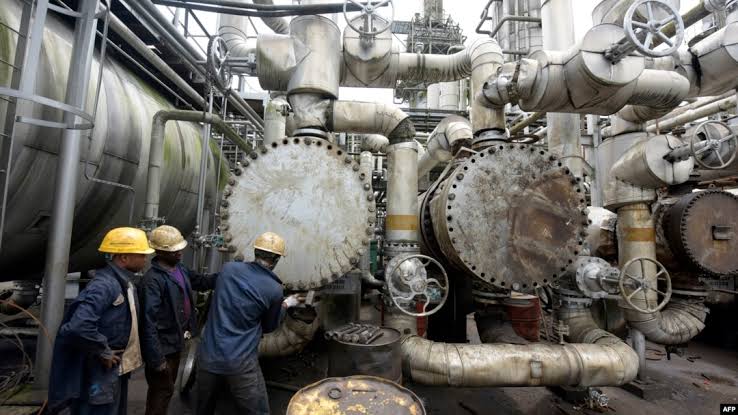
Despite the commissioning of the 650,000 barrels-per-day Dangote Refinery; Africa’s largest, Nigeria continues to import massive volumes of crude petroleum oil.
In the first quarter of 2025 alone, the country imported ₦1.19 trillion worth of crude, making it the third most imported product during the period, according to the National Bureau of Statistics.
The bulk of the imports came from the United States, followed by Angola and Algeria.
The situation is rooted in persistent domestic supply challenges.
Nigeria’s oil production has remained sluggish, averaging around 1.4 million barrels per day, a figure far below the country’s historic highs.
Oil theft, pipeline vandalism, and years of underinvestment have made it difficult for the Nigerian National Petroleum Company (NNPC) to consistently supply crude to local refineries, including the privately owned Dangote facility.
9News Nigeria reports point out that while the refinery is ready to operate at full scale, it lacks the volume of crude needed to do so.
According to reports, the NNPC allocated only about 60,000 barrels per day to the Dangote Refinery, a fraction of its capacity.
To bridge the gap, the refinery has resorted to importing crude from the United States and other countries.
The decision to import crude also reflects economic calculations.
U.S. West Texas Intermediate (WTI) crude, for instance, is competitively priced and readily available, making it a viable option for refiners seeking uninterrupted operations.
In addition to production shortfalls, international oil companies operating in Nigeria reportedly prefer to export their share of crude oil, where they can earn in dollars, rather than sell locally.
This limits the volume of crude available for domestic processing and forces local refiners to look abroad.
Further compounding the problem is the uneven implementation of the Federal Government’s “naira-to-crude” policy, which was meant to allow local refineries to purchase crude using the Nigerian currency.
In reality, refiners often struggle to secure crude without sourcing dollars, a costly and unstable process.
Meanwhile, Nigeria’s state-owned refineries remain largely inactive.
The Port Harcourt refinery, which was expected to resume partial operations earlier this year, is yet to make any significant impact.
The Warri and Kaduna refineries are still undergoing rehabilitation, leaving the Dangote Refinery as the only major functioning facility.
The irony has not been lost on observers: a country with vast oil reserves now finds itself importing both refined products and crude oil.
However, the Federal Government insists the situation is only temporary.
In April, the Minister of Petroleum Resources (Oil), Senator Heineken Lokpobiri, assured the public that mechanisms were being put in place to guarantee stable domestic crude supply to local refineries.
“We are working to resolve the logistical and policy issues that hinder full supply. The refinery will get all the crude it needs soon,” Lokpobiri said.
For now, Nigeria continues to spend scarce foreign exchange importing a product it has in abundance.