By Regina Iliya
In a quiet village, an elderly woman sings a lullaby her grandmother once sang to her. The melody is familiar, but the words are not. None of her grandchildren understands the language. They smile politely, captivated by her voice, yet unaware that they may be witnessing the final echoes of a language that has survived centuries but may not survive another generation. This is the silent crisis unfolding across the world.
Every two weeks, humanity loses another language. With each loss comes the disappearance of unique histories, traditions, oral literature, ecological knowledge, and cultural identities that can never be fully recovered.
According to UNESCO, nearly half of the approximately 7,000 languages spoken worldwide are endangered, with many at risk of extinction before the end of this century if urgent preservation efforts are not intensified.
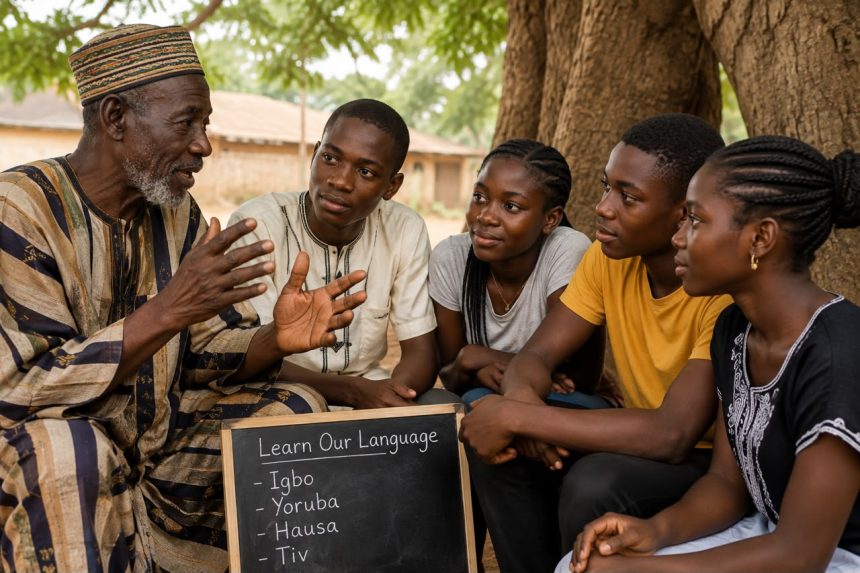
For many indigenous communities, language is more than a means of communication. It is a living archive of identity, ancestry, spirituality, and traditional knowledge passed from one generation to another.
Yet the rapid expansion of globalisation, urbanisation, and digital communication has steadily pushed many indigenous languages to the margins, especially among younger generations who increasingly communicate in dominant languages such as English, French, Spanish, Arabic, and Mandarin.
Ironically, the same digital revolution often blamed for accelerating language decline is now offering hope.
Across the globe, educators, linguists, indigenous leaders, and technology experts are embracing digital tools to document, teach, and revitalise endangered languages. Mobile applications, online dictionaries, podcasts, digital archives, virtual classrooms, speech recognition software, and artificial intelligence are becoming powerful instruments in preserving linguistic heritage.
UNESCO describes digital technology as an essential partner in safeguarding indigenous languages, provided indigenous communities maintain ownership of their cultural knowledge and digital resources. Rather than replacing traditional methods of language transmission, technology is increasingly complementing them by making indigenous languages more accessible to younger generations who spend much of their lives online.
One remarkable example comes from New Zealand.
A TIME report published in September 2024 highlighted the work of Māori technology leader Peter-Lucas Jones, whose organisation, Te Hiku Media, developed an artificial intelligence-powered speech recognition system capable of transcribing the Māori language with approximately 92 per cent accuracy.
Unlike many AI systems trained on publicly harvested data, the project was built using language data contributed and controlled by Māori communities themselves, ensuring that both the technology and the cultural heritage remain in indigenous hands.
The project demonstrates that artificial intelligence can become an ally rather than a threat when indigenous communities guide its development and determine how their languages are preserved.
UNESCO has equally promoted several digital initiatives encouraging indigenous communities to create online dictionaries, educational platforms, digital storytelling projects, and social media content in their native languages.
Such initiatives help ensure that endangered languages are not confined to museums or ceremonial occasions but continue to evolve within everyday conversations, education, and modern digital spaces.
Nigeria, one of Africa’s most linguistically diverse countries, faces similar realities. With over 500 indigenous languages, the nation possesses enormous cultural wealth. However, many local languages are experiencing declining numbers of fluent speakers as English increasingly dominates formal education, government, business, and digital communication.
Experts warn that preserving indigenous languages is no longer solely the responsibility of governments or cultural institutions. Schools, universities, technology companies, media organisations, software developers, and content creators all have important roles to play. Producing local-language educational materials, podcasts, subtitles, digital libraries, translation software, and AI-powered language tools can significantly improve the visibility and everyday use of indigenous languages.
Artificial intelligence continues to open new possibilities. Machine translation, voice recognition, text-to-speech technology, and digital archives can help document endangered languages for future generations.
However, UNESCO cautions that these innovations must be developed ethically, ensuring indigenous communities retain ownership of their languages, cultural knowledge, and digital data.Ultimately, preserving indigenous languages is not merely about protecting words.It is about preserving memories, identities, wisdom, and ways of seeing the world that no other language can perfectly express.
When an indigenous language disappears, humanity loses an irreplaceable chapter of its collective story. But if communities, educators, governments, and technology innovators act together, the digital age may become not the era in which indigenous languages disappeared—but the era in which they found a new voice.
(Regina Iliya is a student journalist from the Department of Mass Communication, University of Maiduguri)