By Santiki Gursa John
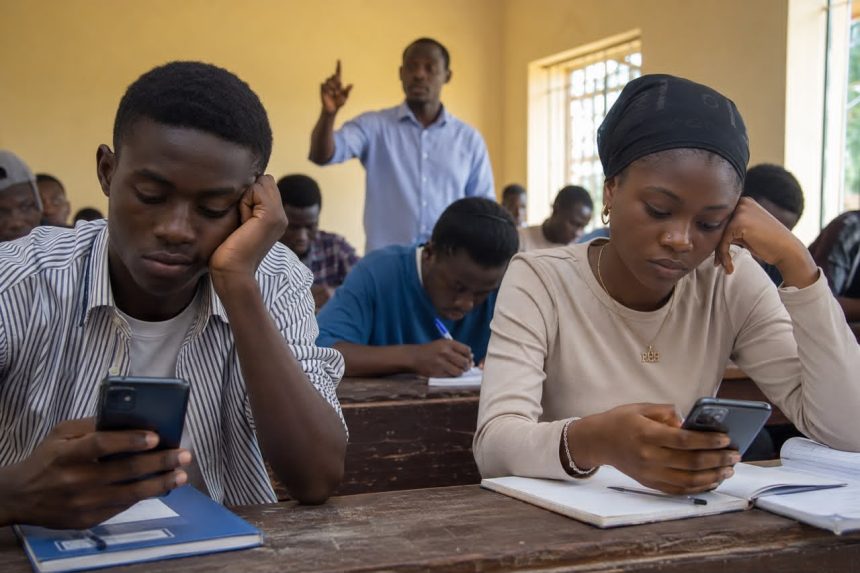
The lecture had barely begun when the familiar vibration echoed across the classroom. One student reached for his phone to reply to a WhatsApp message. Another quickly opened TikTok “just for a minute.” A third was checking Instagram notifications while pretending to take notes. Within moments, the lecturer was speaking to a room full of students whose bodies were present but whose attention had quietly drifted elsewhere.
This scene has become increasingly common in classrooms across Nigeria and around the world. While social media has revolutionized communication, learning, and business opportunities, it has also created a situation where human attention is constantly pulled in competing directions.
Education is no longer competing only with entertainment. It is competing with a digital environment designed to keep users engaged for as long as possible.
For many university students, the struggle is familiar.
“I usually open my phone intending to check one message,” says a 400-level student of Kashim Ibrahim University who requested anonymity. “Before I realize it, I’ve spent a long time watching videos that have nothing to do with my studies.”
Her experience reflects what psychologists describe as the “attention economy”—a system in which digital platforms are designed to capture and hold users’ focus because engagement drives revenue and platform growth.
According to the Organisation for Economic Co-operation and Development (OECD) in its 2025 report, Growing Up in the Social Media Age, 15-year-olds across OECD countries spend nearly 35 hours each week on social media—more time than they spend on homework and school lessons. The report also found that while moderate social media use can support learning and creativity, excessive use is associated with lower academic performance and increased feelings of loneliness among young people.
Dr. Gloria Mark, a professor of informatics at the University of California, Irvine, argues in her 2023 book, “Attention Span: A Groundbreaking Way to Restore Balance, Happiness and Productivity”, that frequent interruptions from digital devices make sustained concentration more difficult. She explains that every notification or switch to another task breaks a person’s focus, and the brain requires time to regain the same level of concentration. These repeated interruptions reduce productivity and make learning, comprehension, and problem-solving less effective.
The effects are increasingly visible in academic environments. Some lecturers report that students struggle to engage with long reading materials, while others observe a growing preference for short-form summaries over full academic texts.
Mohammed Auwal Umar, a lecturer in the Department of Mass Communication at the University of Maiduguri, believes that social media’s addictive tendencies are becoming increasingly evident among students. According to him, excessive use of social media creates habits that distract students from their academic responsibilities.
“Because of entertaining reels across social media platforms, students find themselves glued to their phones more than books and lecture notes,” he says. “They hardly find time to read or visit the library. Some of them cannot even concentrate while in class.”
The lecturer adds that the impact extends beyond classroom distraction. “This is why even with basic assignments, many students struggle to produce work that is average or above average. Those who manage to generate responses often rely on AI without fully understanding the content.”
He argues that these habits may be contributing to the decline in students’ academic performance. “Perhaps this is one of the reasons failure continues to increase across the broad spectrum of students’ academic development,” he says.
Yet social media itself is not entirely negative.
Platforms such as YouTube, LinkedIn, X, Facebook, and TikTok now host a wide range of educational content creators who simplify complex topics, teach digital skills, and provide career guidance. Many students use these platforms to supplement classroom learning, especially in fields like medicine, engineering, and media studies.
The challenge, however, lies in balance.
Dr. Gloria Mark’s research suggests that constant digital interruptions reduce the ability to engage in “deep work”—the kind of focused attention required for meaningful learning and problem-solving. When attention is repeatedly fragmented, productivity and comprehension can suffer.
This is further complicated by the design of social media platforms themselves. Features such as infinite scrolling, autoplay videos, and personalized recommendations are built to maximize user engagement, often making it difficult for users to disengage voluntarily.
For students preparing for examinations, this creates a daily struggle between academic goals and digital distractions.
“I sometimes put my phone on Do Not Disturb, while studying even tho I may have important notifications” says Amos Williams Peter, a 300 level student of University of Maiduguri. “If it stays beside me, I’ll eventually pick it up and may spend time on it”
Educators and psychologists often recommend practical strategies such as setting study periods without phones, turning off non-essential notifications, and intentionally limiting time spent on entertainment-based content. Some also encourage students to develop digital discipline rather than attempting complete avoidance of technology.
Schools and parents are also being encouraged to play a role in guiding responsible technology use. Instead of focusing solely on restrictions, many education experts argue for teaching students how to manage digital tools effectively.
After all, social media is likely to remain a central part of modern life and education. Increasingly, universities and employers also rely on digital platforms for communication, learning, and professional networking.
The real question, therefore, is not whether students will use social media—but whether they will learn to control how it affects their attention and academic focus.
As classrooms continue to evolve in the digital age, the greatest challenge may no longer be access to information, but the ability to stay focused long enough to understand it.
In a world where attention is constantly being competed for, learning has become not just an academic task, but an act of discipline.
(Santiki Gursa John is a student journalist from the department of Mass Communication, University of Maiduguri).