By Chinedum Anayo | 9News Nigeria Exclusive
The White House has released a detailed report asserting that the COVID-19 pandemic most likely originated from a laboratory-related incident in Wuhan, China.
This is not a new development as this topic remains one of the most fiercely debated questions of the global health crisis given renewed attention to claims repeatedly made by U.S. President Donald Trump during the pandemic.
The report published by the official White House website under the title “Lab Leak: The True Origins of COVID-19,” argues that the available evidence points more strongly to a laboratory accident than to a natural spillover from animals.
The document relies heavily on the findings of the U.S. House Select Subcommittee on the Coronavirus Pandemic following its extensive investigation into the origins of SARS-CoV-2, the virus responsible for COVID-19.
The White House report contends that several strands of evidence collectively support the laboratory-origin hypothesis.
Among its key findings, the report argues that SARS-CoV-2 possesses biological characteristics that, in its assessment, are inconsistent with a purely natural origin.
It also notes that unlike previous pandemics, which typically involved multiple documented animal-to-human transmission events, COVID-19 appears to have entered the human population through a single introduction.
The report places significant focus on the Wuhan Institute of Virology, one of China’s leading coronavirus research laboratories.
According to the document, researchers at the institute were conducting experiments involving bat coronaviruses, including research described by critics as gain-of-function studies.
The report further alleges that some of this work was carried out under biosafety conditions that may have been inadequate for handling highly infectious pathogens.
Another major claim contained in the report concerns reports that several researchers at the Wuhan Institute of Virology became ill with symptoms consistent with COVID-19-like illness in late 2019, weeks before Chinese authorities officially reported the outbreak in Wuhan.
According to the White House, those circumstances deserve closer scrutiny and strengthen the possibility that the pandemic resulted from a laboratory-related incident.
The report also raises questions about oversight of U.S.-funded coronavirus research conducted in collaboration with Chinese institutions.
It heavily criticizes what it describes as insufficient transparency and oversight by American agencies responsible for monitoring such research.
The publication goes beyond the origins as It also raises concerns about aspects of the United States’ pandemic response, including lockdown policies, vaccine mandates, school closures and public messaging.
It argues that several emergency measures lacked sufficient scientific justification and recommends reforms aimed at improving transparency, accountability and preparedness for future pandemics.
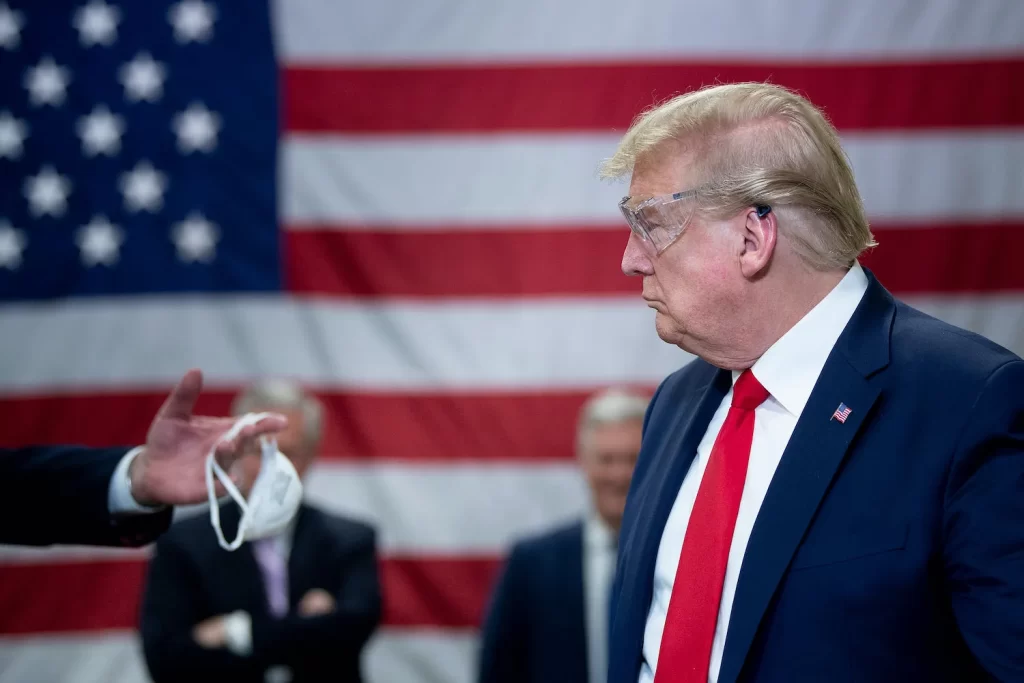
The publication has also revived attention to remarks made by President Donald Trump during the height of the COVID-19 pandemic.
Throughout 2020, Trump repeatedly maintained that the coronavirus originated from a laboratory in Wuhan rather than through natural transmission from animals.
Although his administration did not publicly release conclusive proof, he stated on several occasions that he had seen evidence giving him a high degree of confidence that the virus escaped from the Wuhan Institute of Virology.
Many scientists and public health experts said there was insufficient evidence to support the claim, while political opponents accused the administration of politicizing the origins debate.
Trump also repeatedly accused the Chinese government of concealing critical information during the early stages of the outbreak and delaying disclosure of the virus to the international community.
In response, Beijing rejected those accusations, insisting that it acted transparently and responsibly.
Trump further questioned U.S. funding for coronavirus research linked to the Wuhan Institute of Virology and frequently criticized senior American health officials, particularly Dr. Anthony Fauci, over their handling of the pandemic and their assessment of the virus’s possible origins.
At the time, many scientific studies regarded natural spillover from animals as the leading hypothesis, although researchers acknowledged that a laboratory accident could not be ruled out due to limited access to data, records and biological samples in China.
The debate has evolved over the years.
Different U.S. intelligence agencies have reached different conclusions, with some assessing that a laboratory-related incident is the more likely explanation, often with low or moderate confidence while others continue to regard natural spillover as plausible or conclude that available evidence is insufficient to determine the virus’s origin definitively.
COVID-19, first identified in Wuhan in late 2019, became one of the deadliest public health emergencies in modern history, infecting hundreds of millions of people worldwide, overwhelming healthcare systems.
It was so devastating that it disrupted economies and claimed millions of lives.
China has repeatedly denied that the virus originated from a laboratory accident and has accused some Western governments of politicizing scientific investigations into the pandemic.
Chinese authorities maintain that there is no credible evidence supporting the lab-leak theory.
The World Health Organization has likewise stated that all scientifically plausible hypotheses regarding the origin of COVID-19 remain under consideration and has continued to call for greater international cooperation, unrestricted access to relevant data and independent scientific investigations.
The release of the White House report is expected to intensify international debate over the origins of COVID-19 and could influence future discussions on global biosafety standards, laboratory oversight, scientific collaboration and pandemic preparedness.