NEW YORK — Nigeria’s speaking position at the 81st United Nations General Assembly has been moved following President Bola Ahmed Tinubu’s decision not to attend the summit.
Tinubu was originally scheduled to address world leaders on Wednesday, September 23, during the morning session of the UN General Debate.
He was listed as the 10th speaker, with his address expected between about 11:30 a.m. and noon New York time.
However, Tinubu will no longer attend the General Assembly in person.
Vice President Kashim Shettima has instead been designated to lead Nigeria’s delegation and represent the President.
Following the change, Nigeria’s position on the provisional speaking programme has also changed.
The updated programme places Nigeria on Thursday, September 24, with Shettima listed as the fourth speaker in the afternoon session.
The session is scheduled to begin at 3 p.m. New York time, meaning Shettima is expected to speak at about 4 p.m. to 4:30 p.m.
That would be approximately 9 p.m. to 9:30 p.m. Nigerian time.
The change has raised questions over whether Nigeria’s position was affected by Tinubu’s absence.
However, the United Nations has not announced that Nigeria was “downgraded” because the President would not attend.
One possible explanation is UN protocol concerning the level of representation at the General Debate.
Heads of state and government generally receive precedence over vice presidents, ministers and other representatives.
It has not been publicly established whether Nigeria’s new speaking position resulted automatically from the change in representation, was negotiated by the Nigerian delegation, or was determined by the UN Secretariat.
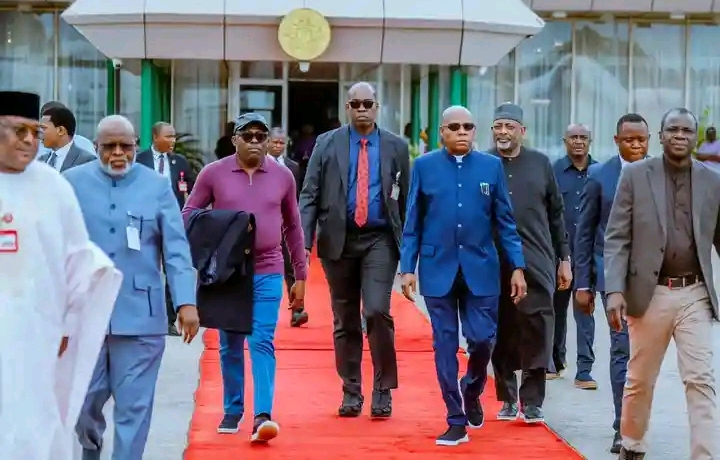
Shettima arrived in New York on Monday to represent Nigeria at the high-level meeting.
He was received by senior Nigerian officials, including Rivers State Governor Siminalayi Fubara, Foreign Affairs Minister Bianca Odumegwu-Ojukwu, Minister of Solid Minerals Development Dele Alake and Nigeria’s Permanent Representative to the UN, Ambassador Jimoh Ibrahim.
The Vice President said Nigeria’s participation would focus on national interests, multilateralism and reforms of global institutions.
Meanwhile, Tinubu’s absence has attracted criticism from former Vice President and African Democratic Congress presidential candidate, Atiku Abubakar.
Atiku questioned Tinubu’s decision to miss the UNGA for the third consecutive year, arguing that repeated presidential absence could affect Nigeria’s visibility and high-level diplomatic engagement.
Those are Atiku’s political claims and do not, by themselves, establish that Nigeria’s international standing has been weakened.
The Presidency has rejected suggestions that Tinubu’s absence would diminish Nigeria’s standing internationally.
A presidential aide said Nigeria would continue to play its role as a major African country, while attributing the President’s decision to domestic priorities.
The immediate fact, however, is that Nigeria’s scheduled Wednesday morning presidential address has been replaced by a Thursday afternoon address by the Vice President.
The shift has therefore prompted questions about the application of UN protocol and the process through which the new speaking position was determined.
For now, there is no official UN statement confirming that Nigeria was deliberately downgraded.
Nigeria will still address the General Debate, with Shettima expected to deliver the country’s statement on Thursday.
The circumstances surrounding the change in Nigeria’s speaking slot, however, remain a subject of interest as the 81st UN General Assembly continues.