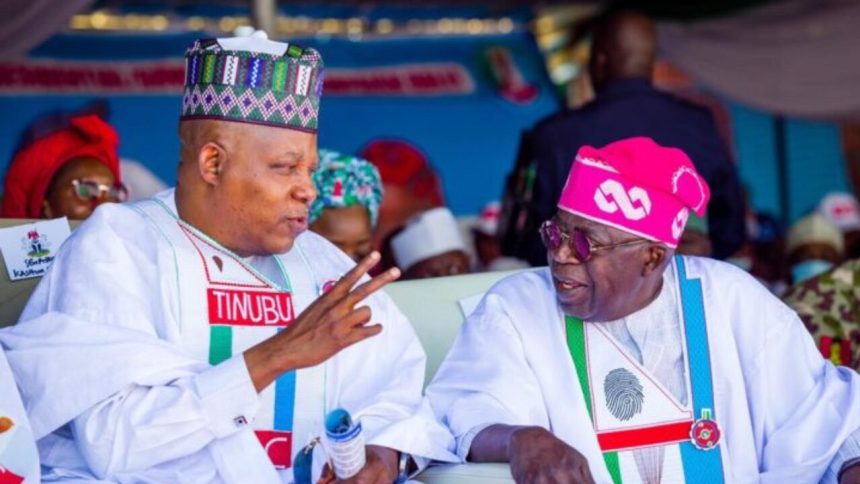
The All Progressives Congress (APC) may have dismissed reports suggesting that Vice President Kashim Shettima could be replaced as President Bola Tinubu’s running mate in 2027, but the persistence of such speculation reveals deeper undercurrents within Nigeria’s political atmosphere.
At surface level, the rumours appear premature.
Political activities ahead of the 2027 elections remain legally prohibited, and no ruling party formally debates ticket composition nearly three years before a general election.
Yet, in Nigerian politics, timing is rarely a deterrent. Power calculations often begin long before official processes commence.
Early Power Positioning
The reports simply indicates early positioning by political actors seeking relevance in a post-2023 power structure.
In ruling parties especially, succession narratives are frequently floated as “trial balloons” to test reactions, unsettle rivals, or stake informal claims to future leverage.
Consistent discussions about a vice president are often less about the individual and more about access and influence within the ruling coalition.
The Regional Arithmetic
Regional balancing remains central to Nigeria’s presidential politics.
With President Tinubu from the South-West and Vice President Shettima from the North-East, some power blocs, particularly from the North-West argue, quietly or openly, that future electoral calculations may demand a different arrangement.
Whether valid or not, such sentiments provide fertile ground for such speculation, especially in a country where electoral strength is closely tied to regional demographics.
Internal Party Rivalries
Within the APC, competing interests are inevitable. Some party stakeholders use media speculation as a strategic tool; leaking narratives, naming potential alternatives, and forcing public conversations that might otherwise remain internal.
These manoeuvres are not necessarily signs of official party discord but rather expressions of ambition within a large and broad coalition.
Media Dynamics And Anonymity
The modern media ecosystem also plays a role. Election-related stories generate traffic and engagement, and vague references to “party insiders” or “sources close to the presidency” often suffice to drive headlines.
Once one report gains traction, repetition across platforms can give speculation the appearance of credibility, even in the absence of concrete evidence.
An Opposition Strategy
For opposition parties, internal uncertainty within the ruling party is politically useful.
Persistent rumours of division, whether real or imagined can weaken public confidence and distract from governance.
From this perspective, sustaining such narratives serves a broader political and mental objective.
Governance Vs Politics
Ultimately, APC’s swift dismissal of the reports reflects an attempt to refocus attention on governance rather than succession politics.
Whether that stance holds as 2027 approaches will depend on economic outcomes, public sentiment, and internal party cohesion.
Currently, speculation over Vice President Shettima’s fate appears less a reflection of imminent political decisions and more a mirror of Nigeria’s obsession with power transitions.
Conclusion
The rumours surrounding Shettima’s potential replacement are not rooted in formal processes or official deliberations.
They are products of regional calculations, media amplification, and political gamesmanship.
In that sense, the speculation says more about Nigeria’s political culture than about the future of the APC ticket itself.