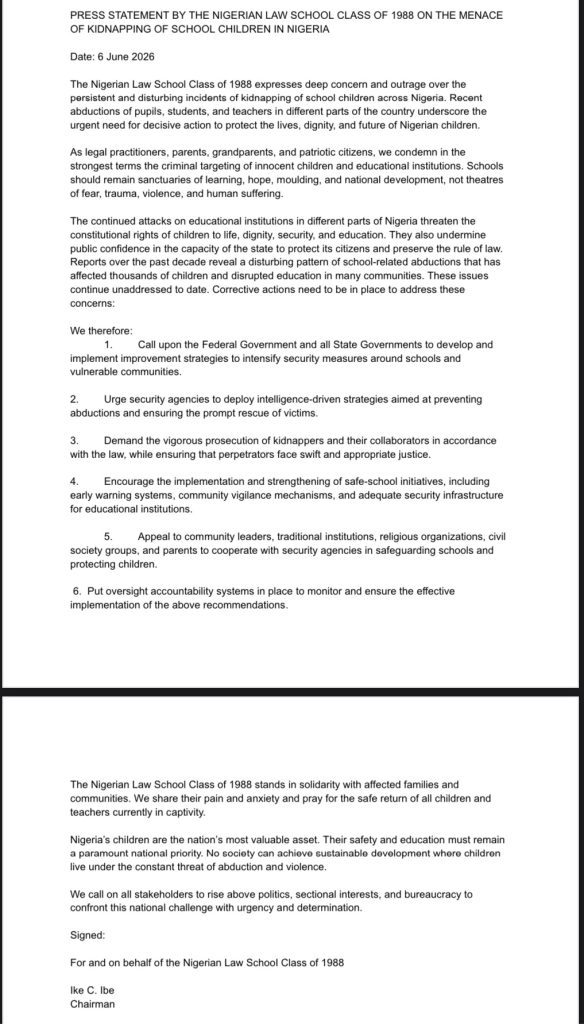
The Nigerian Law School Class of 1988 has expressed deep concern over the persistent wave of kidnappings targeting school children across Nigeria.
In a statement issued on Saturday and signed by its Chairman, Ike C. Ibe, Secretary, Orighoye Obelikpeyah, and Public Relations Officer, Richard Nwankwo, the association condemned in strong terms the abduction of pupils, students, and teachers in various parts of the country.
The group noted that recent incidents of school-related kidnappings underscore the urgent need for decisive and coordinated measures to protect children and educational institutions from criminal attacks.
“As legal practitioners, parents, grandparents, and patriotic citizens, we condemn in the strongest terms the criminal targeting of innocent children and educational institutions,” the statement read.
The association stressed that schools should remain centres of learning, hope, character formation, and national development rather than becoming places of fear, trauma, violence, and human suffering.
According to the group, the continued attacks on schools threaten children’s constitutional rights to life, dignity, security, and education, while also eroding public confidence in the ability of government institutions to guarantee safety and uphold the rule of law.
The Class of 1988 observed that reports over the past decade reveal a disturbing pattern of school-related abductions affecting thousands of children and disrupting education in several communities across the country.
To address the growing menace, the association called on the Federal Government and state governments to strengthen security measures around schools and vulnerable communities.
It also urged security agencies to adopt intelligence-driven strategies aimed at preventing kidnappings and ensuring the swift rescue of victims.
The group further demanded the vigorous prosecution of kidnappers and their collaborators, insisting that perpetrators must face swift and appropriate justice in accordance with the law.
In addition, the association advocated the strengthening of safe-school initiatives through the deployment of early warning systems, community vigilance structures, and improved security infrastructure in educational institutions.
It also appealed to traditional rulers, religious leaders, civil society organisations, parents, and community stakeholders to work closely with security agencies in protecting schools and safeguarding children.
The group emphasized the need for effective oversight and accountability mechanisms to monitor the implementation of recommended security measures and ensure tangible results.
Expressing solidarity with affected families and communities, the Nigerian Law School Class of 1988 said it shares in their pain and anxiety and prayed for the safe return of all children and teachers currently in captivity.
“Nigeria’s children are the nation’s most valuable asset. Their safety and education must remain a paramount national priority,” the statement noted, warning that no society can achieve sustainable development while children live under the constant threat of abduction and violence.
The association concluded by calling on all stakeholders to rise above political, sectional, and bureaucratic considerations and confront the challenge of insecurity with urgency, unity, and determination.