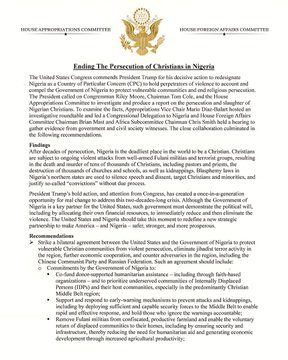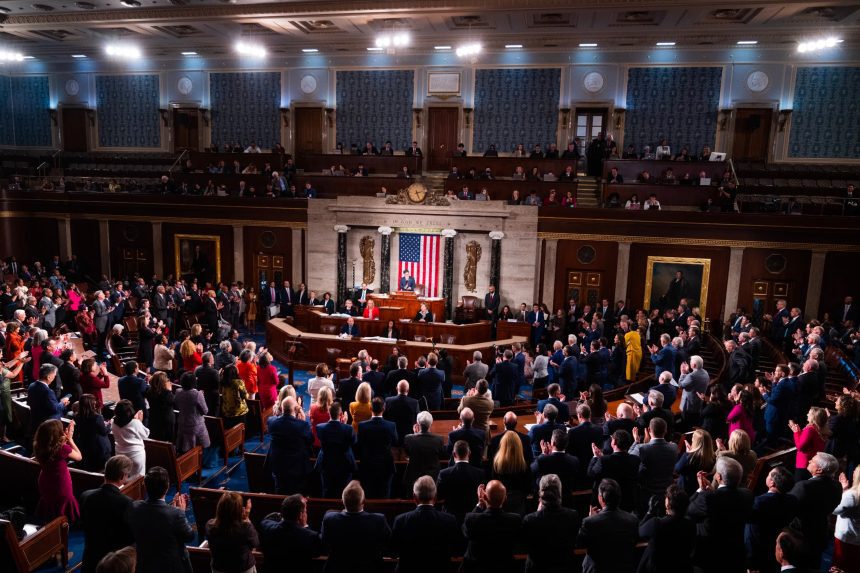
A team from the U.S. House of Representatives has formally submitted a detailed report on the state of religious freedom and security in Nigeria to the White House.
The report, delivered on Monday, 23 February 2026, by members of the House Foreign Affairs Committee and the House Appropriations Committee, is the outcome of months of investigation, including congressional hearings, expert testimony, fact-finding missions to Nigeria and consultations with religious leaders.
According to the document, Nigeria faces grave challenges that include terrorism, banditry, communal conflict, and what the lawmakers describe as systemic violence directed against Christian communities.
The report explained that some areas are among the deadliest in the world for Christians.
This report follows President Donald Trump’s redesignation of Nigeria as a “Country of Particular Concern” (CPC) under U.S. policy.
The designation served as a congressional probe into religious freedom and security issues in the West African nation.
Meanwhile, Nigeria’s Federal Government reacted cautiously.
While acknowledging serious security threats, including terrorism, banditry and communal violence, the government rejected the report’s assertion of state-sponsored religious persecution.
Nigerian officials further highlighted that there is no official policy targeting any religious group and emphasized that the violence stems from complex security dynamics, not government bias.
The Ministry of Information said the government remains committed to upholding constitutional protections for religious freedom and equality.
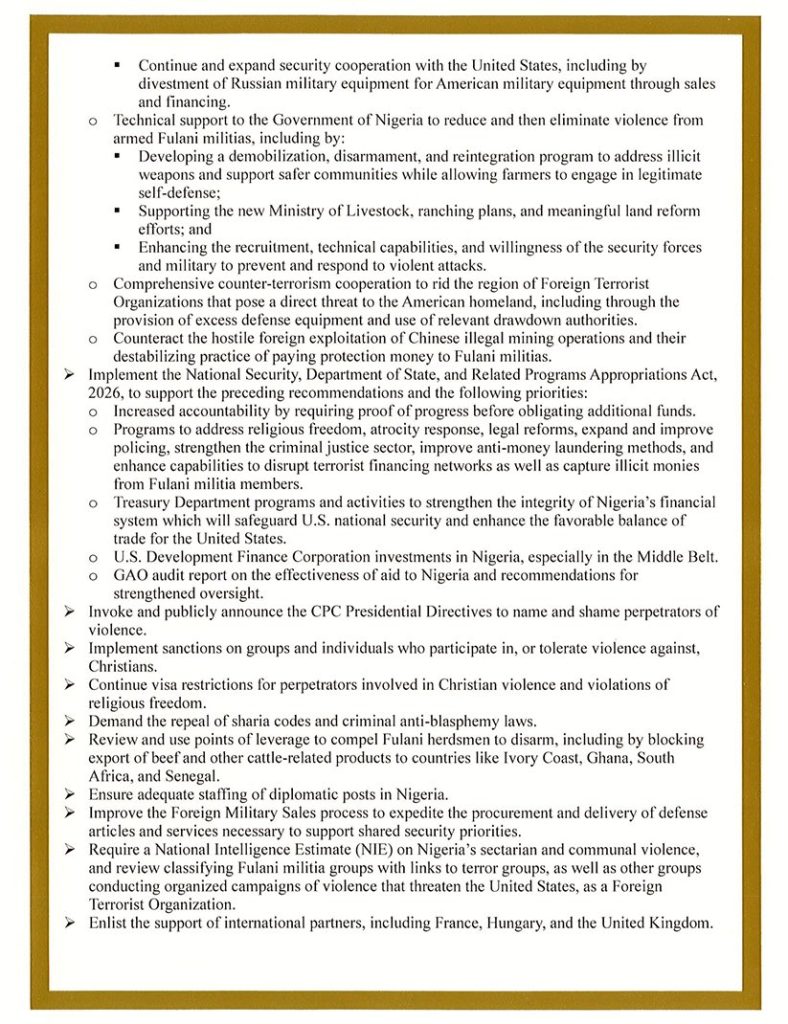
However, the report outlined key recommendations to improve the security situation:
- Targeted sanctions and visa restrictions against individuals and groups allegedly responsible for religious persecution and violent extremism.
- Technical assistance to strengthen Nigerian security capabilities and dismantle extremist networks.
- A proposed bilateral security agreement between the United States and Nigeria to protect vulnerable communities.
Other recommendations include;
- Withholding certain U.S. aid until measurable action is taken to reduce and eliminate violence against civilians.
- Calls for the repeal of Sharia and blasphemy laws in parts of Nigeria, a recommendation that has already sparked debate among religious and civic leaders.
The submission of the report is likely to influence future U.S.–Nigeria diplomatic engagements, including discussions on security cooperation, humanitarian assistance, and legislative actions in Washington.