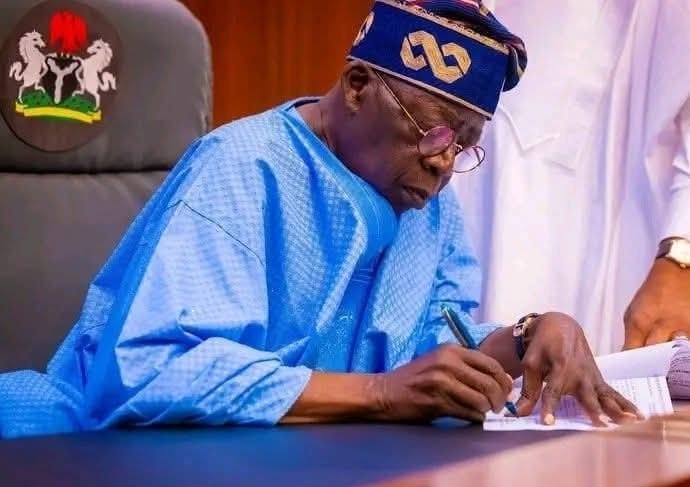
President Bola Ahmed Tinubu has signed the Deep Offshore Oil and Gas Projects Incentives (Tax Remission) Order, 2026.
Tinubu disclosed this in a statement addressed to Nigerians, saying the new framework would provide investors with clear and predictable terms needed to commit billions of dollars to long-term projects.
The President said the move was aimed at unlocking up to $50 billion in investment in Nigeria’s deep offshore oil and gas sector.
According to the President, the initiative is expected to begin with the approximately $10 billion Bonga South West project, while existing deep offshore leases will have until December 31, 2029, to reach Final Investment Decision and qualify for the full standard incentive provided under the Order.
Tinubu said Nigeria could no longer afford to leave its deep offshore resources undeveloped.
He stressed that countries with the greatest natural resources do not automatically attract investment unless they also provide certainty for investors.
“Capital moves, and countries compete for it every day. The countries that attract long-term investment are not necessarily those with the greatest natural resources. They are the ones that provide the greatest certainty,” he said.
The President described the Order as the tenth major policy directive of his administration specifically targeting the oil and gas sector.
He said the directives were designed to address constraints affecting investment, production and value creation, adding that they formed part of his administration’s broader effort to make Nigeria’s oil and gas industry more competitive and attract capital back into the country.
Tinubu, beyond attracting foreign investment, said his administration was focused on ensuring that Nigerians benefit directly from the economic activities generated by the projects.
He said the government expects Nigerian engineers, fabrication yards, marine and technical service companies and young professionals to play significant roles in the new investment cycle.
According to him, projects accessing supplementary incentives under the new Order will be required to undertake activities in Nigeria, subject to defined exceptions and Nigerian Content requirements.
Tinubu said the policy was also aimed at positioning Nigeria as Africa’s regional hub for deep offshore project execution by developing local skills, businesses and industrial capacity.
The President disclosed that he had earlier engaged Shell plc Chief Executive Officer, Wael Sawan, on the need for a broader framework capable of unlocking investment beyond a single company or project.
“That framework is now in place,” Tinubu said.
He added that the success of the policy would ultimately be measured by its impact on Nigerians, including the creation of quality jobs, stronger indigenous businesses, increased oil production, higher revenues for the Federation and the development of new technical and industrial capabilities within the country.
“Our natural resources must work harder for our people,” the President said.