By Princely Onyenwe | 9News Nigeria
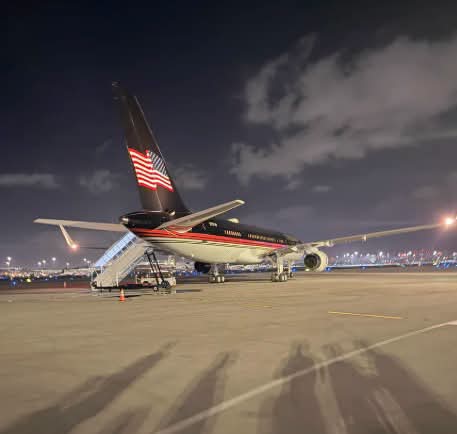
WEST PALM BEACH, FLORIDA – History was made in the United States as Trump Force One, the private Boeing 757 owned by President Donald Trump’s family, became the first aircraft to land at the newly renamed President Donald J. Trump International Airport, marking the official transition from the former Palm Beach International Airport.
The symbolic landing, which occurred shortly after 5:00 a.m., has attracted global attention and further cemented President Trump’s influence in his adopted home state of Florida as 9News reports.
President Trump’s son, Eric Trump, who was aboard the aircraft, announced the milestone on his verified X account, describing it as one of the proudest moments of his life. He stated that no individual had contributed more to Florida and the United States than his father, adding that seeing the initials “DJT” associated with the airport would remain a lasting source of family pride. Eric Trump also acknowledged the support of Governor Ron DeSantis, Florida Attorney General James Uthmeier and other state officials who backed the legislation that led to the airport’s renaming.
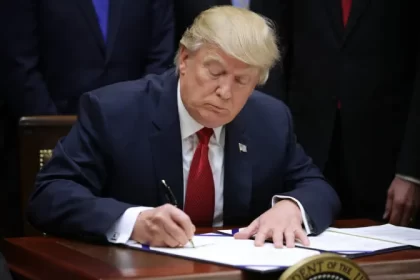
The airport’s renaming became effective after legislation approved by the Florida Legislature and signed into law by Governor DeSantis received the necessary federal approvals. Airport authorities have begun replacing signage and updating operational systems, while aviation regulators are implementing the transition to the airport’s new DJT identifier. The rebranding is estimated to cost approximately 5.5 million dollars, although airport management says normal flight operations, ownership and passenger services remain unchanged.
The development is widely regarded as unprecedented in modern American history because it is believed to be the first time a major commercial airport has been named after a sitting U.S. president while he remains in office. Although the United States has airports named after prominent leaders such as John F. Kennedy and Ronald Reagan, those recognitions came after they had left office or, in Kennedy’s case, after his assassination. Analysts say the Florida decision reflects Trump’s extraordinary political influence in the state, where his Mar-a-Lago residence has become both a political and personal headquarters.
Beyond the symbolism, the renaming has generated intense political debate across the United States. Supporters describe it as a fitting tribute to a president they believe transformed Florida’s political and economic landscape, while critics argue that naming a major public airport after a serving political leader risks deepening political divisions and setting a controversial precedent. The issue has dominated discussions across traditional media and social media platforms since the announcement.
Globally, airports have long been used to immortalize national icons and statesmen. France operates Charles de Gaulle Airport, Türkiye has Istanbul Airport replacing the former Atatürk Airport as the main hub while Atatürk’s name remains on the old airport, Israel operates Ben Gurion Airport, and Nigeria’s capital is served by the Nnamdi Azikiwe International Airport, named after the country’s first President. Nigeria also has the Akanu Ibiam International Airport in Enugu, the Margaret Ekpo International Airport in Calabar and the Mallam Aminu Kano International Airport, all named after distinguished national figures rather than incumbent leaders.
The latest development in Florida also offers broader lessons for Nigeria and Africa. Across the continent, airport naming has generally been reserved for founding fathers, nationalist heroes and distinguished public servants whose legacies have stood the test of time. Aviation experts argue that beyond names, governments should prioritize world-class airport infrastructure, passenger safety, efficient cargo handling, tourism development and international competitiveness. Modern airports are increasingly viewed as economic gateways capable of attracting foreign investment, boosting trade, creating jobs and strengthening national image.
For Nigeria, the discussion extends beyond symbolism. While several airports honour national heroes, industry stakeholders continue to advocate greater investment in airport modernization, expanded runway capacity, improved passenger experience, enhanced security technology and stronger regional connectivity to position the country as West Africa’s leading aviation hub. Similar conversations are taking place across Africa as governments seek to transform airports into engines of economic growth rather than merely transportation facilities.
The historic landing of Trump Force One therefore represents more than a ceremonial first flight. It has sparked an international conversation about political legacy, national identity, aviation branding and the role strategic infrastructure plays in projecting a country’s image to the world. As nations continue to invest in modern airports, the Florida development may remain one of the most talked-about aviation and political stories of 2026.
For inquiries on this news contact 9News Nigeria on+234 08036856526